Long Driveways, Field Dust, and Gravel Edges
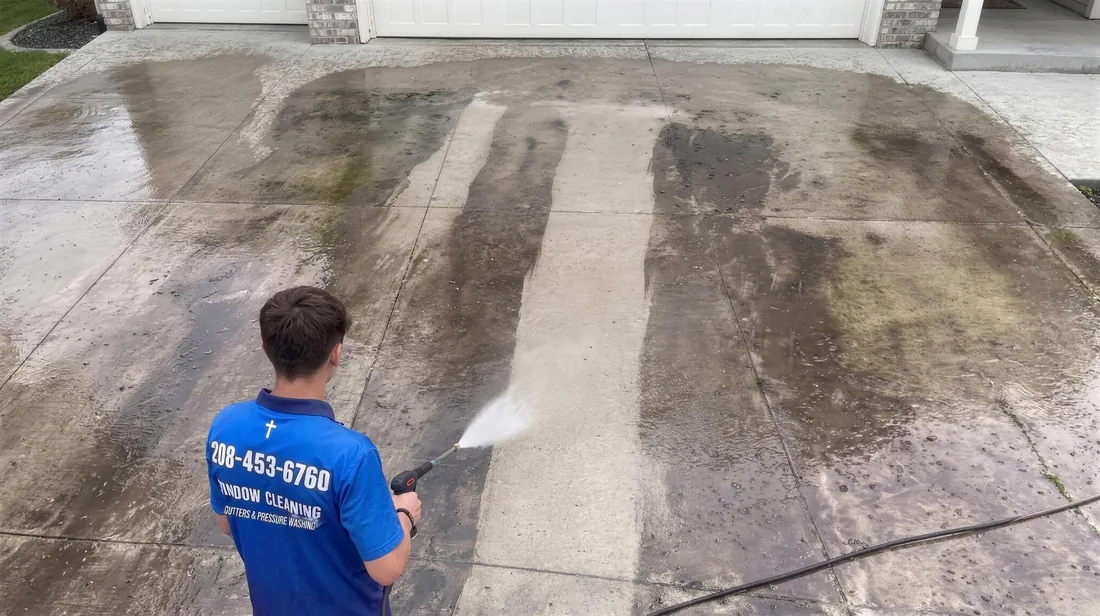
Willowbrook sits at the far west edge of Star, against Can-Ada Road, and the ground on the other side of that county line is still working farmland. Northwest wind carries disking dust in spring and grain and silage dust in fall, and it doesn't just land on the glass. It settles into the broom finish of the concrete, which is exactly the texture built to hold it. Add gravel shoulders and field approaches on the roads feeding into the neighborhood and tires drag grit onto the apron every time you pull in. What you end up with isn't one stain, it's a slow gray-brown darkening across the whole slab that most homeowners don't register until we've washed half of it and the line shows. We run a rotating surface cleaner rather than a wand so that line lands at the edge of the slab, not in stripes down the middle.
The Orange Streaks Are Your Irrigation, Not a Leaking Car
Star runs on pressurized irrigation drawn off canal water, and that water carries iron and manganese along with suspended silt. Every time a head throws across the edge of the driveway or a walkway, it leaves a little more behind, and by August you've got orange fan-shaped streaks that trace the exact arc of the sprinkler. People usually blame a vehicle or a rusted-out fire pit. Here's the honest part: pressure alone will not pull iron staining out of concrete. You can hit it at 4,000 PSI, lighten it maybe twenty percent, and etch the surface doing it. It comes out with an oxalic-based treatment, dwell time, and a rinse — chemistry, not force. We'll tell you upfront when a stain needs that step, when it doesn't, and when one that's been baking in for five seasons isn't going to fully leave.
Newer Pours Need Less Pressure, Not More
A fair amount of Willowbrook flatwork is young. Custom and semi-custom builds mean driveways, patios, and walkways poured within the last decade, and on plenty of these lots the rear patio went in a year or two after the house did. Fresh concrete is still curing at the surface, and the cement paste on top stays soft for roughly the first year. Hitting a green pour with a zero-degree tip or a tight surface cleaner strips that paste and leaves swirl marks and a pitted look you can't undo. Same story with efflorescence, the chalky white bloom that shows on newer concrete and stone as moisture pushes salts up through it. That's not dirt, it returns on its own schedule, and scrubbing it hard just tears the finish. On anything under about a year old we drop pressure and let detergent and dwell time do the work.
North-Side Walkways and the Green That Keeps Coming Back
The other Willowbrook problem is biological rather than mineral. Walkways on north-facing sides of the house, the strip between the house and the fence, and patios tucked under mature landscaping stay damp — irrigation overspray plus shade plus no real air movement. That grows a thin algae film that turns concrete and pavers a dull green-black and gets genuinely slick after rain or an early frost. Straight pressure removes what you can see and leaves the root structure sitting down in the pores, which is why it's back in a few weeks. We soft-wash those areas with a cleaning solution first, let it kill the growth, then rinse at moderate pressure. Same approach on shaded stone or brick at the base of the house, where high pressure would blow out mortar joints and cost you more than the wash did.
What It Costs and When to Schedule It
Pressure washing runs $0.20 per square foot on driveways, patios, and walkways. We measure rather than eyeball it, and you get the number before we start, not after. A long estate driveway plus a rear patio and a side walk is a bigger figure than a production-home apron closer to State Street, and it should be. Iron-stain treatment and any soft-wash step get quoted separately if your concrete actually needs them. Most Willowbrook homeowners run hardscape once a year — late spring once planting dust settles, or November after harvest and leaf drop. We hold next-day slots most weeks, we're fully insured and locally owned out of Meridian, and every job carries our 7-Day Rain Guarantee. Memberships run Monthly or Quarterly with no contract if you'd rather keep glass and concrete on one rotation. Call (208) 453-6760.
Ready for Pressure Washing in Willowbrook?
Free, no-obligation quote — we'll call or text you with your price.
Get My Free Quote