What actually takes output off panels in this pocket
Three things, in order of how much they cost you. First is plain valley dust — this side of Meridian still has open ground and active dirt work within a mile or two, and a dry west wind carries it onto glass that never gets rinsed. Second is spring pollen and cottonwood fluff, which lands as a sticky mat rather than a powder and holds the next round of dust. Third is late-summer wildfire smoke, which drops a fine ash that turns to a gray skin the first time dew hits it. A thin, even layer of any of that costs you a few percent — annoying, not alarming. What actually hurts is uneven soiling: a crusted band along one edge, or bird droppings over a couple of cells. Panels are wired in series, so a shaded cell drags the whole string down with it.
Sprinkler overspray is the one that leaves a crust
If your array is mounted low on a single-story run, or the roof steps down over a garage or a bonus room, there is a good chance a lawn head is reaching the bottom edge of it. Irrigation out here is untreated canal water — silty, hard, and nothing like what comes out of the hose bib. It dries into a tan-white mineral crust that sits right along the bottom frame lip, exactly where the frame holds a little water after every cycle. It builds all season, roughly April through October, and a garden hose will soften it without removing it. That band is worth taking seriously because it sits across the bottom of every cell in the row. We clear it with 100% pure deionized water and a soft brush where it has baked on, and we leave no soap behind for the next dust cycle to grab.
Roof pitch and orientation here work against self-cleaning
A panel needs both real tilt and real rain to shed dirt on its own, and neither one shows up reliably in Alpine Pointe. At 4:12 to 6:12 — call it 18 to 27 degrees — water sheets slowly enough that dust settles back down along the lower third instead of running off the edge. Then the Treasure Valley gives you two to three months a year with almost no measurable rain, in exactly the stretch when the sun angle is best and the array should be producing hardest. South and southwest exposure means more sun on the soiling, not less dirt. The practical upshot is that these roofs are walkable and reachable, so we can get to the array safely — but they will not clean themselves between April and October, no matter how steep the roof looks from the driveway.
Honest limits: what a wash will not fix
Cleaning recovers output lost to soiling. That is the whole of it. It does nothing for panel degradation, which runs somewhere around half a percent a year on most modern modules and never comes back. It does nothing about shade — the trees planted when this subdivision went in are tall now, and if an afternoon shadow is crossing your array at 4pm, that is a pruning problem, not a washing problem. And it does nothing for a failed microinverter, a tripped string, or an optimizer that quit. Here is the quick diagnostic: open your monitoring app. If every string sagged gradually over a dry summer, that is soiling and a wash will show up in the numbers. If one string dropped off a cliff on a specific day while the others held, that is electrical — call your installer, not us. We will tell you that on the phone rather than sell you a cleaning that cannot help.
How we clean it, when to do it, and what it runs
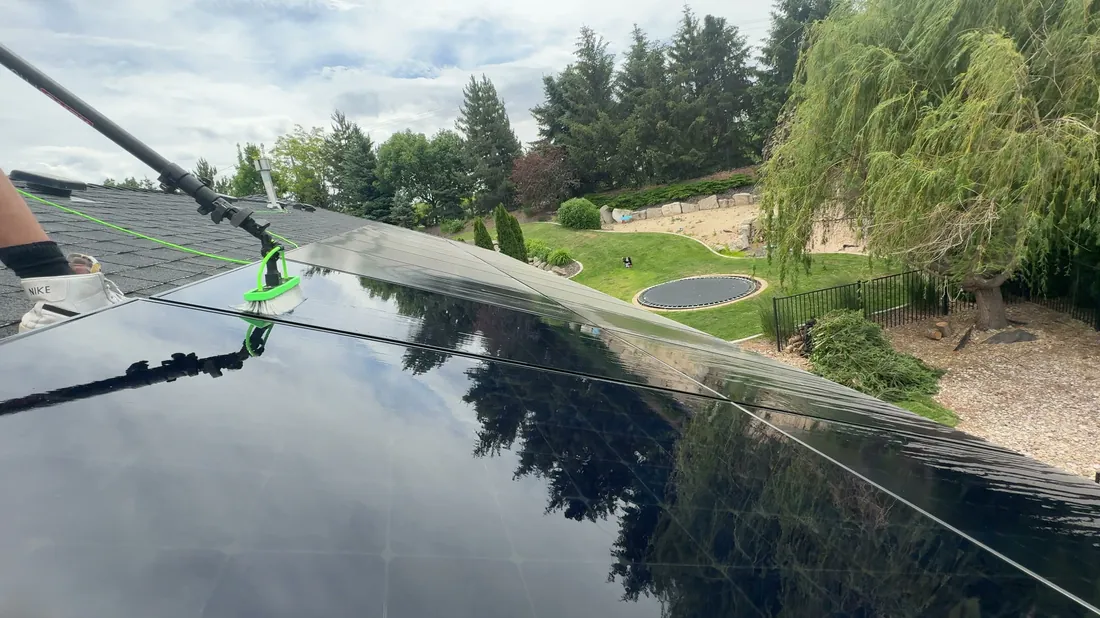
Pure deionized water and a soft brush, nothing else. No soap, no detergent, no abrasive pad, no pressure washer — soap leaves a film that dust sticks to within a week, and pressure is how you push water past a frame seal or scuff the anti-reflective coating. Deionized water dries with nothing left in it, which is the same reason we use it on glass. We stay off the modules themselves and work from the roof deck or from the ground with a pole where the run allows. Timing that actually pays: once in early summer after the pollen drops, and again in fall once smoke season is over and before the low winter sun angle. Solar is quoted per array — pitch, access, and how many modules are up there. Memberships run Monthly or Quarterly with no contract, and next-day slots open most weeks.
Ready for Solar Panel Cleaning in Alpine Pointe?
Free, no-obligation quote — we'll call or text you with your price.
Get My Free Quote