What actually costs you output on a Bear Creek roof
Panel soiling is not one thing, and on this block it comes from four sources that stack. First is your own irrigation — the district water here is untreated and mineral-heavy. Second is the canopy: twenty-plus years in, these trees throw real pollen, blossom and cottonwood fluff in May and June, and it sticks to dew-damp glass overnight. Third, if you sit along Overland, you get the same oil-bound brake and tire film that grays out the road-facing windows, and it lands on a roof just as easily. Fourth is field and jobsite dust carried in on the afternoon wind off the open ground south and west of here — fine tan silt that settles out and cements down with the first light rain. None of it is dramatic on its own. Together it's the difference between an array that makes its numbers in July and one that quietly does not.
Sprinkler overspray is the worst offender on low-mounted arrays
Bear Creek runs on Nampa & Meridian pressurized irrigation — untreated, silty Boise River canal water piped along the back lot lines. If any part of your array sits low enough for a head to reach it, and on the single-story garage wings and shop roofs common here it often does, that water lands on the glass and evaporates in the sun. What's left is a hard tan-white mineral crust that a garden hose will not touch. It builds every cycle from April through mid-October, and a full season of it starts to etch the anti-reflective coating, which is permanent. This is the one form of soiling worth fixing before the season is over rather than after. We take it off with 100% pure deionized water and a soft brush, no soap and no acid, and it dries with nothing left behind.
The canopy gives you pollen and takes away sun — cleaning only fixes one
Most of Meridian is too new to have shade. Bear Creek is one of the exceptions, and that cuts both ways. The mature trees load your panels with pollen, seed and leaf grit that a wash removes cleanly. They also cast shade, and no amount of cleaning touches that. This matters more than people expect: on a string inverter, one module in partial shade can drag down every panel wired with it, so a branch that grew over one corner of the array since 2019 can cost you far more than a season of dust. If your production sags in the same hours every clear afternoon and clears up as the sun moves, that's shading, not soiling. Cleaning won't help. Trimming will. We'd rather tell you that on the estimate than take money for a wash that doesn't move your numbers.
Pitch, orientation and the dirt line along the bottom rail
The houses here are gable-roofed asphalt composition, generally in the 5:12 to 7:12 range, and the arrays are retrofits racked a few inches off the shingle rather than flush-mounted. A couple of practical consequences. On a moderate pitch, rain rinses the field of the panel but not the bottom edge — the aluminum frame is a lip, and water backs against it and dries there. That's why you'll see a dark band an inch or two tall along the low rail of every module and clean glass above it. It's real soiling, it sits over the bottom cell row, and it's the part rain never handles. Second, street orientation in Bear Creek is mixed, so plenty of arrays here are split across two planes with one facing well off south. Those get less self-rinsing sun-and-heat cycling and hold pollen longer. We clean the full module including the frame lip and the gaps between rows.
How we clean it, what it won't fix, and what it runs
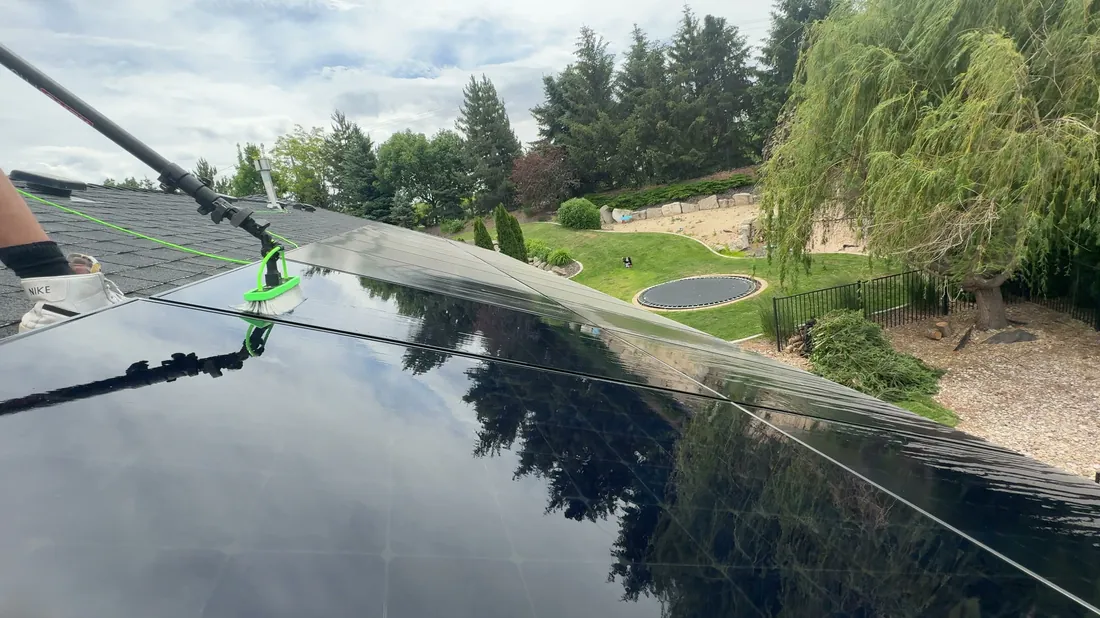
Pure deionized water, a soft brush, and a water-fed pole worked from the ground or a ladder set wherever we can reach safely. No soap, because soap film is a dust magnet on glass that never gets wiped dry. No pressure washer and no abrasive pads — pressure at the frame seal drives water where it doesn't belong. We work early while the glass is cool rather than hosing a panel that's been baking since noon. Honest limits: a wash restores output lost to soiling and nothing else. It does not reverse the roughly half a percent a year that modules lose to normal degradation, and it won't fix microcracks, a failed bypass diode, a tripped optimizer or an inverter fault. Solar cleaning is quoted per array after we see the pitch, height and module count. Fully insured, locally owned, 4.9 stars across 125+ Google reviews. Next-Day slots are often open — (208) 453-6760.
Ready for Solar Panel Cleaning in Bear Creek?
Free, no-obligation quote — we'll call or text you with your price.
Get My Free Quote