What Actually Costs You Output Around This Course
Soiling here is not one thing. From roughly June through October you get agricultural dust drifting in off the farm ground west and south of Nampa, heaviest during cutting and harvest, and it is a fine silt that settles rather than blows off. Layered on that is grit from the gravel overflow lots and event traffic around Ford Idaho Center and the Garrity Boulevard interchange, which spikes on event weekends instead of building evenly. In spring, cottonwood and grass pollen from the course turf and the mature trees on these older lots sticks to glass that already has a dust film on it. None of it is dramatic on any single day. It stacks, quietly, and by August the array is producing noticeably less than it did in May without anything having broken.
Sprinkler Overspray Is Worse Than Dust
Dust rinses. Hard water does not. Nampa city water tests as hard as about 7 grains per gallon, and any sprinkler head that reaches the low edge of a ground mount, a shop-roof array, or a low-pitch garage array leaves mineral deposits every time it cycles. Those dry into a scale film that a hose makes worse, because you are rinsing hard water onto hard water. On fairway-backing lots you can also catch mist off the course's own irrigation on windy mornings, April through October. If your array's bottom row looks hazier than the top row, that is almost always sprinkler reach, not dust. We clean with 100% pure deionized water and no soap, so the minerals lift and nothing is left behind to attract the next round of dust.
Roof Pitch and Orientation on 1990s and 2000s Builder Stock
The houses ringing this course are mostly 1990s and 2000s builder construction with composition shingle roofs at fairly shallow pitch, and that matters more than people expect. On a steep roof, rain sheets off and takes some of the dust with it. On a 4:12 or 5:12 the water crawls, and a summer thunderstorm just turns the silt into a muddy film that dries in place. Retrofit arrays on these homes usually went on whatever plane had room, so plenty of them are west-facing over a garage rather than clean south, which means they collect afternoon dust and produce less to begin with. Flush-mounted panels with a shallow tilt also drain slowly along the bottom rail, and that lower edge is where the dirt line and the water spotting both show up first.
What Cleaning Will Not Fix, and How to Tell Before You Pay
Cleaning recovers output lost to soiling. It does nothing for anything else, and it is worth knowing which one you have before booking. Pull up your monitoring app and look at the shape of the loss. A gradual slide over dusty weeks that recovers after a hard rain is soiling, and washing helps. A sudden drop, or one string or one panel down while the rest are fine, is hardware, and you want your installer, not us. A clean morning curve with a bite taken out of it mid-afternoon is shading, usually the mature trees that have grown in around these older lots over twenty-plus years, and no amount of washing moves a shadow. Panels also lose roughly half a percent a year to normal degradation. That is permanent, and clean glass will not bring it back.
How We Clean It and What It Costs
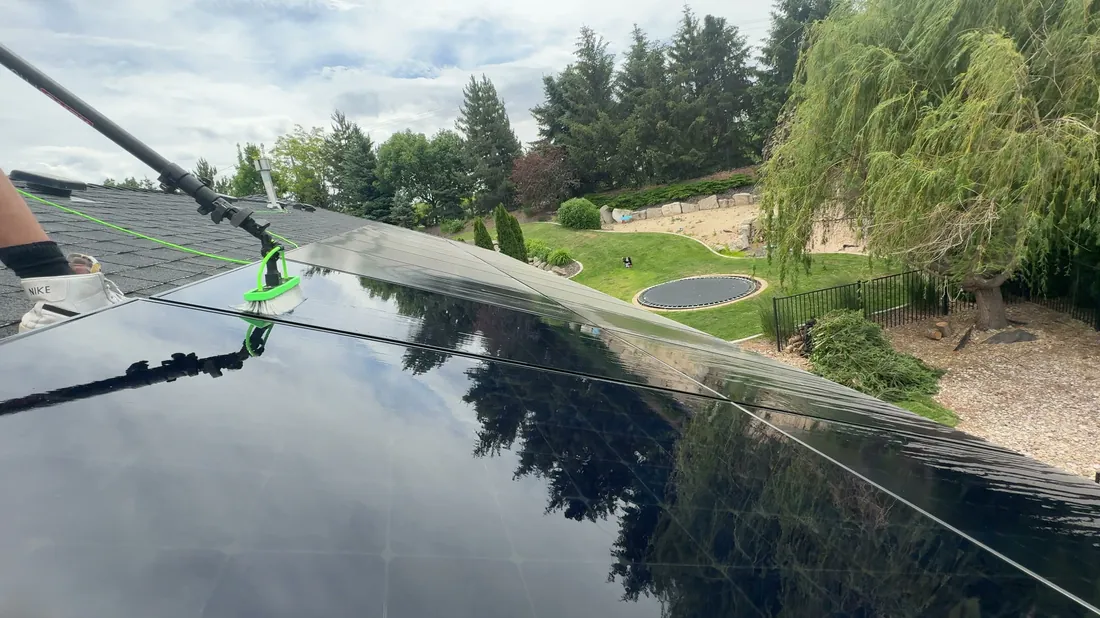
Solar panel cleaning is quoted per array, since a six-panel garage retrofit and a twenty-four-panel south roof are not the same job. We work with pure deionized water and a soft brush on a fed pole, from the ground wherever the reach allows. No soap, no detergent, no wax. Soap leaves a film, and a film on a panel is a dust magnet that has you calling again in six weeks. No pressure washer either, which risks frame seals and junction boxes on older arrays. We stay off the panels themselves, and on these older comp-shingle roofs we only walk what is safe to walk, especially in July heat. Next-Day slots, fully insured, locally owned, 4.9 stars across 125+ Google reviews, and every visit carries our 7-Day Rain Guarantee. Monthly and Quarterly memberships are available with no contract if you want the array bundled with your window work.
Ready for Solar Panel Cleaning in Centennial Golf Course area?
Free, no-obligation quote — we'll call or text you with your price.
Get My Free Quote