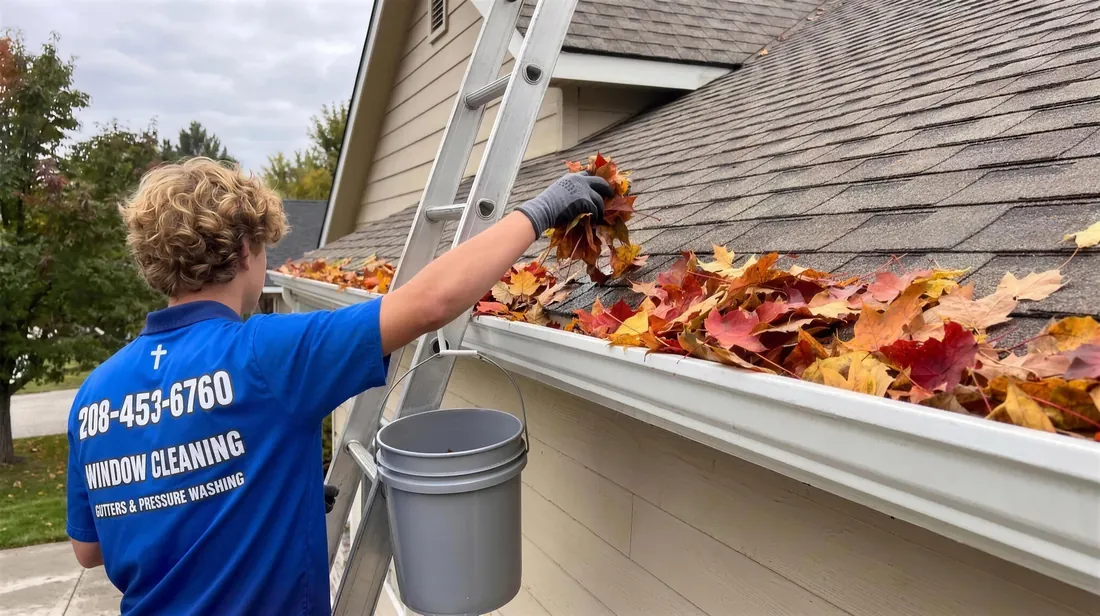
The tree cover here is lopsided, and so are the clogs
Tree cover in Ridgecrest is not even across a lot. Fairway-side yards along Ridgecrest Drive and through Ridgecrest Estates carry the mature stuff planted with the course — cottonwood, ash, silver maple — while the street side of the same house may have nothing but a young parkway tree. So the back gutter run fills three or four times faster than the front, and it is the run nobody sees from the driveway. Cottonwood is the problem child. The June fluff mats into a felt layer that holds water instead of shedding it, then the fall leaf drop lands on top and packs it down. By the time it shows from the ground — grass sprouting in the trough, a drip stain running down the siding — that gutter has been holding standing water for weeks.
Hip roofs and valleys dump everything at one corner
Most of the golf-course-era houses out here are asphalt-shingle hip roofs with two or three valleys per elevation, not simple gable ends. A valley funnels water and everything riding in it into one short stretch of gutter, almost always at an inside corner, and that corner is where the dam builds. On these roofs we clear the valley and the shingle line above the trough, not just the trough itself — pull the pack out of the valley and the gutter stays open roughly twice as long. Steeper two-story elevations make it worse, because debris arrives with speed and wedges tight at the elbow. If your house runs two valleys into a single downspout, that elbow is what backs up in the first real October rain, and it is the first thing we open.
Downspout access: narrow side yards and buried lines
Access is what slows a crew down in this neighborhood. Lots are deep and narrow, and the fairway-side downspouts usually run through a fenced side yard shared with the AC condenser, a gate, and pressurized-irrigation valve boxes stacked against the wall — not much room to set a ladder square. Plenty of the newer elevations also drop into a buried drain line running out toward the street or the course. Here is our honest limit on that: we clear the gutter, the elbow, and the visible downspout, then flush the run and tell you exactly what we see. If water stacks up at the ground outlet, the plug is in the buried line, and that is a drain job, not a gutter job. We will say so rather than sell you a second gutter clean that cannot fix it.
How to tell if yours actually needs cleaning yet
Not every house here needs a spring and a fall visit. Run the check we would run. In a steady rain, walk the fairway side and watch the outside lip — water sheeting over the front edge means the trough is full. Then look at the downspout outlet at grade: a solid stream is a gutter doing its job; a trickle or nothing while the roof is clearly running means a plug. Dry-day version, put a hose in the far end of the run and watch the outlet. A thin layer of grit and silt in the bottom of the trough is normal in Ridgecrest from sprinkler overspray and does not need to come out on a schedule. What matters is whether water still moves. If your mature trees are all street-side and the back run is open, one clean after the November drop is plenty.
What it costs and how we leave the property
Gutter cleaning starts at $199 for one- and two-story homes, quoted on the roofline you actually have — a hip roof with six inside corners is more work than a straight run, and we price it that way instead of guessing from the square footage. We hand-scoop and bag the debris rather than blowing it into the beds, flush every run, clear the elbows, and rinse the ground under the downspouts before we go. Gutter work uses standard soft-wash methods, not the deionized water system that is for glass. Memberships are Monthly or Quarterly with no contract, and every job carries the 7-Day Rain Guarantee. Next-Day slots are usually open. Fully insured and locally owned, founded in 2025 by Hunter Stevens and Ethan Seusy, 4.9 stars across 125+ Google reviews.
Ready for Gutter Cleaning in Ridgecrest?
Free, no-obligation quote — we'll call or text you with your price.
Get My Free Quote