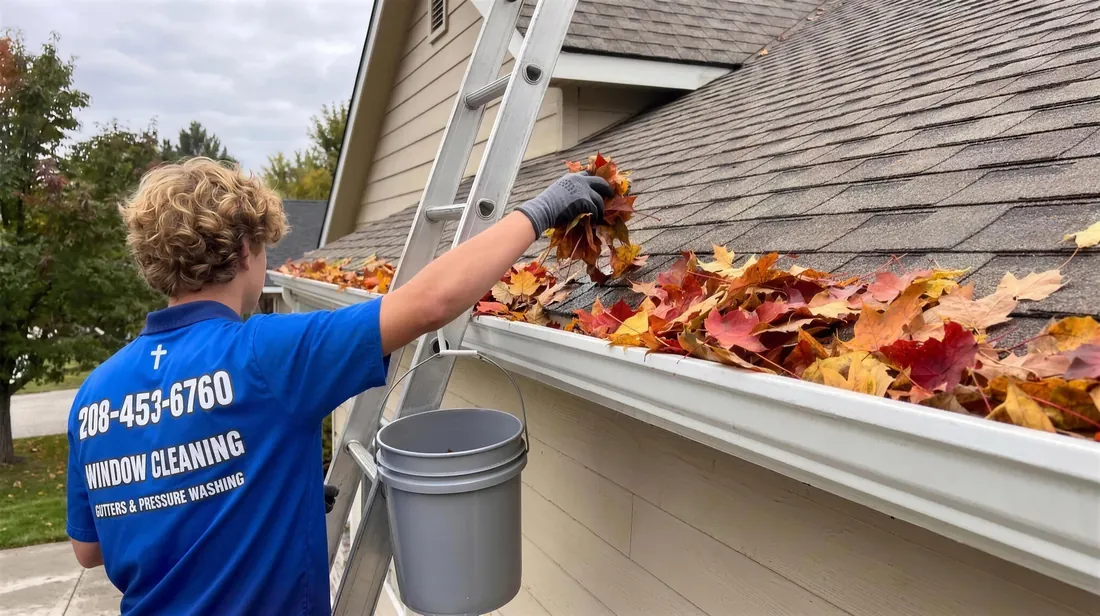
These gutters fill with grit, not leaves
On a fifty-year-old street in Boise's North End, gutter cleaning means hauling out packed maple and elm leaves. Seneca Springs is not that yet. These homes went up recently enough that the asphalt shingles are still shedding granules, and that black sand is the main thing we pull out here. It doesn't look like much sitting in the trough — a quarter inch of dark grit that reads as dirt. What it does is settle at the low end of the run, mix with the Canyon County farm dust that blows in off the northwest all summer, and set up into a dense sludge that holds water instead of passing it. Leaves you can see from the ground. Granule sludge you can't, which is why plenty of Seneca Springs homeowners are surprised the first time we open a downspout.
Two-story gable ends and where a ladder shouldn't go
The custom plans here — Monterey, Whimbrel, Stonefield, Shearwater — are built around two-story great-room glass, and a two-story great room means a tall gable end with fascia well above standard ladder-and-eave height. On several of these homes the front elevation carries a steep upper pitch that dumps into a short section of gutter over the entry, which is the single hardest run to reach and usually the dirtiest, because a steep roof moves granules downhill fast and then hands them all to one small trough. Where a 3-car or RV/boat garage wing meets the main roof, you also get a valley, and valleys concentrate everything the whole slope collects into one point. We work those runs from the ground with poles and a vacuum where we can, and set ladders only on the lower runs where the footing is right.
Young trees here, mature trees next door
Seneca Springs' own landscaping is still young — small-caliper yard trees that drop a handful of leaves in October and not much else. That's why the standard twice-a-year gutter pitch doesn't really fit this street. What does affect you is what's growing off your lot. Beacon Light Road and the older parcels around it carry poplar and cottonwood windbreaks and canal-line trees that predate every subdivision out here, and those throw seed fluff in June and leaves in a hard fall wind that carries well past property lines. If your lot backs onto or sits downwind of one of those rows, your gutters behave like an old neighborhood's. If it doesn't, you're dealing with grit and farm chaff. We'd rather look at your specific lot than quote you a schedule off the subdivision name.
Downspouts, splash blocks, and HOA-run irrigation
Quarter- to half-acre lots mean long gutter runs into relatively few downspouts, so each one carries more water than a downspout on a tight in-town lot in Star. The choke point in Seneca Springs is almost never the trough — it's the top elbow of the downspout, where granule sludge packs into the bend and turns a 3x4 into a straw. We flush every downspout to daylight and confirm flow at the bottom, not just at the top. One thing worth watching on these lots: the HOA covers irrigation on each lot, and downspout outlets often discharge into planting beds that get watered on a central schedule mid-April through mid-October. A downspout draining into an already-saturated bed backs up against your foundation. Extensions are cheap and we'll tell you where you need one.
When your gutters don't need us yet
Here's the honest version. If your Seneca Springs home is under five years old, has no mature trees on or upwind of the lot, and water sheets cleanly out the bottom of every downspout during a real rain, you can likely go a full year — sometimes longer — between cleanings. Check it yourself: during a downpour, walk the perimeter and look for water spilling over the front lip of the gutter, or for dark vertical tiger-striping on the gutter face. Overflow at one corner means a packed elbow. Overflow along a whole run means pitch or volume, not debris, and cleaning won't fix it. When you do need us, gutter cleaning starts at $199 for 1- and 2-story homes, and we bag debris out rather than blowing it into your beds.
Ready for Gutter Cleaning in Seneca Springs?
Free, no-obligation quote — we'll call or text you with your price.
Get My Free Quote