Valleys, not runs: where debris actually piles up here
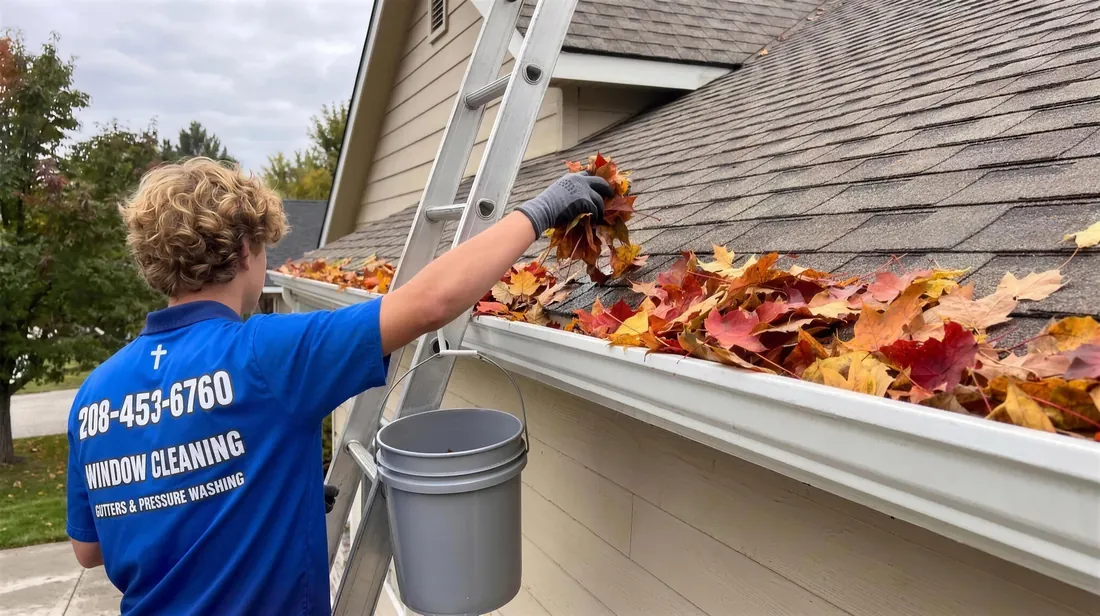
Most gutter pricing assumes a simple gable — two long runs, two downspouts, done. Two Rivers is custom estate work: hip-and-gable roofs broken into multiple planes, dormers, covered rear patios, and a separate portico or garage wing, all with deep overhangs. That geometry means the linear footage of gutter is shorter than you'd guess, but the number of valleys is much higher, and every valley funnels a whole roof plane's worth of needles, fluff, and grit into one short section of trough. Nine times out of ten we find the plug within three or four feet of a valley outlet while the rest of the run is nearly clean. Scooping the easy runs and skipping the valley heads is why some homes here clog again a month after a cleaning.
Cottonwood fluff in June, cottonwood leaves in October
Two Rivers catches debris on two separate schedules, and neither one is the standard fall leaf drop. Late May into June, the cottonwood along the Boise River corridor and the greenbelt galleries throws fluff, and it mats into wet gutter sludge like felt — it doesn't blow out, it seals. Homes backing the lakes get it worse, because the fluff lands on standing water first, gets heavy, and drifts onto the roof already wet. Then in October the cottonwood and the planted estate landscaping — maple, honeylocust, ash — drop within a few weeks of each other. A fall-only cleaning on a canopied Two Rivers lot usually leaves you plugged through the wettest part of spring. Roughly late June and mid-November is what actually keeps these roofs draining.
Downspouts that disappear into the ground
On a lot of Two Rivers homes the downspout doesn't end at a splash block. It drops behind a stone column or into a landscape bed and ties straight into buried drain tile running toward a swale, a drywell, or the lake system. That's the right way to build on these lots, but it changes what a gutter cleaning has to include. We flush every downspout from the top and then go confirm water is actually leaving at the discharge, because a buried line packed with fluff and roof grit looks identical from the roof to one that's flowing free. If the flush stalls, we'll tell you which downspout and roughly where it's holding. What we won't do is dig or attempt to repair buried tile — that's a drainage contractor's job, and you're better off with the diagnosis than a guess.
When your gutters don't need cleaning yet
Not every house here needs gutters cleaned every time somebody knocks on the door. Run a hose into the highest gutter for a minute and watch the downspout outlets. If water leaves at full volume and nothing backs up over the front lip, your gutters are fine no matter how much debris you can see from the ground — a shallow layer of settled grit doesn't restrict flow. What does need attention is water sheeting over the front edge during rain, or a valley section still holding standing water hours after. Separately, the dark vertical streaks on the outside face of your gutters aren't debris. That's oxidized aluminum finish with road film bonded into it, and cleaning the inside does nothing for it — that's a different job, and honest expectations matter more than a sales pitch.
What gutter cleaning costs in Two Rivers, and how we schedule it
Gutter cleaning starts at $199 for one- and two-story homes. Two Rivers estates land above that baseline more often than not, because the valley count and the number of separate roof planes drive the labor, not the square footage of the house. Tell us how many downspouts you have and whether any tie into buried drain lines when you book, and we'll quote it straight. Debris leaves with us — we don't blow it into the beds or rinse it toward a lake edge. Monthly and Quarterly memberships, no contract, and the 7-Day Rain Guarantee applies. We run Monday through Saturday, 7am to 7pm, with next-day slots common in Eagle. Mention any gate code up front. Reflekt is Hunter Stevens and Ethan Seusy, founded 2025, fully insured and locally owned — 4.9 stars, 125+ Google reviews. (208) 453-6760.
Ready for Gutter Cleaning in Two Rivers?
Free, no-obligation quote — we'll call or text you with your price.
Get My Free Quote