What actually costs you output on this block
Three things, in this order. First, dry-season grit off the yards, gravel lots, and Chinden truck traffic north of here, which lands as a thin even haze and quietly shaves a few percent off. Second, cottonwood cotton and pollen from the greenbelt canopy in late May and June, which is the real problem, because cotton catches on the frame edge and holds dust in a band along the bottom of each panel instead of spreading it evenly. Third, sprinkler overspray. An even haze costs you a little. A dense band across the bottom cell row of a panel can drag that whole string down, because a series string produces at roughly the weakest panel in it. That is why a lightly dusty array and a cotton-banded array can read very differently on the inverter.
Ditch water on the glass is the one you cannot ignore
Garden City runs on gravity ditch water out of the Boise River, and a lot of these older lots were plumbed with impact or rotor heads set for a yard, not for a house that later got panels. On a 1950s to 70s cottage the roof is low and the pitch is shallow, so a head that clears the eave can absolutely reach the bottom edge of a low-mounted array. Ditch water carries silt plus dissolved mineral; household tap through Veolia is hard on its own. Either one dries into a spotted mineral crust that a rain shower will not lift. If you can see white flecking along the low edge of your panels, that is not dust and it is not going anywhere by itself. Worth checking your head arcs before you pay anyone to clean, because otherwise it comes back in a week.
Pure water, no soap, nothing left on the glass
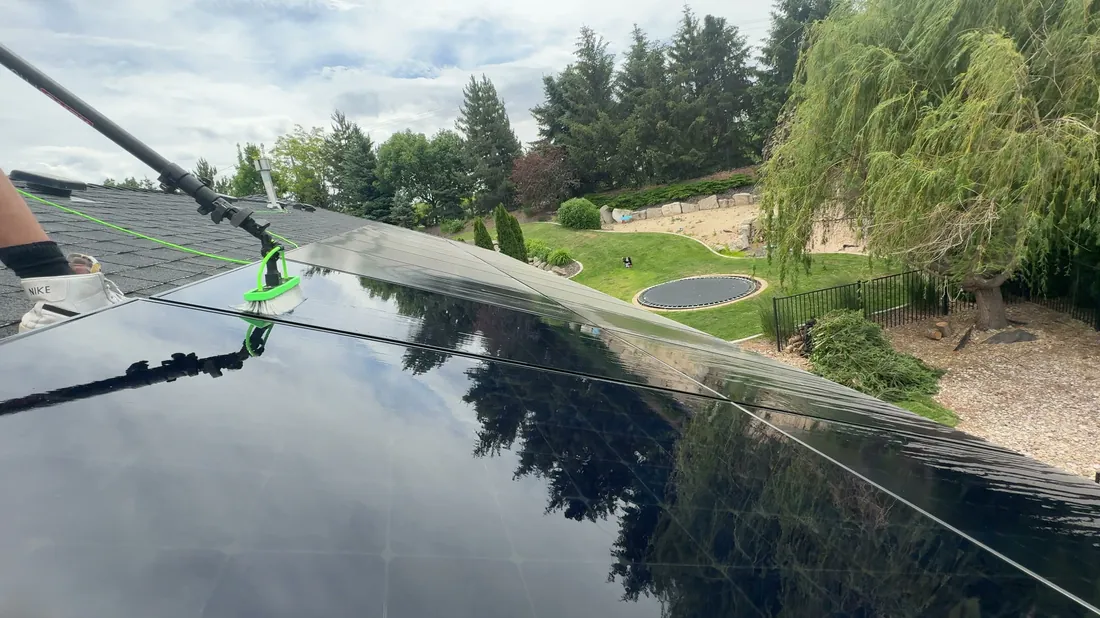
We wash panels with 100 percent pure deionized water and soft brushes. No detergent, ever. Soap on solar glass is worse than doing nothing: the film it leaves is sticky, it grabs the next round of corridor dust and cotton, and on a shallow roof there is not enough runoff angle to rinse it clear. Deionized water carries no dissolved minerals, so it lifts silt and hard water spotting and dries without leaving a residue for anything to bond to. We work off the ground or from the edge wherever the roof pitch allows, which on most of these single-story cottages it does, and we do not walk on panels or use anything that could scratch or void a panel warranty. Pricing is quoted per array after we see it.
The honest limits: what cleaning will not fix
Cleaning recovers output lost to soiling. That is all it does. If your production has been sliding a few percent a year since installation, that is normal panel degradation and no wash will bring it back. If your afternoon numbers fall off a cliff at the same time every day, that is shading, and around here it is usually a cottonwood or silver maple that was a fine size when the array went in and is not anymore. That is an arborist call, not a cleaning call. Same with a bad optimizer, a failing inverter, or a cracked cell. If you tell us what your monitoring is showing, we will tell you honestly whether it looks like soiling or something a wash will not touch. We would rather skip the job than sell you one that changes nothing.
Scheduling around cotton season, not against it
The wrong time to clean panels on this stretch is the first week of June, while the cottonwood is still dropping. You will pay for a clean array and have a banded one again inside two weeks. On these lots the sensible rhythm is one wash after cotton season ends, usually late June into early July, and one in fall after the leaf drop and before the low winter sun angle makes every bit of soiling matter more. If your array sits close to a gravel drive or a working yard, a quarterly cadence pays for itself faster. We run Monday through Saturday, 7am to 7pm, closed Sunday, with next-day slots often open on the Garden City side. Memberships are Monthly or Quarterly with no contract, and there is a 7-Day Rain Guarantee.
Ready for Solar Panel Cleaning in Adams Street Cottages?
Free, no-obligation quote — we'll call or text you with your price.
Get My Free Quote