What Actually Drops Your Output Out Here
The dust in Airport District is fine agricultural silt, not the coarse grit you get off a paved subdivision street. Coarse grit mostly rinses. Fine silt bonds to the glass with morning dew and dries into a thin, even film that shades every cell a little instead of blocking one spot outright, so nothing on your monitoring app looks broken — production just drifts down week over week. The northwest wind reloads panels within days of a rain, and spring adds pollen on top of it, especially on the properties with mature trees around the house. If you have a gravel drive or an unpaved approach to a shop, the array over that end of the property loads faster than the one over the house. We won't promise you a recovery percentage before we've looked; we'll tell you what we actually see on the glass.
Sprinkler Overspray Is the Real Problem on Low Arrays
Plenty of Airport District properties have panels on a shop, a detached garage, or a low single-story roofline, and on the bigger non-HOA lots the irrigation is set to throw far. When a rotor reaches the low edge of an array, Nampa water — up to around 7.08 grains per gallon — dries on the glass and leaves mineral scale. That is not dust and it does not wash off with a rinse. Scale is also cumulative: each cycle adds another layer, and by the second or third season it has etched enough to stay visible. If you see hazy white banding only along the bottom row of panels and the top rows look fine, that is your sprinkler, and the fix is retiming or re-aiming the head — otherwise we'll be back cleaning the same band every visit.
Roof Pitch and Orientation on 1990s and 2000s Builds
Most houses here went up during Nampa's growth run through the 1990s and 2000s, which usually means a moderate gable pitch — steep enough that a panel sheds most of a hard rain, shallow enough that it holds dust and pollen between storms. That middle pitch is the worst case for self-cleaning: too flat to shed film, too steep to walk casually. We work these from ladder and pole where we can and stay off the modules entirely; panel glass is tempered but the cells under it crack from point loading long before the glass does, and microcracks do not show up until production drops. On the older acreage homes toward the county edge, ground mounts and shop-roof arrays are common and are usually easier and faster to quote than a two-story roof array.
Pure Water, No Soap — and Why That Matters More on Panels
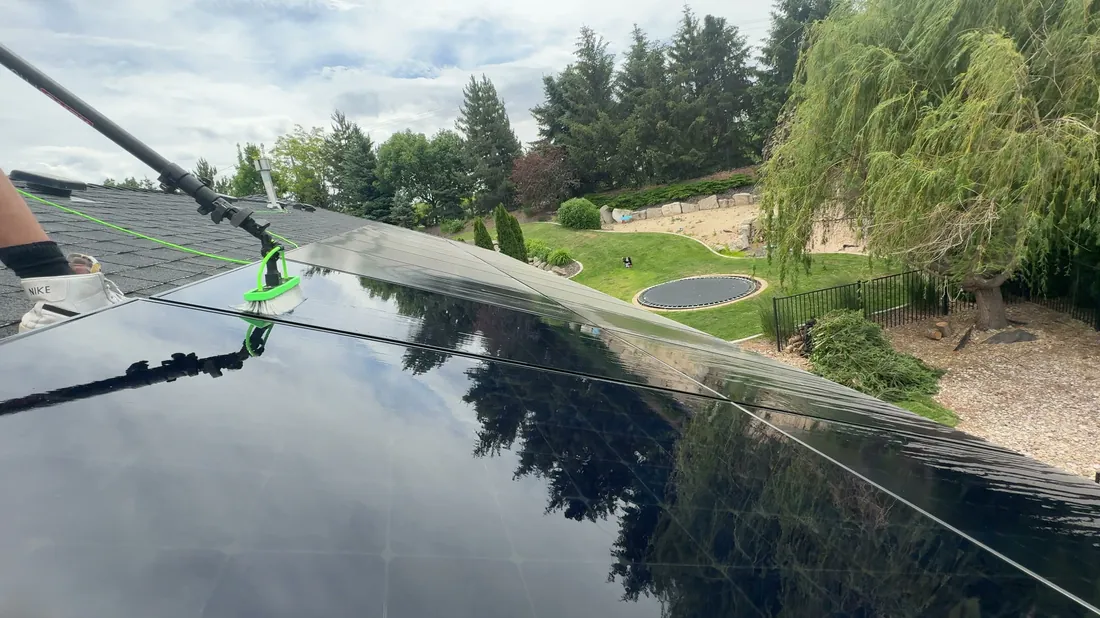
We clean panels with 100% pure deionized water, the same water we use on glass. Zero dissolved minerals means nothing is left to spot as it dries, and no soap means no surfactant film sitting on the modules after we leave. That last part matters more on a solar array than on a window: any residue left on the glass becomes the surface the next round of field silt sticks to, so a soap-washed array reloads faster than one rinsed clean. We use no abrasives, no scrubbing pads, and no pressure washer on modules — pressure drives water past the frame seals and at the junction box, which is a warranty problem you do not want. Gutters and hardscape on the same property get standard soft-wash and pressure methods; panels never do.
The Honest Limits of Cleaning Panels
Cleaning gets back the output you lost to soiling. That is the whole list. It does nothing for panel degradation — modules lose a fraction of a percent of their rated output every year and that is permanent chemistry, not dirt. It does nothing for shading. If the trees you planted when the house was new now clip the array from mid-afternoon on, clean glass will not buy that back; that is a trimming job or a panel relocation. It does nothing for a failed optimizer, a tripped string, or an inverter fault, and if one panel reads far below its neighbors on a clean, sunny day, that is electrical and you want your installer, not us. If we get on site and the array is genuinely clean, we will say so and you will not be charged for a cleaning you did not need.
Ready for Solar Panel Cleaning in Airport District?
Free, no-obligation quote — we'll call or text you with your price.
Get My Free Quote