Field Dust and Construction Dust Are the Main Culprits
The north and west edges of BanBury back onto working farm ground, and the dust that comes off a disked field in July does not stay in the field. It drifts in on the afternoon wind and settles as a fine tan film that clings harder than ordinary road dust because there is clay in it. Add the construction traffic still running Beacon Light and Floating Feather as Eagle builds north, and you have a second dust source most of the year. On a low-tilt array — anything under about ten degrees — that film never fully rinses in rain. It just migrates into a dark band along the bottom edge of each panel. That bottom-edge band is where we see the most measurable loss on BanBury roofs, and it is the first thing we check.
Pollen Under the Canopy — and What Cleaning Will Not Fix
BanBury Meadows has real tree cover: mature ash, maple, and cottonwood planted with the subdivision, plus whatever went in along the fairways. Late April through June that canopy drops pollen and cottonwood fluff onto everything below it, and pollen behaves differently than dust. It is sticky, it takes dwell time and agitation to release, and a garden hose mostly just smears it. If your array sits under or downwind of a big tree, expect a spring soiling spike. Here is the honest part: if that same tree has grown tall enough to actually shade panels for part of the day, cleaning does nothing for that. Shade is a pruning problem or a layout problem, and no amount of washing changes it. We will tell you which one you have while we are up there.
Canal Water on Low-Mounted Arrays
Every yard in BanBury runs on pressurized irrigation off the canal — untreated, silty, and mineral-heavy. Fine for grass, hard on glass. If any part of your array is low-mounted on a garage roof, a shop, a patio cover, or a ground rack, and a rotor or impact head reaches it, that overspray dries into mineral scale that is genuinely bonded, not just sitting on the surface. There is an easy way to tell the two apart: dust wipes off with a fingertip, scale you can feel with a fingernail. Soap makes it worse, because the film it leaves behind gives the next irrigation cycle something to bond to. We clean with 100% pure deionized water and no soap, so nothing is left behind. Heavy scale sometimes takes two visits plus a sprinkler head turned a few degrees — we will point out which head is doing it.
Roof Pitch and Access on BanBury Builds
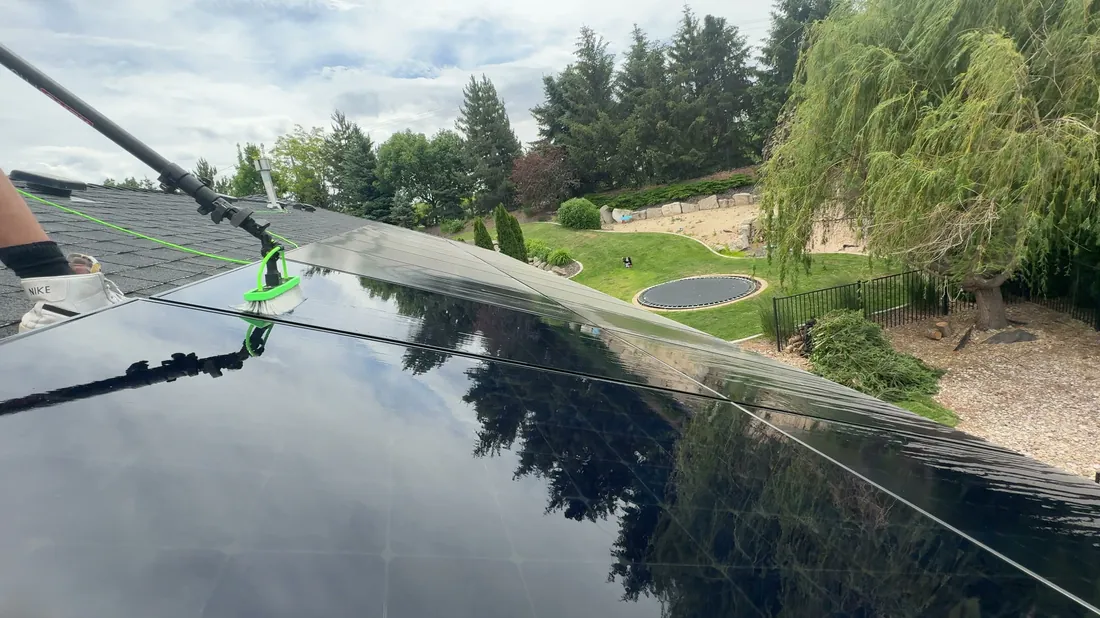
Most of BanBury and BanBury Meadows went up as custom and semi-custom homes on third-to-full-acre lots, which for this build era means steep pitches, cut-up hip and gable rooflines, and a lot of architectural shingle. Arrays generally got mounted on whatever south or southwest plane was big enough, which is often the steepest face on the house. That pitch works in your favor — it sheds snow and sheets rain better than a shallow array, so you carry less standing soiling than a flat commercial install. It also means we do not walk it casually. We work these from the ground with pole-fed pure water wherever the reach allows, and off proper anchors where it does not. If an array sits on a plane we cannot get to safely, we say so up front instead of taking the job and improvising.
What a Cleaning Actually Buys You
Cleaning restores the output you lost to soiling. That is the entire claim, and we would rather be straight about it than oversell. It does nothing for panel degradation — panels lose a fraction of a percent of rated output every year no matter how clean the glass is — and nothing for a failed optimizer, a tripped inverter, or a string that has been dark since the last windstorm. If your production is down a third and the glass looks reasonable, the problem is electrical, and you want your installer, not a cleaning crew. We quote per array once we see size, tilt, and access, and we will tell you if we do not think a cleaning is worth your money yet. Fully insured, locally owned, based in Meridian. Call (208) 453-6760 — next-day slots most weeks.
Ready for Solar Panel Cleaning in BanBury?
Free, no-obligation quote — we'll call or text you with your price.
Get My Free Quote