What actually takes output off a Bayhill array
Three things, and they don't cost you the same amount. First is the fine silt that comes off the farm ground west of Nampa toward Lake Lowell, heaviest during field prep in spring and again through harvest — it lands as an even gray film. An even film is the cheapest problem you have; a light one usually costs low single digits of production. Second is pollen, which comes in a heavy pulse from April into June and sticks because it lands on morning dew instead of dry glass. Third, and the expensive one, is banded soiling: a hard line of crud along the lower rail where dust washes down and sits. That band shades whole cells in a row, and because cells run in series, a shaded strip drags down more than its share of the string.
Sprinkler overspray is the worst thing that happens to a low-mounted array
Nampa city water runs around 7 grains hard, and the pressurized irrigation that turns on in mid-April is siltier still on the first flush. Bayhill's 0.3- to 0.44-acre lots take big rotor zones to cover, and on this neighborhood's low-slope garage roofs and any ground-mount, a rotor that throws long will put mineral-loaded water straight onto the glass. It dries in place and cements. That is not dust anymore — it's a mineral deposit, and rinsing with more hard water just adds to it. We wash panels with 100% pure deionized water, which carries nothing dissolved and lifts the deposit without leaving spots of its own. Honest note: mineral that has baked through several summers sometimes leaves a faint haze we can't take off. Etched glass is etched.
The canopy cuts both ways, and washing only fixes half of it
Trees planted when this neighborhood went in are now twenty-five-plus years old, and around the ponds and the stream corridor they're tall. That canopy is the reason Bayhill panels carry a heavier pollen and leaf-grit load than a bare 2015 subdivision on the south end of Nampa. It is also the reason some of these arrays lost production that a wash will not bring back. If a limb has grown into the sun path and shades a corner of the array from mid-afternoon on, the panels are clean and still underproducing. We'll tell you that on site instead of selling you a wash. Same with age: a panel loses roughly half a percent of its rating per year no matter what you do, so a 2010 array is legitimately down several percent from new. Cleaning restores soiling loss only.
Roof pitch, racking gap, and how we get to the glass
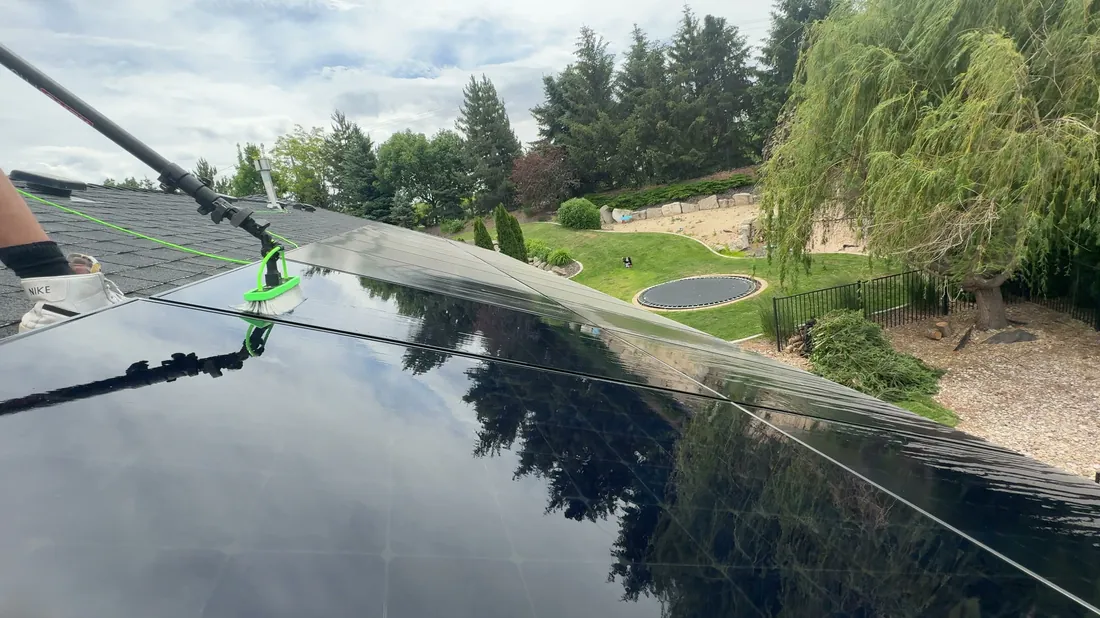
Bayhill's build era gives you mostly asphalt shingle at a walkable pitch with gable and hip runs, and arrays racked a few inches off the deck. That gap is where trouble collects. Leaf litter, seed pods and grit wash under the modules and pack against the lower rail, and once it holds moisture you get a wet band sitting against the frame that never dries out and stains the bottom of the glass. We clear what we can reach under the rail while we're up there. We don't walk on modules, ever — foot pressure microcracks cells, and you won't see it until your production sags a year later. We work from ladders and a water-fed pole off the roof edge. We don't do electrical work or bird exclusion screening; if something is nesting under the array, we'll point it out.
How we wash them and what it runs
Solar cleaning is quoted per array, since a six-panel garage bank and a twenty-four-panel south run are not the same job. We use 100% pure deionized water and a soft brush — no soap, no detergent, no pressure washer. Soap is the wrong tool on panels for a specific reason: whatever residue it leaves behind grabs the next round of dust, so a soaped panel re-soils faster than one rinsed with pure water, and detergent film can dull anti-reflective coating. We also schedule early morning and don't dump cold water onto glass that's been baking since noon. Memberships run Monthly or Quarterly with no contract, there's a 7-Day Rain Guarantee, and next-day slots are usually open. Reflekt is locally owned and fully insured, based in Meridian, founded in 2025 by Hunter Stevens and Ethan Seusy, with 4.9 stars across 125+ Google reviews.
Ready for Solar Panel Cleaning in Bayhill?
Free, no-obligation quote — we'll call or text you with your price.
Get My Free Quote