What actually cuts output on a roof in this pocket
Three dirt sources hit these roofs and they do not behave the same. Canyon wind comes down the Boise River corridor past Lucky Peak carrying real grit, and it lands hardest on the exposed south and southwest planes where the modules are. Ag and construction dust drifts in from the west and from the lots still going in around Barber Valley and Harris Ranch, a fine tan silt that bonds once it gets damp overnight. Then cottonwood off the Greenbelt, late May into June, which does not lie flat the way dust does. It packs into the lower rail and the frame edge and builds a dark band across the bottom of every module. That band matters more than the haze in the middle, because a shaded strip across the bottom of a cell string drags the whole string down, not just the part it covers.
Hard water from a sprinkler that reaches a low-mounted array
The pressurized Boise Project irrigation on this side of town throws hard, and it is untreated canal water. On a two-story roofline that is not a problem, the array is out of reach. Where we see it is low-mounted glass: modules over a single-story wing, over the garage, on a patio cover, or on a ground rack in the back yard. One misaimed head catches the bottom row every cycle from April to October, and by August you have a white mineral crust banded where the water dried. Boise tap runs roughly 10 to 13 grains of hardness and canal water is no better. We rinse with 100% pure deionized water, which has nothing dissolved in it and leaves no soap film sitting on the cells. Be straight with yourself about one thing, though: scale baked on across several seasons does not always release fully, and the real fix is moving the head.
Roof pitch, orientation, and how we get to the glass
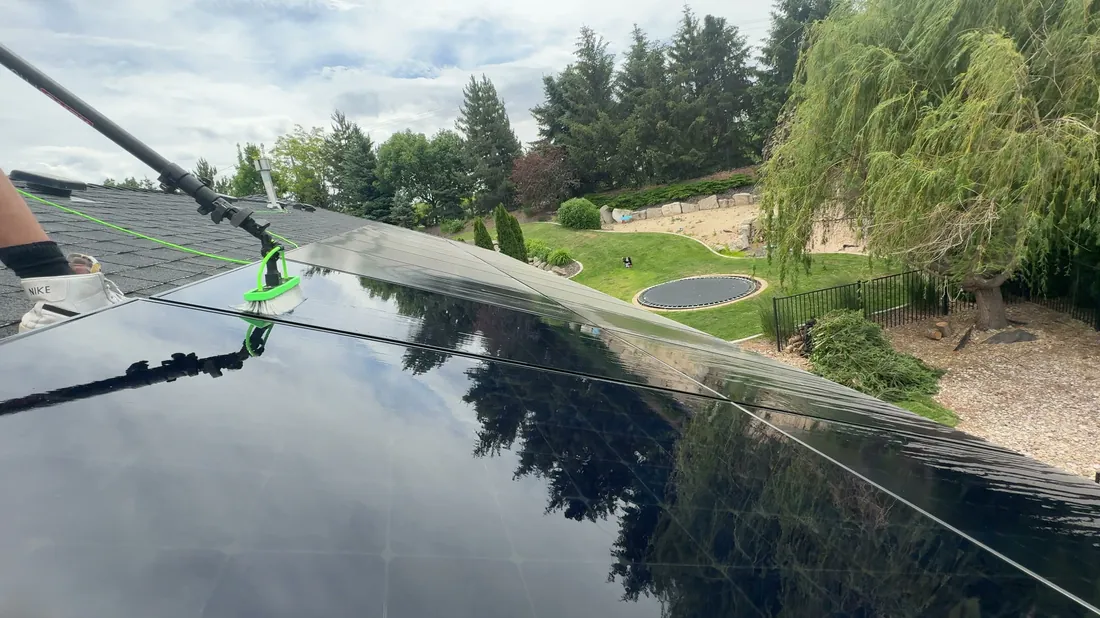
Most of Bown Crossing went up from about 2005 on, and the roofs show it: asphalt shingle, roughly a five-in-twelve to six-in-twelve pitch across the single-story and garage wings, steeper over the two-story great-room forms. That pitch is shallow enough that rain does not truly rinse a module, which is why panels here can look clean from the street and still be down several percent. Orientation is mostly south to southwest, so the array bakes in full afternoon sun and whatever lands on it sets hard. We work with water-fed carbon poles from the ground wherever the reach allows, which on a garage or single-story array is usually the whole job. Where we do have to be up top we stay on shingle at the edge and never step on modules. Lots are tight and garages are often alley-loaded, so tell us where to park when you book.
What a cleaning will not fix, and when to skip one
Washing recovers output lost to soiling. It recovers nothing else, and knowing the difference saves you money. Panels give up about half a percent of rated output per year to normal degradation, so a 2013 array is legitimately down six or seven percent and no amount of washing brings that back. Shading is the other one. The street trees and back-yard maples planted with these houses around 2006 are twenty years old now, and plenty of them clip an array for an hour or two of the afternoon. That loss is real and stays until somebody prunes. And if production fell off a cliff instead of drifting down over a season, that is hardware: a tripped microinverter, a dead optimizer, a string offline. Call your installer first. Dirt costs you a few percent, not a third. If you have had a good soaking rain in the last week and the glass reads even, you can wait.
Scheduling and what it costs
Solar cleaning is quoted per array rather than at a flat rate, because pitch, height, module count and access all change the work. If we are already at the house for windows, adding panels to the same visit costs less than a separate trip, and Bown Crossing, Harris Ranch, Columbia Village and Barber Valley sit close enough together that we can usually get out next-day. We run Monday through Saturday, 7am to 7pm, closed Sunday. Memberships are Monthly or Quarterly with no contract, and the 7-Day Rain Guarantee covers you if weather undoes the work inside a week. Reflekt is Hunter Stevens and Ethan Seusy, founded in 2025, fully insured and locally owned, 4.9 stars across 125+ Google reviews. Call (208) 453-6760 for a per-array number.
Ready for Solar Panel Cleaning in Bown Crossing?
Free, no-obligation quote — we'll call or text you with your price.
Get My Free Quote