What actually coats an array on this side of Meridian
Two dust sources hit BridgeTower harder than interior Meridian. First, the active scrape-and-grade work on the west edge — the tracts going in on former farm ground near Ustick, McDermott and Black Cat — throws a fine pale silt every dry, windy day. Second, the ag ground still in production out past Black Cat kicks its own load at disc and harvest. Valley winds run northwest to southeast, with post-frontal northwest gusts the common high-wind pattern, so BridgeTower's roofs sit upwind-first rather than downstream of dust that already settled elsewhere. Add spring cottonwood and grass pollen, which is sticky rather than loose and binds the grit to the glass instead of letting the next rain rinse it off. That combination is why a BridgeTower array films over faster than one in a built-out neighborhood two miles east.
Sprinklers are the problem nobody expects on a low-mounted array
Meridian runs on pressurized irrigation — untreated, silty Boise River water through the Nampa & Meridian canal system, straight to the heads with no softening in front of it. On a compact BridgeTower lot, a head throwing toward the house can reach the low edge of a garage-roof array, a patio-cover array, or anything ground-mounted along a fence line. That water dries to a hard tan-white mineral scale on the panel glass and the anodized frame. It is not the same problem as dust. Dust dulls output and rinses partly off; scale bonds, builds ring on ring through the April-to-October irrigation season, and eventually etches. If your lowest row of panels looks chalky while the top row looks fine, that gradient is your sprinklers, not the sky, and the fix is a pattern adjustment plus a proper wash.
Roof pitch and orientation on BridgeTower's build era
BridgeTower filled in over phases, and the production floor plans running through it share a profile: composition shingle at a moderate pitch, two-story rear elevations, and arrays laid flush to the deck a few inches off the shingle. That flush, moderate-pitch mount is the worst case for self-cleaning. Steep panels shed a dust film with a good rain; a shallower array holds a puddle-and-dry cycle that leaves a tide line along the bottom rail and in the frame channel. The low rail is also where debris packs in — grit, seed, and elm seed bug shells in July and August — and that packed line shades the bottom cell row of every panel above it. On a series-wired string, one shaded cell row drags the whole string, which is why the bottom inch matters more than its size suggests.
What cleaning fixes, and what it honestly does not
Washing recovers output lost to soiling. That is the whole claim. It does not reverse panel degradation — modern panels lose roughly half a percent of rated output per year, permanently, and no wash touches that. It does not fix a failed diode, a cracked cell, or a bad string. And it does not help shading from trees that have grown into the sight line, which is real in BridgeTower's older interior phases where the original landscape trees are now tall enough to clip a rear-facing array. Here is the diagnostic: pull up your inverter app and compare a clear midday hour to the same week last year. A flat, all-day percentage drop is soiling and a wash will get most of it back. A dip that moves across the day and deepens seasonally is shading, and that is a tree job, not a cleaning job.
How we wash them, and what it runs
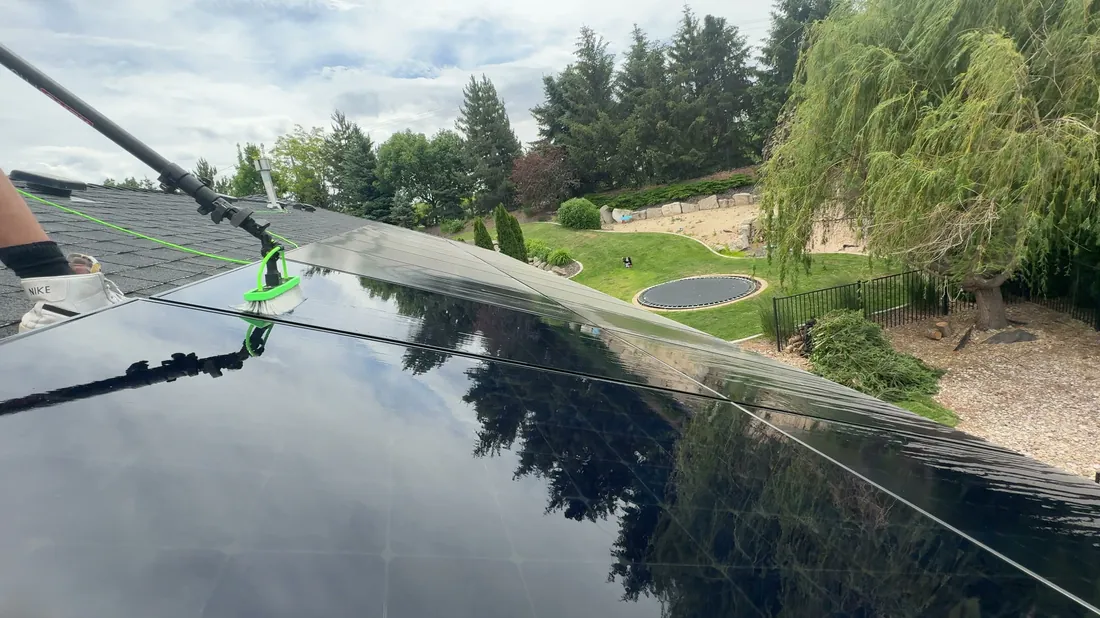
We clean panels with 100% pure deionized water and soft brushes — no soap, no detergent film for the next dust cycle to grab onto, and nothing abrasive on the anti-reflective coating. Pure water is the right tool for exactly the two things BridgeTower throws at an array: bonded sprinkler minerals and pollen-stuck silt. We work off the array's own access path, keep off the panel faces, and clear the bottom rail and frame channel rather than just wiping the glass. Solar cleaning is quoted per array — panel count, pitch, and access all move the number, so you get a firm price before we start, not a per-panel guess. Memberships run Monthly or Quarterly with no contract, and there's a 7-Day Rain Guarantee. Locally owned, fully insured, 4.9 stars across 125+ Google reviews. Next-Day slots are usually open. Call (208) 453-6760.
Ready for Solar Panel Cleaning in BridgeTower?
Free, no-obligation quote — we'll call or text you with your price.
Get My Free Quote