What Actually Costs You Output on This Acreage
Bridle Ridge sits on Kuna's acreage belt off Black Cat, and the dust load comes from three directions at once. Gravel driveways run long here — several hundred feet on some lots — and every truck, trailer, and delivery kicks fine grit into the air that settles downwind on whatever is flat, including a ground-mount array or a low-slope shop roof. Dry paddocks, round pens, and arena footing throw more of it every time a horse moves. Then there is the farm ground surrounding the subdivision: disking, cutting, and harvest all put a haze in the air that drifts across the whole area, and any lot still under construction adds concrete and framing dust on top of that. Kuna gets almost no summer rain to knock it down, so from May through October the film builds and stays built until somebody washes it off.
Sprinkler Overspray Is the Film That Won't Rinse Off
Pressurized irrigation out here runs raw canal water off the Boise-Kuna and New York district system, and the heads are sized to throw across pasture, not a quarter-acre lawn. If your array is ground-mounted, pole-mounted low, or sitting on a single-story roofline inside that throw, it is getting hit several nights a week from the mid-spring headgate opening through fall shutoff. That water carries suspended silt plus dissolved minerals. The silt dries as a tan haze; the minerals dry as scale that bonds to the glass and will not come off with a hose. Left through a full season of summer sun it bakes on and takes real work to remove. We rinse with 100% deionized water, which has nothing dissolved in it to leave behind, so the panel dries clear instead of drying to a fresh set of spots.
Roof Pitch, Orientation, and Where the Array Actually Sits
Housing here is genuinely mixed — custom single-story and two-story homes alongside manufactured and modular, plus the metal shops and barns that come with a horse setup — so there is no single roof profile to plan around. That matters for solar because tilt is what determines how much a panel cleans itself. A steeper south-facing house array sheds a fair amount of dust in a hard rain. A low-slope metal shop roof, or a ground mount set shallow to favor summer production, holds water and lets it evaporate in place, which is exactly how you end up with a permanent-looking mineral band along the bottom edge of every panel. We look at pitch, height, and mount type before quoting, and we quote per array rather than per panel, because a 20-panel shop roof and a 20-panel ground mount are not the same job.
What Cleaning Fixes, and What It Doesn't
Washing panels recovers output lost to soiling. That is the whole of it. It does not reverse cell degradation — panels lose a fraction of a percent of rated output every year, permanently, and no wash brings that back. It also does nothing about shading. If the trees planted when the house was built have grown into the array's afternoon sun, or a new shop went up on the lot next door, that is a shading problem and the fix is a saw or a different mount, not a cleaning. Run this diagnostic before you call anyone: open your monitoring app and compare panels or strings against each other. If everything is down by a similar amount and it improves after a rainstorm, that is dirt and we can help. If one or two panels sit far below the rest while their neighbors read normal, that is an electrical or hardware fault, and a wash is wasted money.
How We Clean an Array, and When We Schedule It
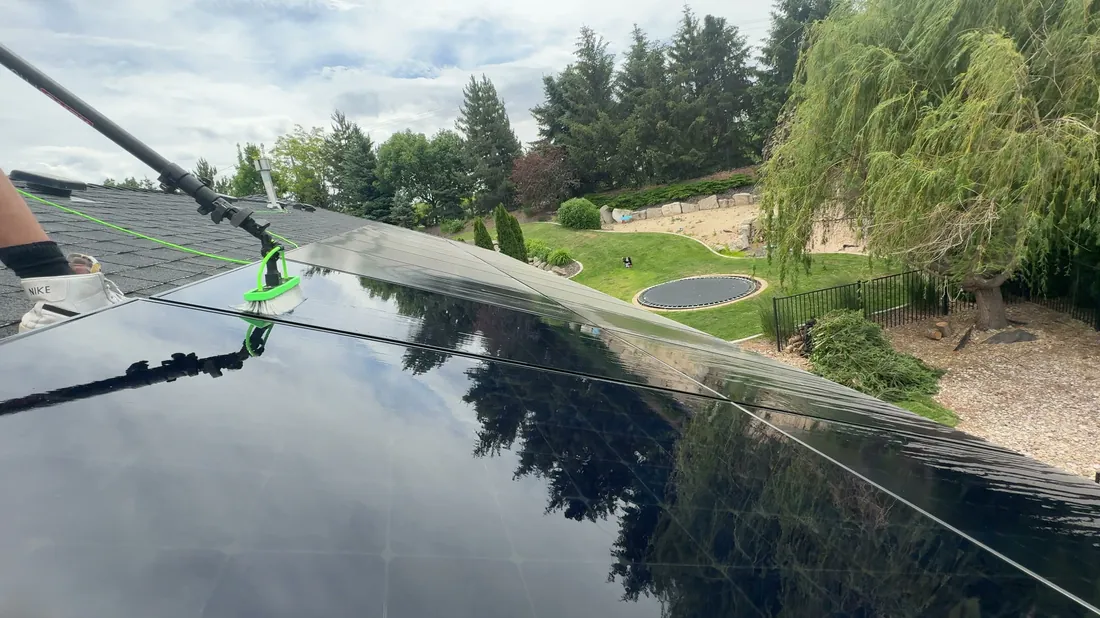
Pure deionized water and soft brushes. No soap, no pressure washing. Detergent leaves a film that dust bonds to within days, and most panel manufacturers are specific about abrasives and high-pressure water in their warranty language. We work from the ground or a ladder with a water-fed pole wherever reach allows, and we do not walk on panels. Array work gets scheduled early in the day, before the glass is hot — spraying cool water across a panel baking in July sun is asking for thermal stress. Access here means long drives and, on some lots, a gate, so send a code or an arrival window and we will build the extra time in. Next-Day slots are usually open. Memberships run Monthly or Quarterly, no contract, with a 7-Day Rain Guarantee.
Ready for Solar Panel Cleaning in Bridle Ridge Equestrian Estates?
Free, no-obligation quote — we'll call or text you with your price.
Get My Free Quote