What a 3:12 Roofline Does to a Gutter
A low-slope mid-century roof doesn't move water the way a steep bungalow roof does. Rain leaves a 3:12 or 4:12 composition roof slowly, so grit and leaf litter that would flush clean off a 9:12 in the North End settles into the shingle instead and arrives at the trough as sludge rather than loose debris. The long horizontal design of these houses also means long, unbroken gutter runs — forty and fifty feet on one fascia line with an outlet at each end — so anything packing at the low end has a lot of trough feeding it. And with eaves this short, an overflowing gutter dumps within a foot or two of the foundation and the brick, not out into the lawn. The first sign of trouble here is usually a stained fascia board or a wet stripe of siding, not a waterfall off the corner.
Canopy Sitting At Gutter Height
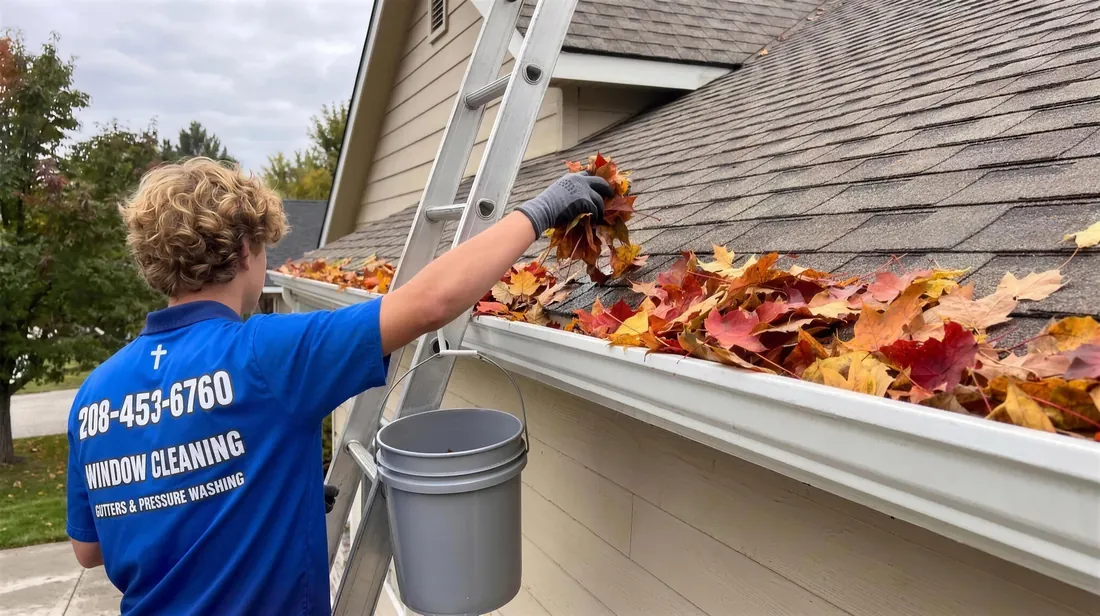
These blocks went in with street trees planted at the same time as the houses, and those trees are now fifty-plus years old standing over roofs that are only one story tall. That changes the debris pattern completely. On a two-story house, leaves land on the roof, dry out, and blow off before they ever reach a gutter. Here the canopy is often at or below gutter height on the back and side elevations, so leaves, seed pods, and small twigs go straight into the trough and stay wet. We see three loads a year on these streets: maple and elm seed in late spring, a light summer load of catkins and windblown cottonwood, and the heavy one from late October into November. Anything that sits wet through a Boise winter turns to compost, and compost holds water against the fascia and the shingle edge all season.
Downspouts, Side Yards, and Buried Lines
Access is the part that actually takes time in Randolph-Robertson. Side yards on these lots are narrow — often just enough for a walkway — and the downspouts sit right on the lot line, behind an AC condenser, a gas meter, or a fence that got added years after the house. The low roof makes the ladder work easy; getting a ladder and a charged hose into a three-foot gap between two houses does not. Some of these homes also drop the downspout into a buried line running out to the street or alley instead of a splash block. We flush every outlet with water after we scoop, so we know whether a run is genuinely clear or just clear at the top. If a buried line backs up, we tell you at the truck instead of pretending the flush fixed it.
How to Tell If Yours Doesn't Need It Yet
Not every house on these streets needs service twice a year, and we would rather say so than sell a visit. From the ground on a one-story ranch you can see more than most people expect. After a hard rain, walk the drip line and look for a trench cut in the bark mulch or a dark vertical stripe on the fascia — that is overflow, and it means the trough is holding. Look at the outside lip for a fuzz of seedlings or grass; anything growing up there means organic material has been sitting long enough to stay damp. Shingle grit alone in the bottom of a gutter is normal and does not need to come out on a schedule. If your outlets run fast during a storm and nothing is growing, wait until the leaves actually drop.
What It Costs and What You Get
Gutter cleaning starts at $199 for one- and two-story homes in Randolph-Robertson. Price follows the length of the gutter run and how much of it sits under canopy, not just the square footage of the house. We hand-scoop debris into a bag and carry it out — we don't blow wet leaf pack into the beds or leave it piled on the roof to wash back in with the next storm. Every outlet gets flushed and checked. Gutter and hardscape work uses standard soft-wash and rinse methods; the pure deionized water system is for glass. Monthly and quarterly memberships are available with no contract, and the 7-Day Rain Guarantee covers the work. Reflekt is locally owned, fully insured, and holds 4.9 stars across 125+ Google reviews. Next-day slots are usually open on the Bench — (208) 453-6760.
Ready for Gutter Cleaning in Randolph-Robertson?
Free, no-obligation quote — we'll call or text you with your price.
Get My Free Quote