Sixty-Year-Old Concrete Is a Different Substrate
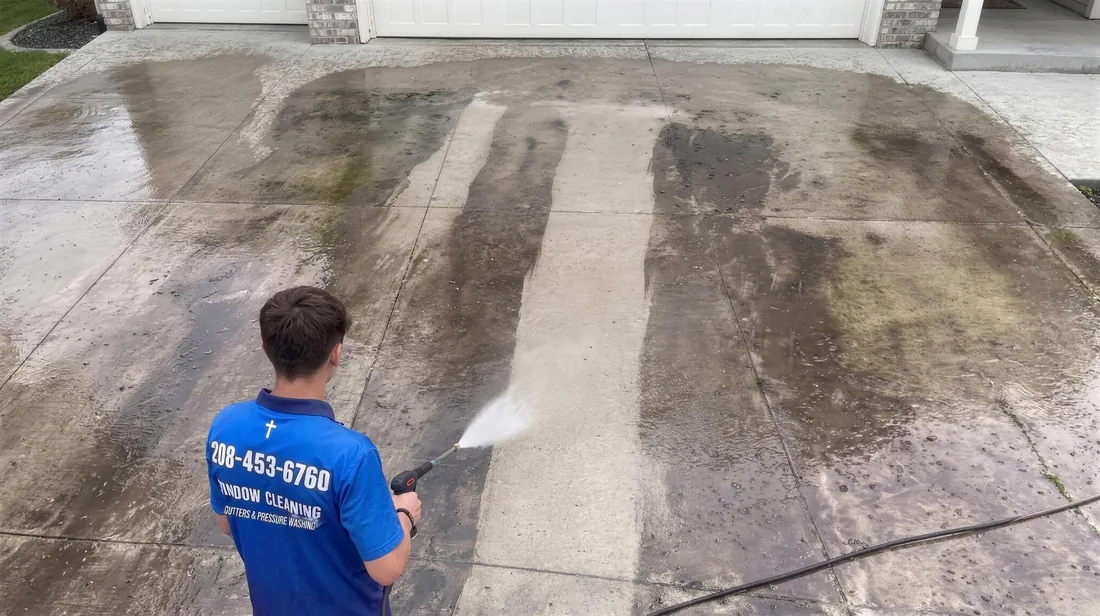
A driveway poured in a 2020 Meridian subdivision and a driveway poured in Randolph-Robertson in 1958 are not the same material to wash. Six decades of freeze-thaw, deicer tracked home off Vista and Curtis, and plain weathering carbonate the top layer and open the pores. The cement paste that used to seal the surface has worn back, and on a lot of these slabs the sand is already standing proud of the finish. Hit that with a 3,000 PSI zero-degree tip and you don't clean it — you cut it, and you leave wand stripes that never fade out. Same story on the exposed-aggregate patios that showed up on the later remodels here: the aggregate is fine, but the paste holding it is what fails first. We wash these at reduced pressure through a rotating surface cleaner so the slab gets one even pass instead of fifty overlapping stripes.
Where Randolph-Robertson Concrete Actually Gets Dirty
Four sources, and they need different treatment. First, carports. A lot of the original mid-century ranches here have a carport rather than a closed garage, so sixty years of drips landed on open concrete instead of inside a garage — that's the dark blotch near the back of the slab. Second, irrigation. Bench yards run hard, iron-bearing water through sprinkler heads, and the rust-orange fan across the driveway edge and along the walk is mineral, not dirt. Third, the mature street trees that grew up over these low rooflines drop tannin and aphid honeydew onto walkways and back patios, which turns into a sticky gray-black film that hose water won't touch. Fourth, north-side walkways under short mid-century eaves stay shaded and damp, and they grow the slick black algae you feel before you see.
No HOA Concrete Here — Just Your Slab
Randolph-Robertson predates the HOA-and-common-area subdivision model by decades. There's no association-maintained sidewalk network, no shared pool deck, no board approving a vendor. It's a public sidewalk the city treats as yours to keep clear, a private drive, and whatever patio and path the previous owners poured out back. In practice that means we quote what you actually want washed instead of a fixed common-area package, and most jobs here come out as one of three shapes: drive plus front walk, drive plus front walk plus back patio, or the whole hardscape footprint before a party or a listing photo shoot. Neighbors on the same block often split a visit and get both driveways done in one trip, which is usually the cheapest way to do it since our setup time gets shared.
What Pressure Alone Will Not Fix
Worth knowing before you pay for it. Old motor oil that has been wicking into porous 1950s concrete under a carport for years is not a surface stain — pressure lifts the top layer, the shadow underneath stays, and honest expectation is significant lightening, not disappearance. Same with irrigation rust: that needs a dedicated oxalic-acid rust treatment, and pressure by itself will scrub around it all day without moving it. If your slab is already spalling — flaking, popped-out chunks, exposed rebar shadow — washing it will pull more material loose, and we'd rather show you that spot and wash around it than hand you a worse driveway. And a driveway that's simply gray from carbonation, not dirty, is not going to come back white. We'll tell you that on the estimate instead of after.
Pricing, Timing, and How to Book It
Driveways, patios, and walkways run $0.20 per square foot, so a typical Randolph-Robertson single-width drive at roughly 10 by 50 feet lands near $100, and a drive plus front walk plus a back patio usually falls in the low hundreds. We measure it rather than guess. Best window here is spring after the sprinklers come on and again in fall once the tree litter finishes dropping — washing before leaf drop just means doing it twice. Next-Day slots are often available since we run the Central Bench, Vista, and Morris Hill area regularly. Reflekt is locally owned, fully insured, started in 2025 by Hunter Stevens and Ethan Seusy, and carries 125+ Google reviews at 4.9 stars. Monthly and quarterly memberships exist with no contract if you want it kept up rather than rescued.
Ready for Pressure Washing in Randolph-Robertson?
Free, no-obligation quote — we'll call or text you with your price.
Get My Free Quote