What These Houses Are Actually Clad In
Drive Randolph-Robertson and you see the same three claddings over and over: brick or brick veneer across the front third of the house, painted wood lap siding or board-and-batten on the gable ends and side walls, and a strip of stucco or later T1-11 on a garage addition. Very few of these ranches were built with vinyl — vinyl here is a replacement, usually one wall someone re-sided after a remodel. That mix matters because it can't all be washed the same way. Brick takes soap and a rinse without complaint. Sixty-year-old painted lap siding does not; it wants low pressure, a longer dwell, and a rinse that runs down the lap instead of driving up under it. We change the mix wall by wall on the same house instead of running one setting around the whole thing.
The Sprinkler Line Is the Hardest Stain on the Street
Almost every ranch on this stretch of the Bench with an original in-ground system has a sprinkler line — a hard, chalky band roughly eighteen inches to three feet up the wall where heads have been throwing water at siding for years. Valley irrigation water is hard and often carries fine silt, and afternoon sun bakes it onto the wall. That band is not dirt, and it does not come off with soap and a rinse. It needs a dedicated mineral treatment worked into the band and given time to sit, and on painted wood some of it has etched into the paint film — it will lighten, not vanish. We'll tell you which one you have at the estimate. The permanent fix is usually moving or swapping two heads, which costs less than washing the same stripe every spring.
North-Side Algae Under Short Mid-Century Eaves
The north and northeast walls are where the green shows. These ranches have short eaves — often twelve to eighteen inches on a 3:12 roof — so the shaded side of the house gets almost no drying sun from October through April, and the mature street trees over these low rooflines keep it damper still. What grows there is a green-black algae film, heaviest in the bottom four feet and under window sills where the wall stays wettest longest. Pressure will strip it, and it will strip the paint with it. We soft-wash instead: a surfactant and sodium hypochlorite mix applied at low pressure, left to dwell, then rinsed. That kills the organism rather than knocking the visible layer off, which is why it stays clean for a couple of seasons instead of greening up again by spring.
Sun-Side Chalking: What a Wash Will Not Fix
South and west walls have the opposite problem. Full Treasure Valley sun on paint that may be two or three repaint cycles old breaks down the binder, and the pigment powders off the surface — rub the wall and your hand comes away white or beige. Homeowners read that dull, faded look as dirt and expect a wash to bring the color back. It won't. Washing removes the loose chalk, the wall genuinely looks better for it, and it's the right prep before a repaint. But the color underneath is the color you have. If your hand comes away coated after a swipe, what that wall needs is paint, not another wash. We'd rather say so at the estimate than take the money and leave you looking at a tired west wall.
Pricing, Access, and How It Pairs With Glass
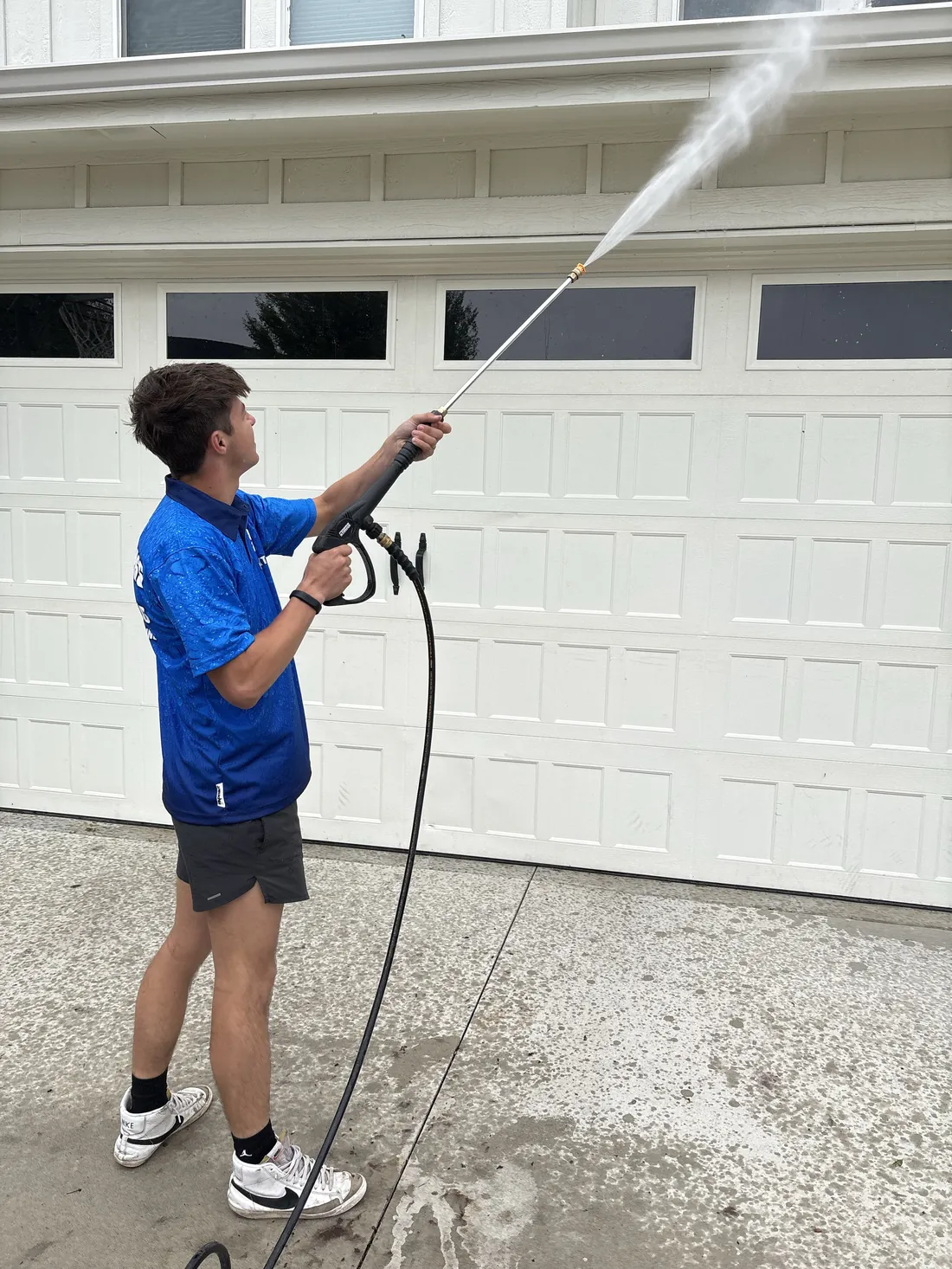
House washing runs $0.18 per square foot, soft-wash, safe on brick, stucco, hardie, vinyl and painted wood. Most Randolph-Robertson ranches are single-story with roughly 1,200 to 1,900 square feet of wall, and the low rooflines mean the whole envelope is reachable from the ground — no lift, no scaffolding, usually a half day. Gutter faces get washed at the same time, since the same north-side algae streaks the fascia. If you want windows done too, we clean glass separately with 100% pure deionized water and do it after the wash, because house-wash soap left on glass dries spotted. Memberships are monthly or quarterly with no contract, next-day slots are common, and the 7-Day Rain Guarantee covers a return trip if weather undoes the work.
Ready for House Washing in Randolph-Robertson?
Free, no-obligation quote — we'll call or text you with your price.
Get My Free Quote