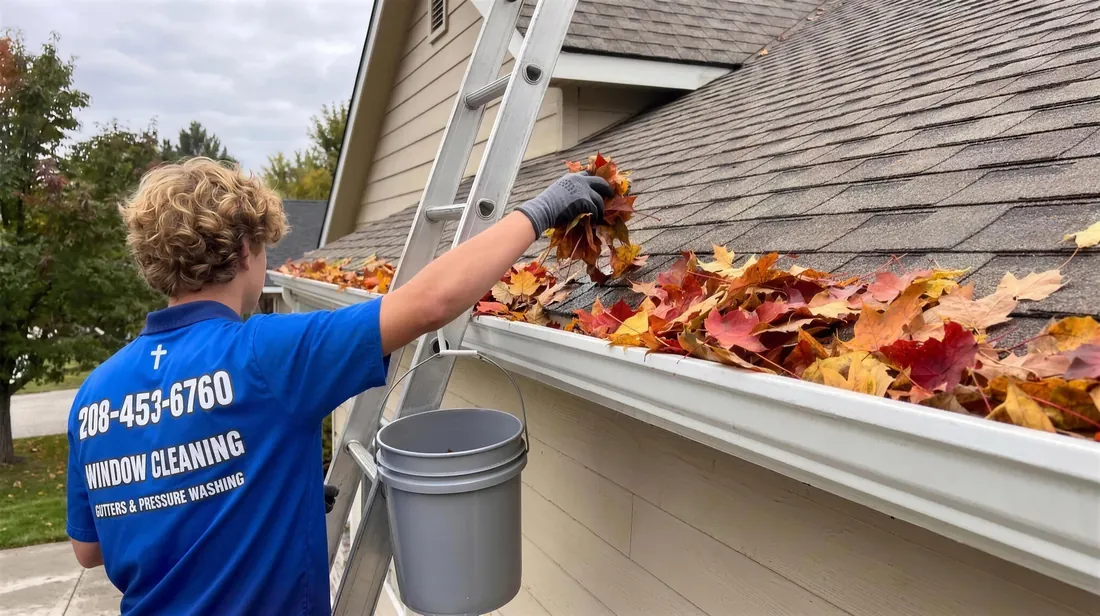
Shallow pitch and wide eaves change how debris moves
Most roofs here run a low pitch, four or five in twelve, which is normal for the era but means debris does not shed on its own. Leaves and needles creep down slowly, stall in the valleys, then arrive at the gutter already wet and matted instead of blowing off dry. The wide eave overhang common on these ranches pushes the gutter line well out from the wall, so a ladder has to stand back further and lean shallower than it would on a newer two-story in Meridian. Split-levels add a second problem: the upper roof section usually dumps onto the lower roof, which funnels two roof areas of water and debris into one gutter run and one downspout. That is almost always the run that fails first, and it is the one we open up before anything else.
Cottonwood that falls straight into the trough
Cottonwood is the whole story on these lots. Other Garden City neighborhoods get fluff that drifts down the Greenbelt corridor and thins out on the way. Riverside Village has mature cottonwoods standing at the riverbank and around the pond edges, so seed, bark and small limb drop land directly on the roof. Cotton mats into a felt layer in the gutter, then river fog and pond humidity keep it damp instead of letting it dry and crumble. Wet cotton plus silt composts down into a black sludge that holds water against the aluminum, and by August we routinely pull cottonwood seedlings that have rooted in it. After a summer windstorm we also find bark strips and finger-thick branches wedged into the downspout elbows, which is a different clog than leaves and does not flush loose with a hose.
Downspouts, soft ground and buried drain lines
The water-facing side of these lots is where the access problems live. Ground near a bank or pond edge is soft, and a lot of it is landscaped down toward the water, which is not somewhere to set a ladder foot. We work those runs from the deck or patio where the house allows it, and use standoffs and pads instead of planting a ladder in wet turf. Plenty of homes here have downspouts tied into buried drain lines that daylight at the bank or discharge into a rock bed. Those lines silt up at the outlet, so the gutter can be spotless and still back up. We flush every downspout after clearing and watch for flow at the far end. If nothing comes out, we tell you the line is the problem rather than charging you for a second gutter clean.
When your gutters do not actually need cleaning
Honest answer: a thin layer of grit and a few leaves in the trough is not a clog. If water runs clear out of every downspout during a real rain and nothing is spilling over the front edge, you can wait. Two things that look like clogs but are not: original spike-and-ferrule hangers backing out of the fascia, which lets a section sag and pond in the middle no matter how clean it is, and gutter that was hung with too little fall from the start. Both show a standing waterline and streaking on the outside face. We will point that out and tell you it is a hanger or pitch fix, not a cleaning. Same with rusted-through seams on 40-year-old aluminum. Cleaning them will not stop the drip, and we would rather say so on the first visit.
Cost, timing and how we schedule Riverside Village
Gutter cleaning starts at $199 for one- and two-story homes, and on these lots the water-side runs under the cottonwoods take the most time. We hand-scoop the trough, bag the debris rather than dropping it in your beds or the pond, clear the downspouts and flush the whole system. On this side of town the useful rhythm is one clean in late June after the cotton has finished falling and one in November after the cottonwoods and the neighborhood's silver maples have dropped. Memberships come Monthly or Quarterly with no contract if you would rather have it on a schedule. Reflekt is Hunter Stevens and Ethan Seusy, founded in 2025, fully insured and locally owned, 4.9 stars across 125+ Google reviews. We run Monday through Saturday and usually have next-day slots in Garden City. Call (208) 453-6760.
Ready for Gutter Cleaning in Riverside Village?
Free, no-obligation quote — we'll call or text you with your price.
Get My Free Quote