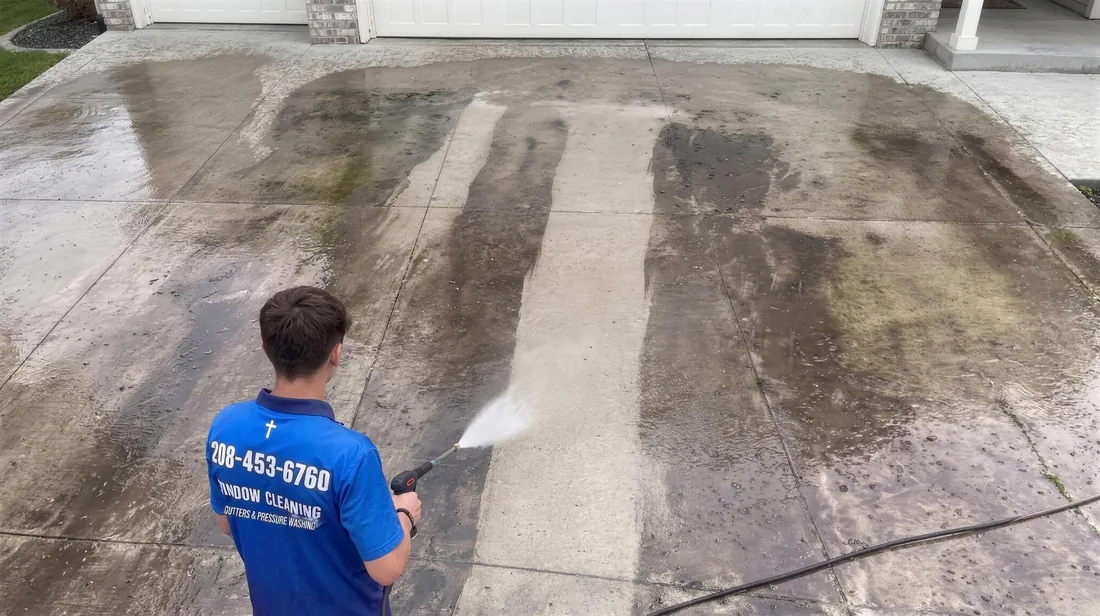
Forty-year-old concrete, not fresh pours
Most of what we wash in Riverside Village was poured between the mid-1970s and the early 90s. That means a lot of exposed aggregate driveways and broom-finish flatwork that has lost its original surface paste and gone porous, plus older walkways that have heaved and settled on river-bottom soil. Porous concrete drinks stains instead of holding them on top, so it comes clean slower than a five-year-old driveway and it never comes back to white. It also chips. Where a driveway is already spalling and popping aggregate, we back the pressure down and let the detergent do the work rather than blasting more surface off. The short split-level driveways here are usually 500 to 900 square feet, so the whole thing prices out at $0.20 per square foot without much guesswork.
Cottonwood tannin and pond-edge algae
Two stains show up on almost every property back here. The first is tannin: cottonwood fluff and leaf litter falls straight off the bank onto the driveway apron and patio, gets rained on, mats down and leaves a brown-gray shadow in the shape of whatever sat there. That is organic and it lifts with dwell time and soap, not with more pressure. The second is green and black growth on the pond and river side, where morning fog and pond humidity keep the concrete damp under a shade canopy for most of the day. Shaded walkways along a pond edge are the slickest surfaces we touch in Garden City. Those come clean fast, but on a north-facing shaded slab they start returning within a year, faster than the three to four years a sunny driveway holds.
Ditch-water rust is a chemistry job, not a pressure job
This ground has been irrigated off gravity ditch water since the 1860s, and that water carries iron and silt. If your sprinklers throw onto the driveway, sidewalk or the concrete skirt around a patio, you get orange-brown fan-shaped staining that follows the arc of the head. Here is the honest part: pressure will not remove that. You can run 4000 PSI over an iron stain all afternoon and take surface off the concrete before the color moves, because the iron has soaked into the pores and oxidized there. Rust needs an oxalic or similar acid treatment applied and neutralized, which is a separate step from washing. We will tell you on the walkthrough which stains are dirt and which are iron so you are not paying for a wash expecting rust to disappear.
Where we drop the pressure entirely
Not every hard surface on a river lot should see a pressure tip. Wood decks and dock boards facing the water go soft-wash at low pressure, because 40-year-old cedar and fir will fuzz and splinter under a fan tip and you will feel it barefoot all summer. Paver patios get the pressure pulled back too, since blowing the polymeric sand out of the joints invites weeds and shifting the following spring. Siding on these older homes is house washing at $0.18 per square foot on a soft-wash setting, not pressure. And we watch our footing: the ground right at a bank or pond edge is soft and landscaped down to the water, so tell us when you book if there is a seawall, retaining wall or shared shoreline so we know where we can set the machine and run hose.
Timing, pricing and how we schedule it
Driveways, patios and walkways run $0.20 per square foot. The best window in Riverside Village is late June through July, after the cottonwood has finished falling; wash in May and you will be looking at fresh fluff mats within two weeks. If a slab is only mildly gray, it may not be worth doing yet, and we would rather say so than sell you an annual wash you do not need. Most homes here need concrete done every two to three years, with shaded pond-side patios on a shorter cycle. We run Monday through Saturday, 7am to 7pm, and Garden City is on our regular route, so next-day slots come up often. Memberships are Monthly or Quarterly with no contract, and the 7-Day Rain Guarantee applies. Call (208) 453-6760.
Ready for Pressure Washing in Riverside Village?
Free, no-obligation quote — we'll call or text you with your price.
Get My Free Quote