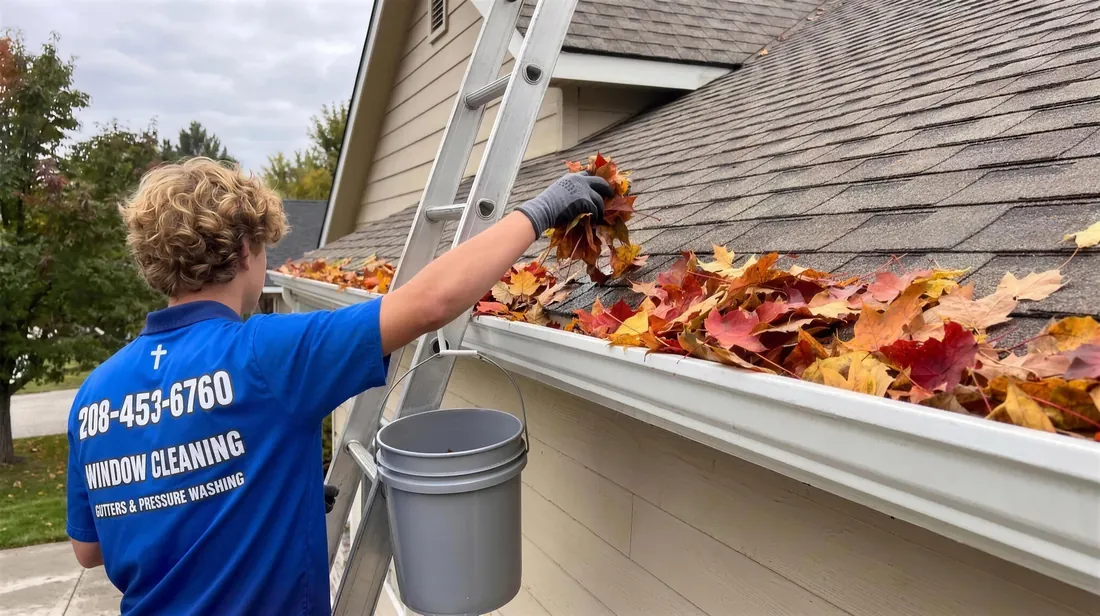
Young Trees, Full Gutters — Here's What's Actually in There
Homeowners in Valor and Trilogy call us saying they doubt they need it, because they can see the whole front yard tree from the porch and it's four inches around. Fair. But we've pulled plenty out of gutters on this side of Kuna. On a house built since 2021, the biggest single contributor is the roof itself: architectural asphalt shingles shed loose granules heaviest in their first few years, and that grit washes straight into the gutter and settles. Add wind-blown silt off graded lots and the open farmland south and east of town, cottonwood fluff and elm seed drifting in from the canal banks, and you get a low, dense sludge that packs along the bottom of the trough. It sits flat instead of mounding, so you will not spot it from the driveway the way you'd spot a wad of maple leaves.
Low-Slope Porticos and Covered Patios Clog First
The plans through Valor and Trilogy at Valor lean on hip roofs at a moderate pitch, with a low-slope portico over the entry and a covered patio out back. Each of those adds a short, nearly flat secondary gutter run — and those short runs are almost always the first thing to fail. A long main run off a big roof plane moves enough water to partly flush itself. A six-foot portico gutter collects from a small area, moves water slowly, and never builds the velocity to push grit toward the outlet. Roof valleys make it worse where a valley dumps a concentrated stream onto a short run and drops its load right at the outlet. When we service one of these homes we clear the porch and patio runs by hand first, because that is usually where the real blockage is, not the main eave.
Downspouts and the Buried Drain Line Nobody Sees
Side yards on these lots are tight, so the downspouts get tucked into the narrow run between houses and the corners of the covered patio. Some homes here discharge onto a splash block; plenty of others tie into a buried drain line that runs under the side yard out to the curb or into a landscape drain. That buried line is the failure point we find most often in newer Kuna construction, because nothing about it is visible. Grit works down the downspout, settles in the horizontal buried section, and builds until water backs up the pipe and pushes out at the top of the elbow. From the ground it looks like a gutter problem. It is not. We flush every downspout at the end of the job specifically so we find that before you do — during a February thaw or a July thunderstorm.
When You Don't Need Us Yet — and When You Really Do
Straight answer: if your Valor home is two or three years old, has no mature tree overhanging the roof, and nothing has overflowed, once a year in late fall is usually plenty. Twice-yearly service earns its keep under mature trees, and there are very few of those here yet. Here is the useful test. Overflow along a long stretch of gutter during rain means the trough is loaded. Overflow at one corner only, with the rest of the run running clean, is almost never a gutter problem — that is a plugged downspout or a blocked buried drain line, and paying to clean 140 feet of gutter will not fix it. Also worth knowing: a light dusting of shingle granules in the bottom of a trough is normal on a young roof and does not need clearing. If we get up there and that's all we find, we'll tell you and you'll hear it from us before the invoice.
Pricing, Access, and Scheduling in Valor
Gutter cleaning starts at $199 for one- and two-story homes. Trilogy at Valor is a 55+ single-level community, so most of those homes have low fascia and straightforward ladder access — no steep two-story reach, and we don't need to walk your roof. The broader Valor build includes two-story plans, and those price the same. We hand-clear the troughs, bag the debris and haul it off rather than blowing it into your beds, flush the downspouts, and confirm every outlet drains. Gutters use standard soft-wash and flushing methods — the pure deionized water is for glass. Next-Day slots open up regularly in Kuna. Memberships run Monthly or Quarterly with no contract, and every job carries our 7-Day Rain Guarantee. Fully insured, locally owned, 4.9 stars across 125+ Google reviews. Call (208) 453-6760.
Ready for Gutter Cleaning in Valor (Trilogy at Valor)?
Free, no-obligation quote — we'll call or text you with your price.
Get My Free Quote