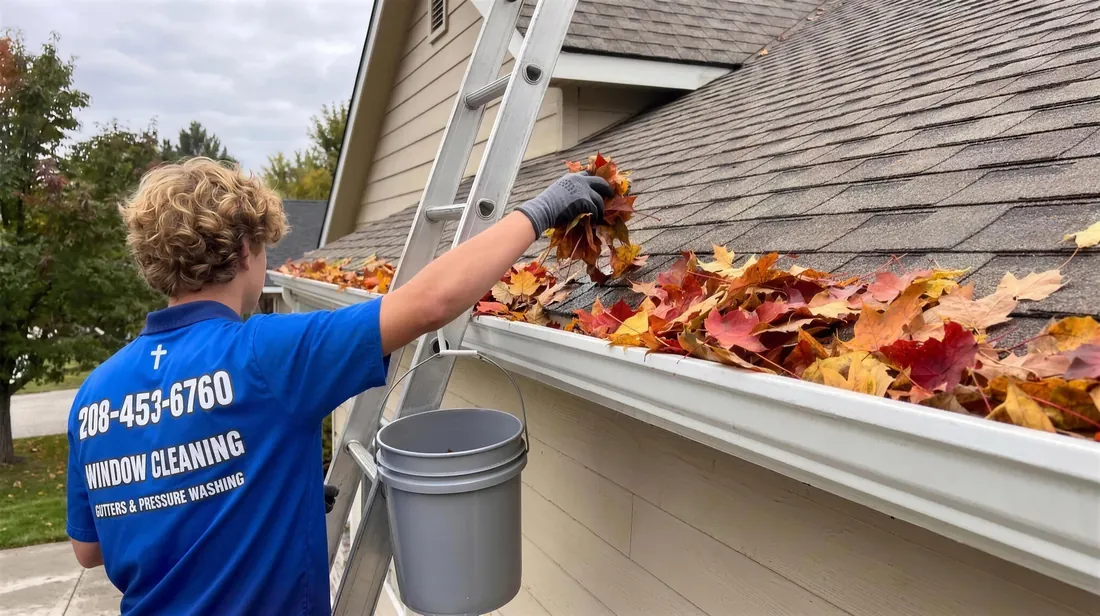
Young trees here mean a different kind of debris
In the older parts of Meridian we pull whole compacted leaf mats out of troughs under mature silver maples and cottonwoods. Around The Village, the landscape went in with the development, so the trees are ornamental and street-tree sized and their canopies mostly sit below or beside the roofline rather than over it. That fools people. Homeowners look up, see no branches hanging over the gutter, and assume there is nothing in there. What we actually scoop is fine material: blossom drop and seed casings in spring, catkins and cottonwood fluff blown in from the drainages, and dust. Fine debris does not bridge across the trough the way leaves do. It travels with the water to the low end and packs solid at the downspout outlet, which is the one spot you cannot see from the ground.
Shingle grit plus Eagle Road dust makes sludge, not leaves
Two things are specific to this pocket. First, these roofs are asphalt shingle at a moderate pitch, and shingles shed mineral granules for their whole life, heaviest in the first few years and again once they start aging out. Those granules end up in the gutter. Second, you are a few hundred yards off Eagle Road, State Highway 55, and the fine grey grit that traffic throws does not stop at the storefronts. It lands on roofs too. Mix granules and road dust with a summer thunderstorm and you get a dense wet sludge in the bottom of the trough, closer to wet sand than yard debris. It will not blow out with a leaf blower and it does not float out with a hose. It has to be scooped by hand and then the downspout flushed to move what is left.
Downspouts here are the hard part, not the gutters
Lot lines in the newer blocks around the center are tight, so a lot of downspouts drop into a side yard three or four feet wide, sometimes with an AC condenser, a hose reel or a gate crowded in next to them. Several of these homes run the downspout into a buried drain line or a pop-up emitter out toward the lawn instead of a splash block, and that buried section is where clogs actually live. A trough we cleared can still overflow if the underground line is packed. We test every downspout with water before we leave, and if a leg will not take flow we tell you where it stops rather than closing the ticket. Front-entry porticos and garage returns on the two-story plans also have short isolated gutter runs with their own outlet, and those get missed constantly.
When your gutters do not need cleaning yet
Not every house needs this twice a year, and we would rather tell you that than sell you a visit. If you can look up during a steady rain and see water running the full length of the trough and firing hard out of the downspout, not sheeting over the front lip, your gutters are moving water and can usually wait. Same if you pull a ladder to the outlet and find loose grit you can stir with a finger instead of a packed plug. The real tells for this neighborhood are a stripe of dirt splashed up the siding under one gutter section, a downspout that trickles when the roof is clearly dumping, or grit and granule fans on the driveway below an outlet. Also worth knowing: a gutter that only overflows at a roof valley in a hard downpour is often a capacity problem, not a debris problem, and cleaning it will not fix that.
What it costs and how we schedule it
Gutter cleaning starts at $199 for one and two-story homes here, priced on roof footprint and how much gutter run you actually have, since the hip roofs on these plans carry more linear feet than the square footage suggests. We hand-scoop the troughs, bag the debris rather than dumping it in your beds, flush and test each downspout, and wipe the drip splatter off the fascia. Monthly and Quarterly memberships are available with no contract if you want it handled on a schedule instead of remembering it, and we hold next-day slots for a downspout that quit mid-storm. Reflekt is fully insured and locally owned, started in 2025 by Hunter Stevens and Ethan Seusy, with a 4.9-star rating across 125+ Google reviews. Call (208) 453-6760.
Ready for Gutter Cleaning in The Village at Meridian?
Free, no-obligation quote — we'll call or text you with your price.
Get My Free Quote