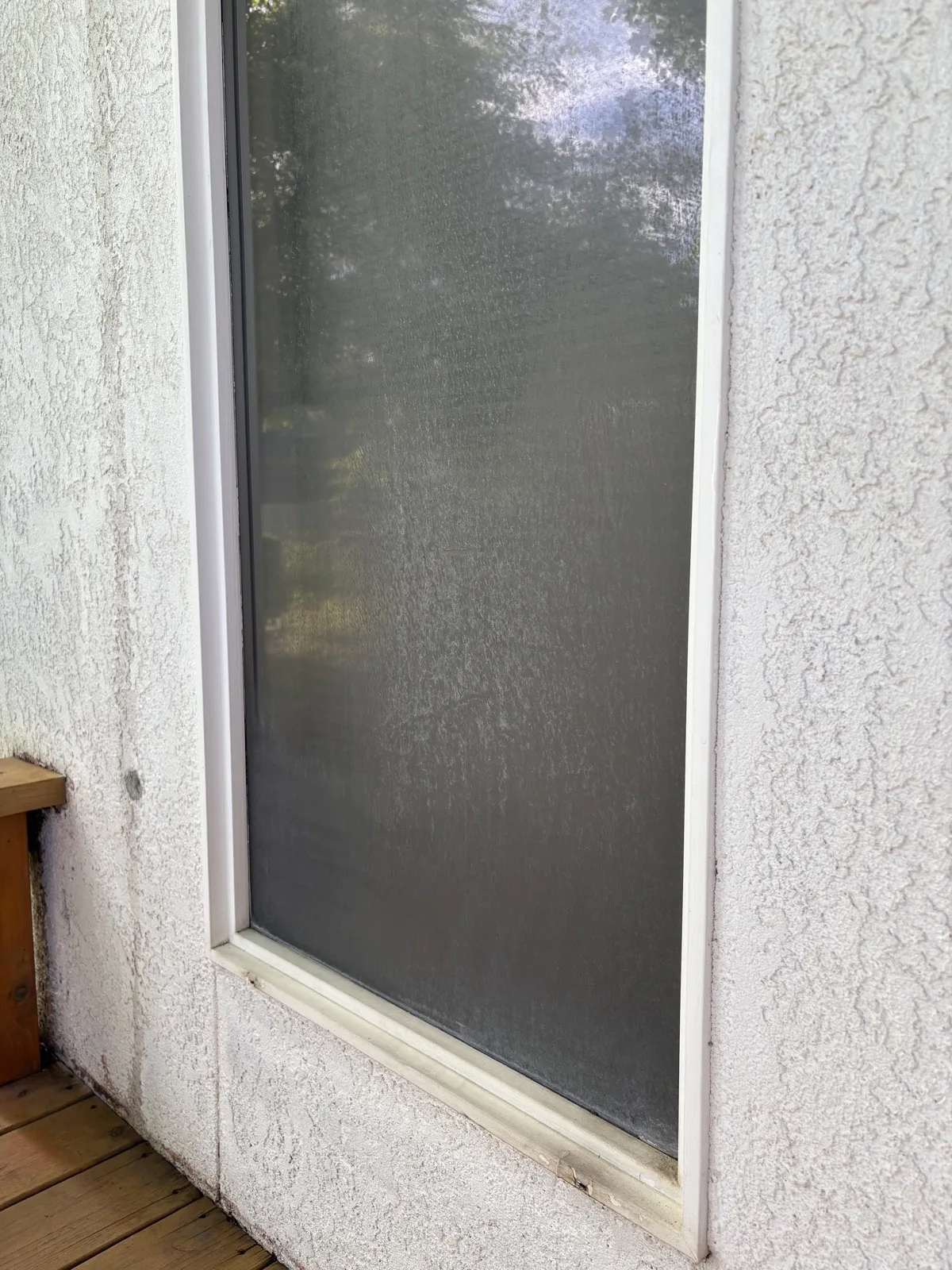
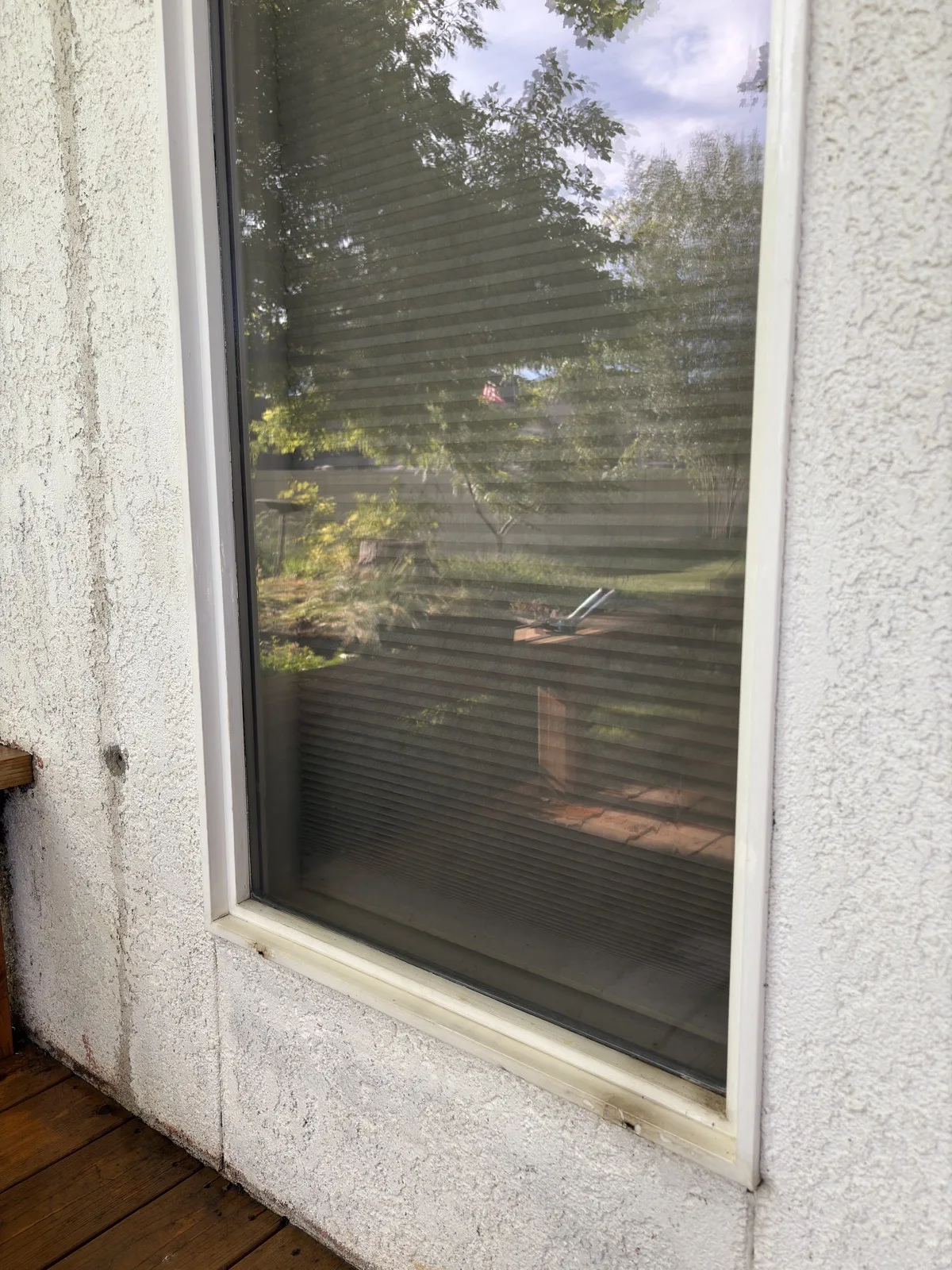
Who owns the sprinkler head is the whole problem here
Most hard water damage traces back to one head that got bumped, or never got aimed right when the system went in. In a subdivision, the homeowner mowing around it notices inside a season. Silverstone doesn't work that way. The lawn strips along Silverstone Way, the islands in the parking fields, the beds at the building entries — that's common landscaping on a controller nobody in the suites has access to. A tenant sees hazy glass and assumes it's road dirt off I-84. The property manager sees a clean irrigation invoice. Nobody connects the two, so the same head hits the same lite for four or five seasons. By the time somebody calls us it isn't a spot problem anymore, it's a band running the length of an elevation.
Pressurized irrigation water is not what comes out of your tap
Most of Meridian waters off pressurized irrigation — untreated surface water out of the district canal system, not the culinary line. It carries dissolved calcium and magnesium plus fine silt from the ditch. It's cheap, it's fine for grass, and it is considerably harder on glass than city water. A spot from a garden hose is a nuisance you wipe off. A season of pressurized-irrigation mist is minerals plus grit baking onto a pane in July, each cycle leaving a little more than the last. That's why two buildings a mile apart can be in completely different shape: one watering off a domestic line has spotting, and the one on the district system has etching. The pattern on the glass usually tells us which you've got before we ask.
Which glass takes it, and which is fine
The tell is height. Irrigation damage sits in a band from the sill up three or four feet, because that's where a rotor or spray head throws. Anything above the first story is clean, and if the upper lites look as bad as the lower ones, we're dealing with road film off Eagle Road, not sprinklers, and it's a different job. Ground-floor storefront within about twenty feet of a lawn strip is where we find the worst of it. Prevailing wind runs northwest to southeast here, so on a breezy night the drift reaches glass the head doesn't physically touch — the west and northwest faces along Silverstone Way and Cobalt Point Way take more than the numbers suggest. South-facing lites along Overland bake the deposit on fastest; heat dries the mist before it can run off.
The wet test: what comes off and what doesn't
Before you pay anyone, do this. Wet the hazy area with plain water and look at it while it's wet. If the cloudiness disappears and comes back as it dries, that's surface scale sitting on top of the glass, and it lifts with a mineral treatment and a pure water rinse. If it stays cloudy while wet, the mineral has eaten into the glass itself. No cleaner on earth touches that. Etched glass takes a cerium oxide polish, done slowly by hand, and on a large lite it doesn't always come back to uniform. On tempered, tinted or low-e coated glass we won't polish at all — polishing distorts tempered panes and destroys a factory coating. If a lite is past saving, the honest answer is replacement, and we'll tell you that instead of billing for restoration that won't show.
Cost, and keeping it from coming back
Restoration is quoted by severity after we look at the glass, because a summer of light spotting and five years of baked-on scale are not the same labor. On a Monthly membership, hard water treatment is included in the visit — we deal with spotting as it shows up instead of letting it stack into a restoration job. Memberships are Monthly or Quarterly with no contract. Either way, we'll mark the head that's causing it and note the arc so you or your landscaper can turn it; we don't adjust irrigation we don't own. Skip that step and the band is back in six to eight weeks. Windows finish in 100% pure deionized water, no soap. 7-Day Rain Guarantee, next-day slots, fully insured and locally owned. 4.9 stars across 125+ Google reviews. Call (208) 453-6760.
Ready for Hard Water Stain Removal in Silverstone?
Free, no-obligation quote — we'll call or text you with your price.
Get My Free Quote