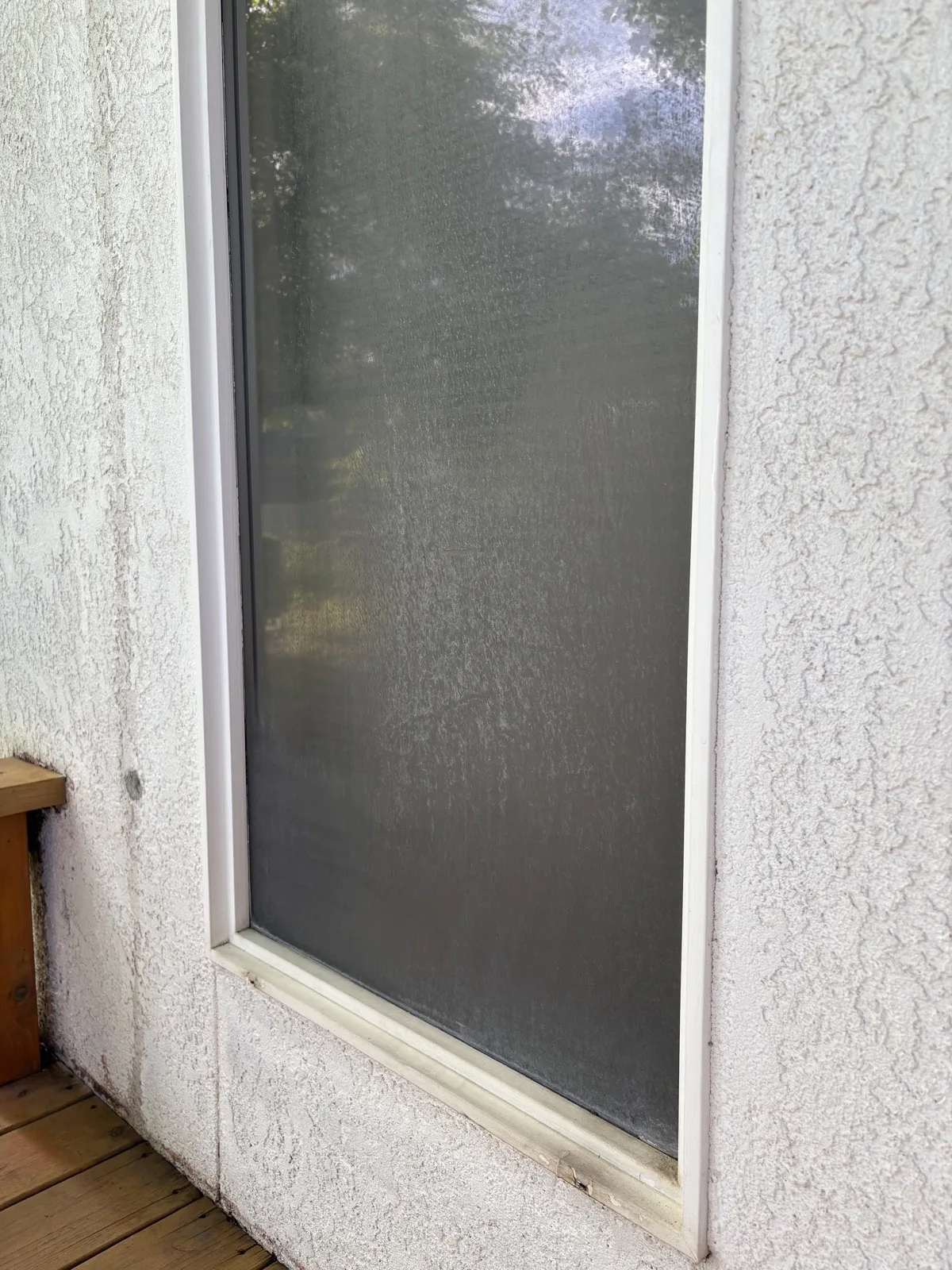
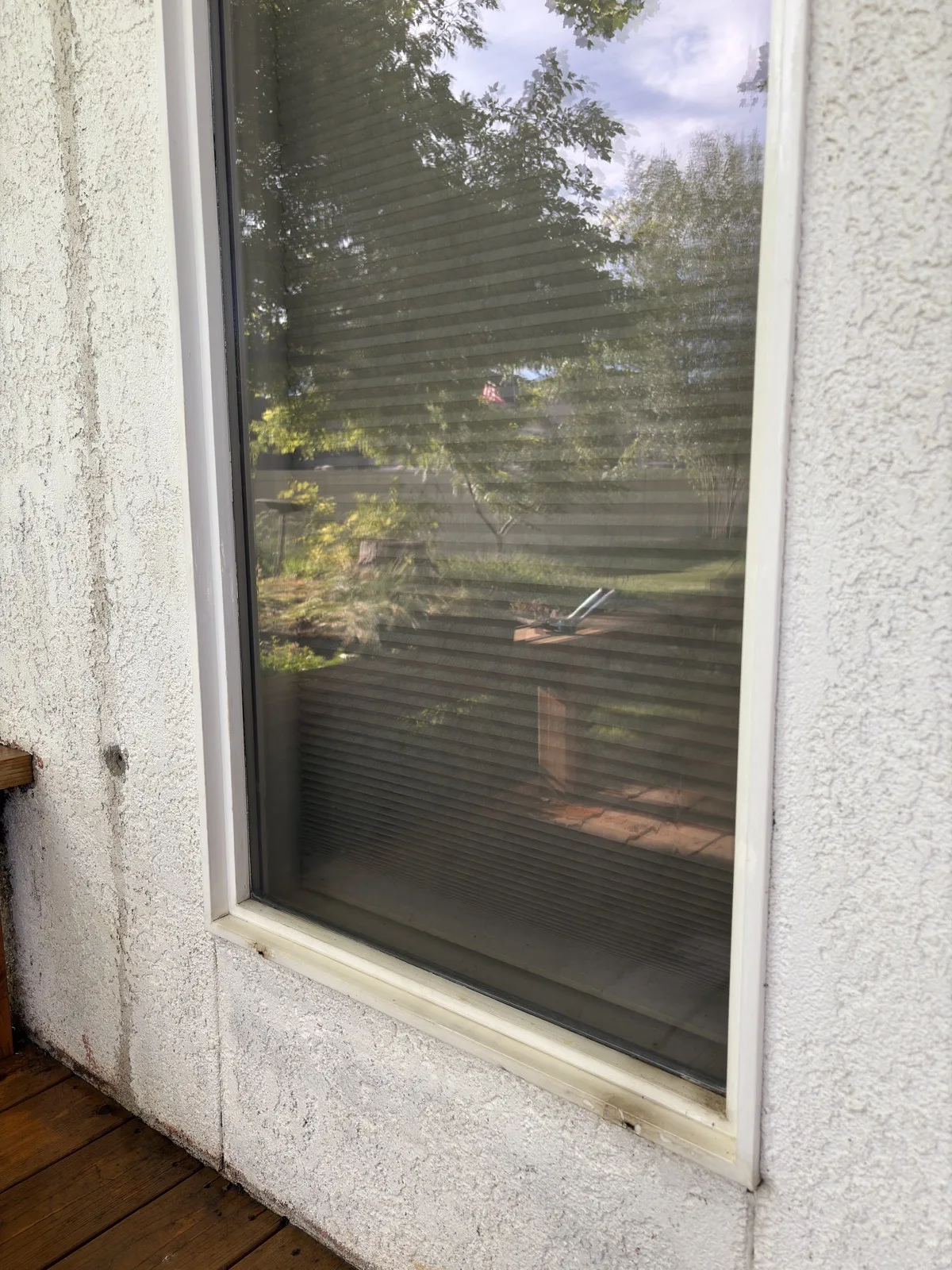
Twenty seasons of the same head hitting the same pane
A subdivision built last year has sprinkler heads that have run maybe two hundred cycles. A Sundance head has run somewhere north of four thousand — twenty seasons, April to mid-October, most of them on the same arc, wetting the same band of glass. Hard water damage is cumulative, and that is the whole story on this street. Each cycle lays down a thin mineral deposit, the sun bakes it hard, and the next cycle puts another layer over the top. After two decades you are not looking at spots sitting on the surface, you are looking at a deposit that has bonded into it. Same house plan, same water, different age of irrigation system, completely different job. That is why a Sundance quote and a quote out on the new west edge of Meridian are rarely close.
Which walls take the overspray on these lots
On compact CBH lots the heads sit close to the foundation, so what matters is which direction the spray drifts and how fast it dries. South and west elevations are the worst here. Those windows are hot by mid-afternoon, and if a zone runs late in the day or a head has drifted off its arc, water flashes off the glass in minutes and leaves everything it was carrying behind. East-facing glass on a 4 a.m. cycle stays wet longer and rinses cleaner. Then there is the common landscaping. If your lot fronts or backs an HOA-maintained strip — entry beds, pathway edges, the school-side frontage — those are larger rotors on a shared clock, not your controller, and they throw farther than a residential head. Homes on that boundary usually carry the heaviest etching in the neighborhood and have no way to adjust it themselves.
Three stages of damage, and how to tell which one you have
Run a fingernail across a spotted pane. Stage one, the deposit sits on top and your nail catches it — that comes off with the right mineral dissolver and a scrub, and the glass goes back to new. Stage two, the mineral has bitten into the surface; it cleans up most of the way, but the pane may hold a faint haze when you look at it from a low angle in direct sun. Stage three, the silica has leached out and the surface is pitted. That is not a stain anymore, that is missing glass, and no chemical brings it back. We can polish stage three for a real improvement, but polishing removes material and can leave slight optical distortion, so on a big picture window we will usually tell you a replacement pane is the better spend. Twenty-year-old south-facing Sundance glass is often stage two, sometimes stage three across the bottom eighteen inches.
Pressure does not touch it — here is what does
Hard water is a mineral bond, not dirt, so pressure does nothing to it. People take a 3000 PSI tip to a spotted slider and end up with the same stain plus a chewed-up vinyl frame and water driven behind the trim. It has to come off chemically. We work the affected panes with a mineral dissolver, let it dwell, agitate with a pad rated for glass, then neutralize and rinse the full elevation with 100% pure deionized water so nothing is left behind to re-spot. Frames, sill tracks, and the stone or brick wainscot get treated too — mineral builds up there first and bleeds back down onto clean glass the next time it rains. We always test a small patch at the bottom of one bad pane first, so you can see exactly what your glass will look like before you pay for the whole house.
Cost, and keeping it from coming back
Stain removal is quoted by severity, because two Sundance houses on the same street can be an hour apart in labor depending on where the heads point. Once it is off, keeping it off is sprinkler work as much as window work: pull the arc back off the house, replace a head that has drifted, or shorten a zone so the wall is not getting soaked at 4 p.m. We will walk you to the head that did it before we leave. Ongoing, hard water removal is included on the Monthly membership, so a house that etches fast never gets past stage one again. Monthly and Quarterly, no contract, 7-Day Rain Guarantee. Next-Day slots most weeks. Reflekt is locally owned and fully insured, started in 2025 by Hunter Stevens and Ethan Seusy, 4.9 stars across 125+ Google reviews. Call (208) 453-6760.
Ready for Hard Water Stain Removal in Sundance?
Free, no-obligation quote — we'll call or text you with your price.
Get My Free Quote