Know the siding before you pick the mix
The older blocks here went up in the 1920s through the 1940s, so the original skin is painted wood lap or cedar shingle, usually sitting on a brick or river-rock foundation skirt, with stucco showing up on porch piers and on a scattering of whole fronts. The 1950s infill ranches came with wide painted lap. Since then a lot of these houses picked up a vinyl or aluminum retrofit right over the original wood, and you can spot it by the J-channel running up the corners. Rentals and flips added hardie in the last twenty years. That mix is the whole job. Vinyl takes a stronger soft-wash solution and rinses clean in one pass. Chalking painted wood takes a weaker mix and twice the rinse. Stucco grabs solution down in the texture and has to be flooded off, not misted off, or it dries streaky and you see every wand stroke from the sidewalk.
The line four feet up the wall is your water, not dirt
Plenty of yards in South Boise Village still hold ditch rights and get flood-irrigated on a rotation, and almost everybody else runs sprinklers off Boise tap that carries 10 to 13 grains of hardness. Both leave a band on the bottom three or four feet of siding: gritty tan silt where irrigation splashes off a wet yard onto the wall, and a chalky white mineral crust dried on top of it. If your water has iron in it, add an orange fan-shaped stain spreading out from wherever a head throws at the house. Silt and fresh mineral wash off in the normal soft wash. Set-in iron staining does not, and no amount of pressure moves it, because it is a chemical stain sitting in the paint or stucco rather than dirt sitting on it. That one needs a dedicated rust treatment quoted separately, and we would rather tell you that at the estimate than at the invoice.
North walls go green, south and west walls go chalky
These are narrow old lots with houses twelve to fifteen feet apart and street trees that are now well past the rooflines. A north or east wall in that shade barely dries between spring rains and irrigation sets, and it grows a green-black algae film that starts in the lap shadows and works outward. That is organic, it comes off with a soft wash, and pressure alone will not kill it, so it grows back in months. The south and west walls have the opposite problem. Decades of Idaho sun oxidize the paint until the surface chalks, and you get a dull, streaky wall that leaves white powder on your hand. Washing takes the loose chalk off and evens the color, and it is the correct prep before a repaint, but it will not restore paint that has already given up its binder. If the chalk is heavy, washing buys you a better-looking summer, not a new paint job.
Soft wash on pre-1978 paint, and when to leave it alone
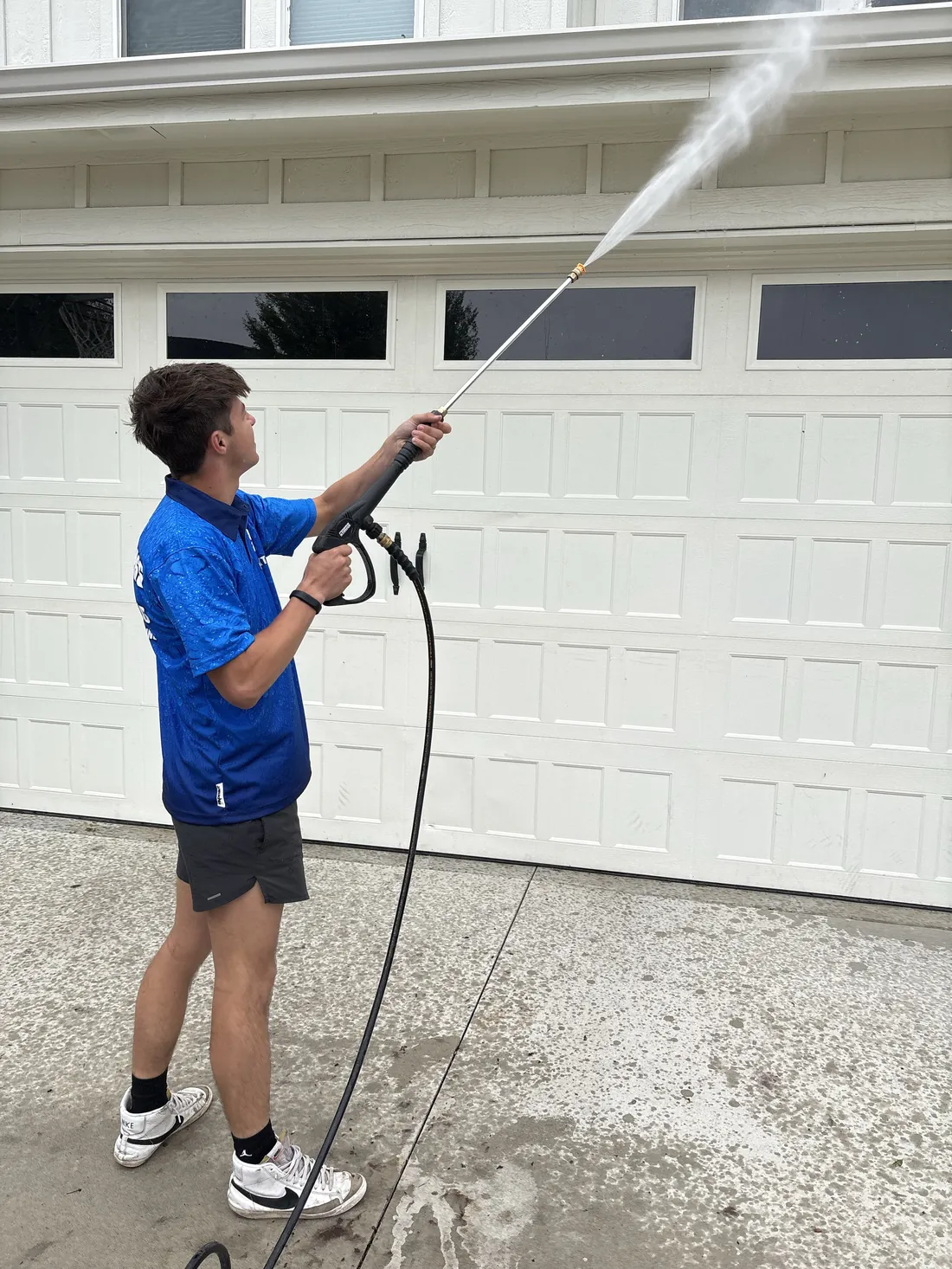
Everything on these blocks older than 1978 is likely carrying lead paint somewhere in the stack, and old painted lap that is already cupped and checked does not need a pressure wand driving water up under the boards. We soft wash: low pressure, cleaning solution doing the work, controlled rinse, and we keep the flood off soffit vents, window putty lines and any spot where siding meets an unsealed trim joint. Honest note that costs us jobs: if your walls are only dusty, skip it. Dust rinses off with a garden hose and the wash is wasted money. What actually justifies a house wash here is green growth on the shaded side, the irrigation band along the bottom, aphid honeydew off the maples, or prep before paint. If you send photos, we will tell you which of those you have and whether it can wait a season.
What house washing costs in South Boise Village
House washing is $0.18 per square foot on a soft-wash setting that is safe for painted wood, cedar, stucco, hardie, vinyl and aluminum. Rust and heavy mineral treatment on siding is quoted separately after we see it, because it is a different chemical and a different amount of labor. Pressure washing for driveways, walks and alley aprons runs $0.20 per square foot. Gutters start at $199, hand-scooped rather than blown into the beds. Window cleaning starts at $199 and is priced by pane count. Memberships come Monthly or Quarterly with no contract, Quarterly saves $100 per cleaning, and every job carries our 7-Day Rain Guarantee. Next-Day slots are usually open, Monday through Saturday, 7am to 7pm. Reflekt is locally owned, started in 2025 by Hunter Stevens and Ethan Seusy, fully insured, 4.9 stars across 125+ Google reviews. Call (208) 453-6760.
Ready for House Washing in South Boise Village?
Free, no-obligation quote — we'll call or text you with your price.
Get My Free Quote