Four different sidings in one neighborhood, and none of them wash the same
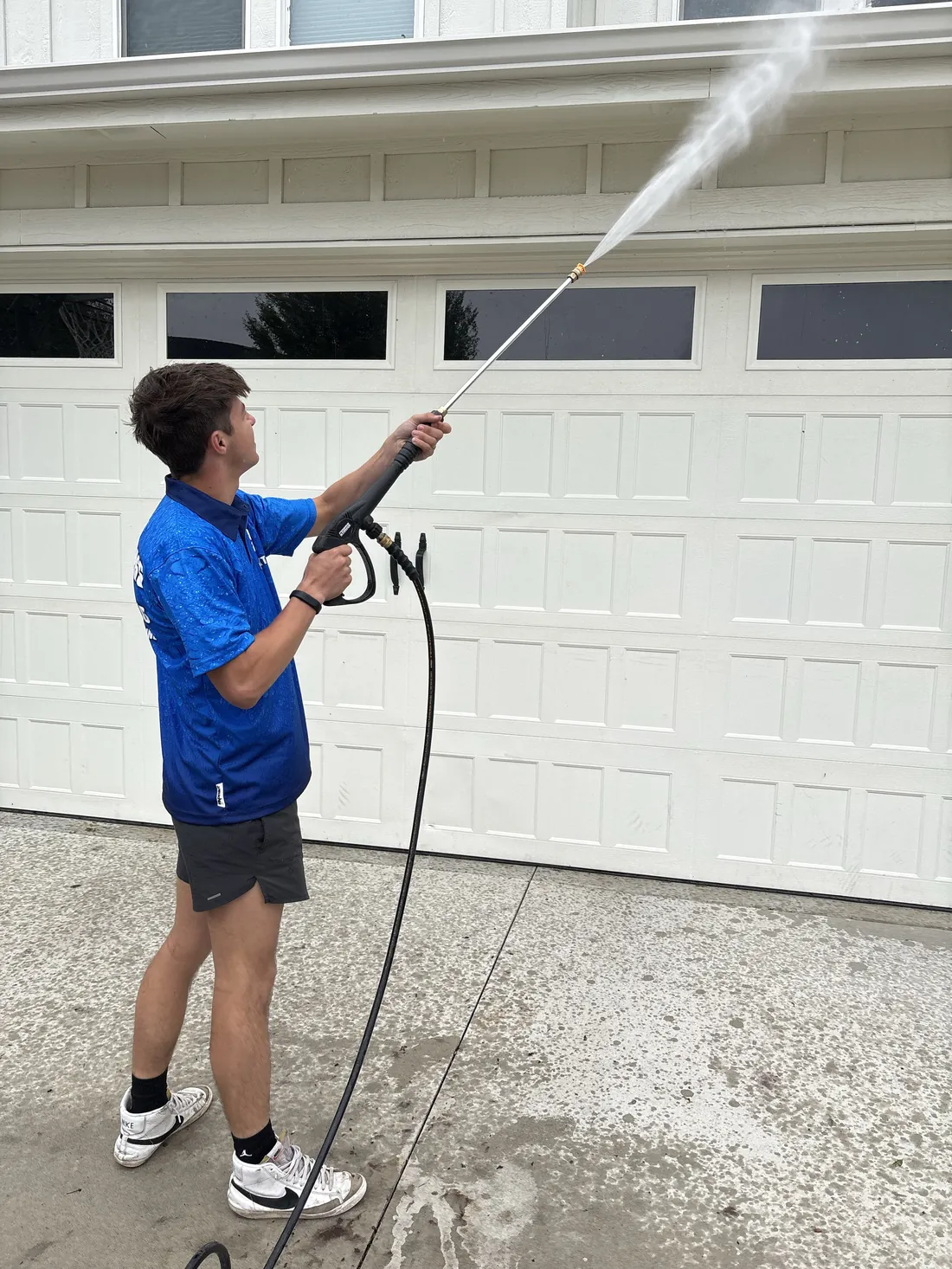
Because The Plantation built out over roughly twenty years, one street can have a 1974 cedar lap house next to a 1996 stucco one. The older course-side homes are mostly cedar lap or T1-11 with a brick wainscot; the later builds lean stucco; and a good number of homes have had failing cedar swapped for fiber cement in the last fifteen years. Each takes a different setting. Cedar and T1-11 get the lowest pressure we run and a short dwell, so we are not pushing water into open lap seams or lifting an old semi-transparent stain. Stucco gets rinsed top down on a wide fan, because that texture grabs cleaner and is slow to let go of it. Brick handles more, but 1970s mortar joints do not. Price does not change with material: $0.18 per square foot, soft-wash, every time.
The sprinkler band along the bottom three feet
This is the single most common thing we get called about in The Plantation. Heads on big lots throw farther than heads on a starter-home yard, and on course-facing walls you also catch drift off fairway irrigation. Garden City ditch water and hard tap both carry iron and calcium, so what lands low on the wall dries into a rust-orange or chalky white band roughly eighteen to thirty-six inches up, usually worst on the corner nearest a head. Here is the honest part: that band is not dirt. It is mineral and iron bonded into the surface, and pressure will not remove it. It takes a dedicated rust or mineral treatment, and on textured stucco even that usually gets it to faint rather than gone. We will tell you which one you have before we quote it, not after.
North walls grow algae, south walls chalk
The mature cottonwood canopy that makes this neighborhood is also why the north and northeast walls stay damp into the afternoon. Under that shade you get the green-black film that people assume is dirt. It is living growth, and scrubbing it off without killing it means it is back in a season. We soft-wash with a cleaning solution that kills the organism rather than just knocking the color off the surface, which is the difference between a wall that stays clean two years and one that greens up by next spring. The south and west walls have the opposite problem. Decades of Treasure Valley sun break down the paint binder and leave a chalky powder that comes off on your hand. Washing removes the loose chalk and evens the color out. It does not restore faded paint, and no wash will.
Old siding, old caulk, and where water actually gets in
Most failures we see on 1970s and 80s houses are not the siding, they are the transitions: dried caulk at window returns, gaps where cedar meets brick, and open butt joints on T1-11 where the batten pulled loose. High pressure aimed at any of those puts water inside the wall, and on a house with original aluminum window frames it will run straight down the inside of the frame. So we wash downward, keep the wand off seams, and hand-detail around window heads rather than blasting them. If we find a joint that is already open or a soffit that is soft, we stop and show you rather than washing over it. On a lot of these homes the wash is also the first time anyone has looked closely at the trim in years.
Pricing, timing, and booking on the Garden City side
House washing runs $0.18 per square foot on a soft-wash setting that is safe for cedar, T1-11, stucco, brick and fiber cement. The best window in The Plantation is late June into July, after the cottonwood cotton has finished and stopped sticking to damp walls, though spring works fine if you want it clean for the season. Memberships are Monthly or Quarterly with no contract, and our 7-Day Rain Guarantee covers the window work if weather spots it within a week. We run Monday through Saturday, closed Sunday, and next-day slots come up often on this side of town. Reflekt is Hunter Stevens and Ethan Seusy, founded 2025, fully insured and locally owned, 4.9 stars across 125+ Google reviews. Call (208) 453-6760 and tell us what your siding is so we bring the right mix.
Ready for House Washing in The Plantation?
Free, no-obligation quote — we'll call or text you with your price.
Get My Free Quote