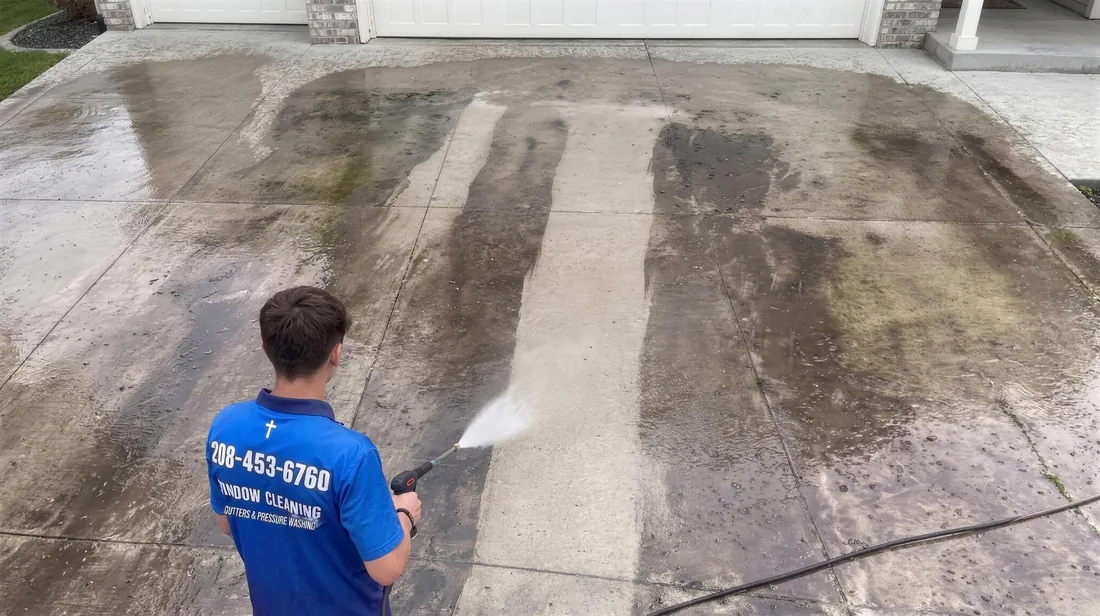
Forty-year-old concrete does not wash like new concrete
Most Plantation flatwork is original to the house, poured somewhere between the mid-1970s and the 90s: broom-finished gray driveways on the street side, and a lot of exposed aggregate on the walkways and pond-side patios, which was the finish of choice when this neighborhood was going up. Concrete that old has lost its surface paste. The cement skin that made it smooth has worn and carbonated away, so the sand and rock are closer to the surface than the day it was poured. Run a zero-degree tip or a turbo nozzle across that and you will cut visible wand lines and start knocking pea gravel loose. We wash it with a surface cleaner at moderate pressure and let detergent and dwell time do the work instead of PSI. It comes back clean and uniform. It does not come back looking new, and anybody telling you otherwise on concrete this age has not washed much of it.
Cottonwood tannin and the shade line across the patio
The mature cottonwoods planted when the country club went in are the single biggest reason Plantation concrete looks dirty. Cotton mats in June and holds moisture against the slab. Leaves and seed pods sit through fall and leach tannin, which is the reddish-brown blotching that shows up under the drip line and stays after the leaves are raked. And the part of your patio that lives in canopy shade all day is usually not dirty at all. That gray-green or black film is algae and mildew growing on a surface that never fully dries, and it comes off with a soft-wash detergent step, not with a bigger machine. If someone has been hitting the shaded strip with straight pressure every spring and it keeps coming back within weeks, that is why. Kill it, then rinse it.
Irrigation iron: the stain that pressure alone will not remove
This is the honest one. Garden City runs on ditch irrigation, and a lot of Plantation lots are on pressurized irrigation or a shallow well with real iron content. Sprinkler heads throwing across a driveway or walkway leave orange fan-shaped stains that follow the arc of the head. That is oxidized iron bonded into the top of the concrete, and no amount of pressure gets it out. We treat it separately with an oxalic acid rust remover before the wash, which typically lifts most of it. Stains that have been rebuilding every summer for fifteen years usually lighten several shades rather than disappearing. We will tell you which one you have before we quote it, not after. The permanent fix is a head adjustment or a deflector so the arc stops hitting the concrete in the first place.
Root heave, joints, and washing near the pond bank
Big cottonwoods and forty years do things to flatwork. Lifted slab edges at driveway joints, cracked walkway panels along a root run, and paver patios on the water side with washed-out joint sand are all common here. We wash across a heaved joint rather than parking the wand on it, and we do not blast open cracks or chase weeds out of an expansion joint with a pencil tip, because that widens the gap and gives water a path under the slab. On paver work we keep the surface cleaner moving and expect that some polymeric sand will need topping up afterward. On pond-side patios we sweep debris away from the bank first, direct the rinse back toward the house rather than downhill into the water, and stick to detergents at label dilution. Side-yard gates and pool fencing are common on these lots. Give us the gate code when you book.
Pricing, timing, and booking a Plantation wash
Pressure washing is $0.20 per square foot on driveways, patios, and walkways. A typical Plantation driveway plus a front walk lands in a predictable range once we have the dimensions, and the pond-side patio is usually quoted with it since we are already set up. Rust treatment is called out separately when a slab needs it. On timing: the best window here is late June or early July, after the cottonwood cotton has finished dropping. Wash in mid-May and you will be looking at cotton mats across clean concrete two weeks later. Memberships run Monthly or Quarterly with no contract. We work Monday through Saturday, 7am to 7pm, and next-day slots come open on the Garden City side of the schedule. Reflekt is Hunter Stevens and Ethan Seusy, founded in 2025, fully insured and locally owned, 4.9 stars across 125+ Google reviews. Call (208) 453-6760.
Ready for Pressure Washing in The Plantation?
Free, no-obligation quote — we'll call or text you with your price.
Get My Free Quote