What actually stains the concrete out here
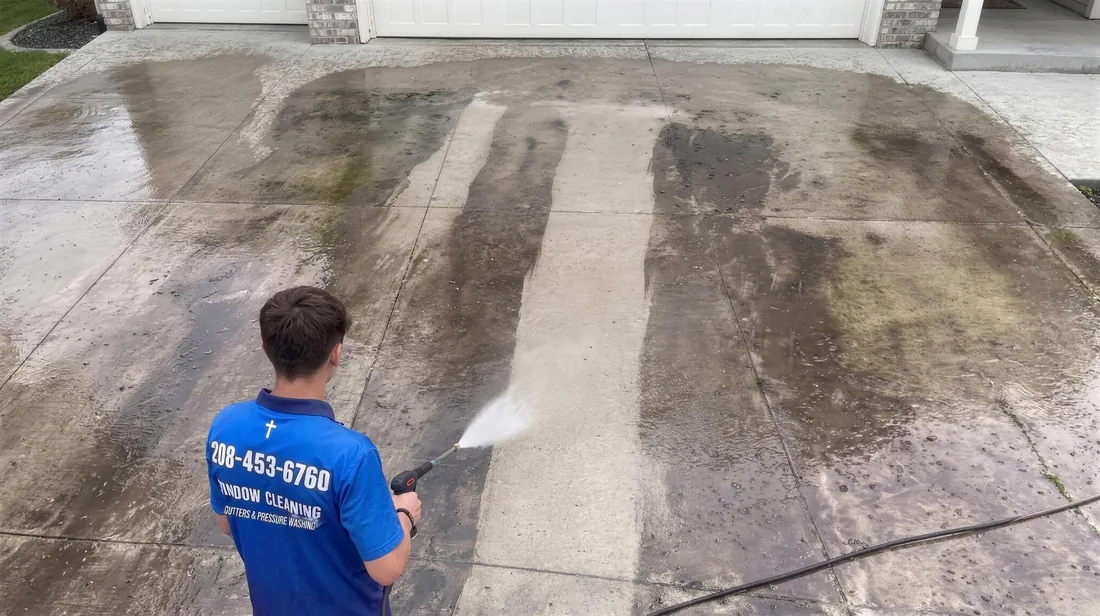
Sutherland Farm runs on pressurized irrigation off the Nampa & Meridian district — untreated canal water, hard and carrying silt. On lots this compact the heads sit only a few feet off the driveway and the front walk, so from April through mid-October that water lands on concrete and dries there. You end up with two different problems on the same slab. One is a chalky tan mineral haze across the whole surface, which is what makes a twenty-year-old drive read gray-brown even after a rain. The other is fan-shaped orange staining where a head throws iron-bearing water across the edge of the drive, always in the same arc. The haze comes off with a surface-clean. The orange is rust and it does not, which is worth knowing before you rent a machine for a Saturday.
Stains that pressure alone will not remove
Three things on Sutherland Farm driveways do not respond to water pressure, no matter how much of it you have. Irrigation rust needs an acid-based rust treatment applied and then neutralized so it doesn't keep eating the concrete; even done right, a stain that has sat for fifteen summers can leave a ghost. Old motor oil that soaked in years ago needs a degreaser with dwell time and sometimes a second pass, and on porous aged concrete it usually lightens rather than disappears. And hot-tire marks on a sealed drive are the sealer itself lifting, not dirt on top of it. We will tell you which category your stain falls in before we quote it, because the honest answer on a few of them is that a cleaning gets you eighty percent and a resurface gets you the rest.
Twenty-year-old broom finish takes a lighter hand
Concrete poured in the mid-2000s here is standard broom finish, and after two decades of freeze-thaw and winter ice melt near the garage apron, the cream layer on top is worn thin. That changes how you clean it. We run a rotary surface cleaner at controlled pressure, which pulls dirt evenly and leaves no stripes, instead of walking a zero-degree tip across the slab — that method leaves permanent zebra lines on aged concrete and can blow out the weak spots. Where an apron is already spalling or going popcorn-textured, we drop pressure further and clean it chemically, because full pressure on failing concrete takes material off. If we see that on your drive we point it out rather than quietly making it worse.
Shade, mature trees, and the side-yard walks
The trees in Sutherland Farm have had twenty years to fill in, and on 5,000-to-9,000-square-foot lots they now sit right on top of the house. North elevations and the narrow side-yard walkways between homes barely see sun from November to March, so they hold moisture and grow a black-green algae film with moss packed into the control joints. That surface gets genuinely slick, and it is the most common trip hazard we get called about here. Blasting it off makes it look clean for a month. We apply a detergent, let it dwell long enough to kill the organic growth at the root, then rinse — it stays gone considerably longer. One caution: a dark streak in a patio corner is often gutter overflow from leaf-clogged gutters, and until the gutter is cleared that stain comes back every storm.
Patios, stamped concrete, and the common walks
A lot of the covered patios and rear slabs here got stamped or colored concrete with a sealer on top, and mid-2000s sealer is well past its life. If yours looks cloudy, white, or is peeling in sheets, pressure washing will take the failing sealer off in patches and hand you a blotchy patio. That job is a strip and reseal, not a wash, and we will say so instead of pressure washing it and calling it done. Flatwork is $0.20 per square foot — a typical driveway here runs 600 to 800 square feet, so $120 to $160, walkways and patios priced the same way. If you are in Sutherland Downs or The Village and your association maintains shared walks, we can bid the common concrete as one job; check your CC&Rs for where the HOA's responsibility stops and yours starts.
Ready for Pressure Washing in Sutherland Farm?
Free, no-obligation quote — we'll call or text you with your price.
Get My Free Quote