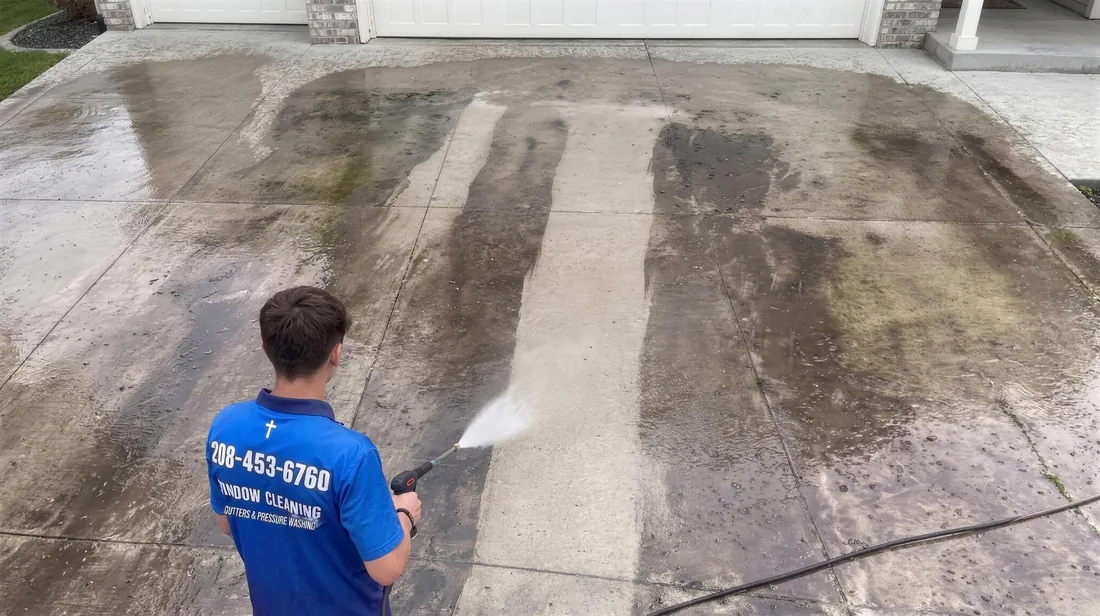
Twenty-year-old broom concrete holds a stain differently
The flatwork here is standard broom-finish concrete poured with the original build, and age changes how it cleans. The cement paste on the surface has weathered off over two decades, which opens the sand and leaves thousands of shallow grooves from the broom drag. Dirt, tannin and algae settle down in those grooves and sit below the level a garden hose ever reaches, which is why a Vienna Woods driveway can look dingy right after a rain. It also means the concrete drinks in whatever lands on it instead of letting it sit on top. Cleaning it is less about blasting and more about lifting what is down in the texture without tearing up the paste that is left. We wash driveways, patios and walkways at $0.20 a square foot.
The orange arcs are canal water, not dirt
Almost every yard in this part of Meridian runs on pressurized irrigation off the Nampa & Meridian district rather than city water, and that water comes out of the canal system carrying silt and dissolved iron. When a head throws onto the edge of the driveway or across a walkway, the water dries and the iron oxidizes, and you get those fan-shaped orange arcs that mirror the spray pattern exactly. Straight pressure will not take that out. Rust is a chemical stain bonded into the concrete, not a layer of grime sitting on it, so we treat it with an oxalic-based rust remover, let it dwell, then rinse. On lightly stained concrete it goes away. On concrete that has been getting sprayed for fifteen summers, expect it to lighten substantially rather than vanish, and expect it to come back unless the head gets adjusted or swapped for a lower-arc nozzle.
Tree canopy: tannin, black spot and slick north walkways
Vienna Woods has real trees, which is rare in Meridian, and they do things to concrete that the bare new subdivisions never deal with. Leaves that sit wet on a patio through winter leach tannin and leave tan or black leaf-shaped outlines that stay put long after the leaf is gone. Under heavy shade, walkways along the north side of the house and the run out to the back gate grow a black-green algae film that turns genuinely slick when it is wet or frosted. That is a fall hazard, not just an appearance issue. Both of those come off well: a surface cleaner pulls the tannin, and a low-pressure treatment kills the algae at the root so it stays gone longer than a plain rinse, which only knocks off the top layer.
Surface cleaner, not a wand — and why that matters on old concrete
The fastest way to wreck an aging driveway is a turbo nozzle waved by hand. On concrete this old the paste is already thin, and a spinning tip held too close cuts into it and leaves permanent wand marks — those wavy zebra stripes you see on driveways around the valley where somebody rented a machine for a Saturday. We run a rotary surface cleaner that holds a fixed distance and even pressure across the whole pass, so the driveway comes out one uniform color instead of striped. Stamped or colored patios and any pavers get lower pressure still, since the sealer on twenty-year-old decorative concrete is usually long gone and the color coat underneath is soft. Edges and steps get done by hand at a pressure that matches the field.
What it costs, and the right time of year to do it
Driveways, patios and walkways run $0.20 a square foot, so a typical two-car drive plus the front walk lands in the low hundreds and you will have a firm number before we show up. On timing, here is the honest version: if you wash in June, the irrigation runs until October and the rust arcs start rebuilding immediately. Either fix the spray pattern first, or schedule the wash for fall after the water is shut off and the leaves are down — that clean lasts through winter. House soft-washing runs $0.18 a square foot if the siding needs it in the same visit. No contract on our Monthly or Quarterly memberships, we keep next-day slots open, and Reflekt is fully insured and locally owned with 125+ Google reviews at 4.9 stars.
Ready for Pressure Washing in Vienna Woods?
Free, no-obligation quote — we'll call or text you with your price.
Get My Free Quote