What actually costs you output on a Boise Heights roof
The soiling up here is not the same stuff that settles on panels out in Kuna or Star. Out there it is farm dust off plowed ground. In Boise Heights it comes down the road: snowmelt and storm runoff pull decomposed granite off the Boise Front, traffic on these narrow streets atomizes it, and cold air draining out of Hulls Gulch and Crane Creek at night carries dry hillside dust downslope onto whatever is facing up. Infill construction on these lots adds concrete and sawdust fines for a season or two. Uniform light film is usually a single-digit output loss and honestly not worth a service call on its own. What costs you more is the hard crust that builds along the bottom rail of each panel, because that band shades whole cells and drags the string down with it.
Pollen, canopy litter and the birds that come with the trees
The mature canopy below in the North End and the older plantings on these hillside lots throw a heavy spring pollen load, and pollen is the one contaminant that does not rinse off in a rain shower. It goes sticky, catches the granite dust behind it, and turns into a film that a garden hose only smears. If you have cottonwood or pine within reach of the roof, you also get needle drop and sap in the array gaps, plus bird traffic anywhere a branch overhangs the panels. Droppings are the worst case because they are opaque, they bond hard in the sun, and a single spot sitting on one cell can pull down the whole string through the bypass diode. Those are the ones worth clearing when you see them, not at the end of the season.
Sprinkler overspray on a low-mounted array
Boise water is hard, and on these terraced side-hill yards it is common for a head to reach a garage-roof array or a low ground mount that nobody thought was in range. Every cycle wets the glass, the sun bakes it dry, and the minerals stay. Over a few seasons that becomes a white scale film that reads worse than dirt because it scatters light across the whole panel face instead of shading one spot. Deionized water and the right dwell will lift most of it. Honest limit: scale that has been cooking on for years can leave a faint permanent haze in the anti-reflective coating, and no amount of scrubbing brings that back — and scrubbing hard is how people damage that coating. The real fix is a nozzle change or a head moved four feet. We will point at the head that is doing it.
Roof pitch, orientation and access on these build eras
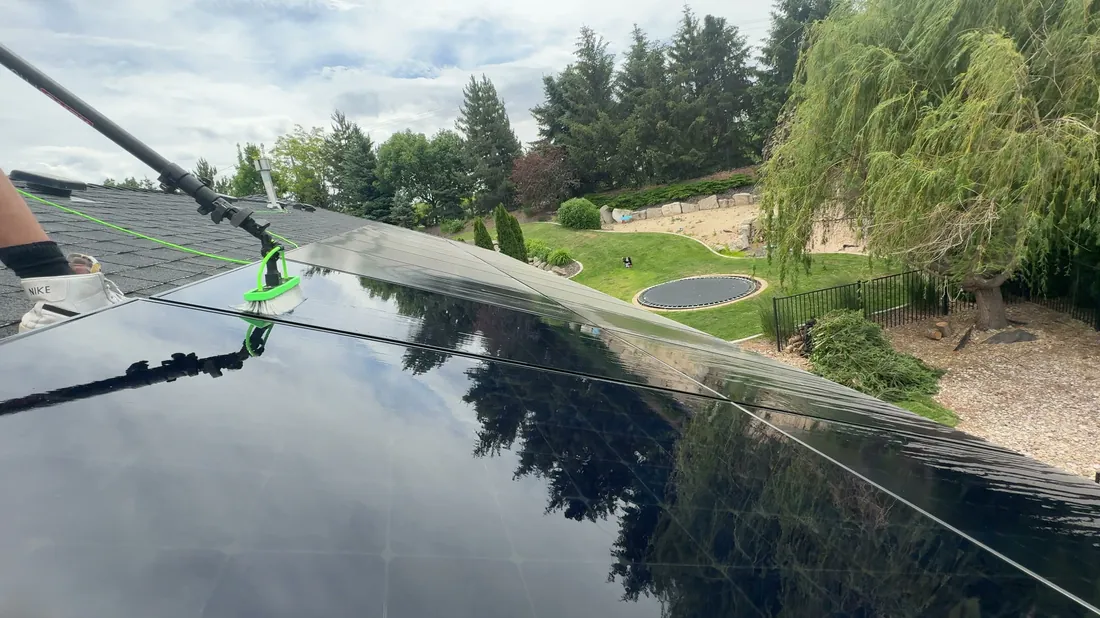
Two very different roofs carry solar in Boise Heights. The 1920s through 1950s hillside houses have steep composition-shingle gables, often with the array broken across two smaller planes to find south, which means more edges for crud to collect and a pitch steep enough that rain does a decent job of self-cleaning between visits. The newer infill builds run low-slope and standing-seam roofs with one big array, and anything under about ten degrees of tilt barely sheds at all — that is where dust bands and mineral film really accumulate. Access is its own problem here. Streets are narrow, driveways are short and steep, and what is a ground floor uphill is a second story on the downhill side. We reach what we can with a water-fed pole from stable ground and we say no to a roof we cannot stand on safely rather than improvising. Fully insured.
Read your monitoring before you book us
This is the part most companies skip. Pull up your panel-level or string data before calling anyone. If production is down evenly across every panel and it has drifted lower over months, that pattern fits soiling and cleaning will get most of it back. If one panel or one string dropped and the rest held, that is shading or hardware — a grown-in tree, a new neighbor's addition, a failed optimizer — and washing the glass changes nothing. If output fell off a cliff on a single date, call your installer, not us. Cleaning also does not touch normal panel degradation, which runs roughly half a percent a year and is permanent. And if a real rain came through in the last week and your array sits on a steep pitch, wait and watch the numbers before spending money. We would rather tell you that than sell you a wash you did not need.
Ready for Solar Panel Cleaning in Boise Heights?
Free, no-obligation quote — we'll call or text you with your price.
Get My Free Quote