Feedlot Dust Is What Costs You Output Here
South of Homedale Road you are closer to the dairies and beef feedlots than to row-crop ground, and the west wind carries that difference onto your panels. Feedlot dust is finer and more organic than plain field silt. It has manure fines and grease in it, so it does not sheet off in a rain the way seed-ground dust does. It bonds. That matters more on a panel than on a window, because a panel is a flat surface at a shallow angle pointed at the sky with nothing to help it shed. Through a dry August stretch, an array in Caldwell Origins picks up a heavier, stickier film than the same array would in a subdivision north of town near the seed fields. That is the honest reason a system out here needs washing more often than the installer's brochure interval suggests.
Moderate Pitch, Platted Orientation, and the Bottom-Edge Band
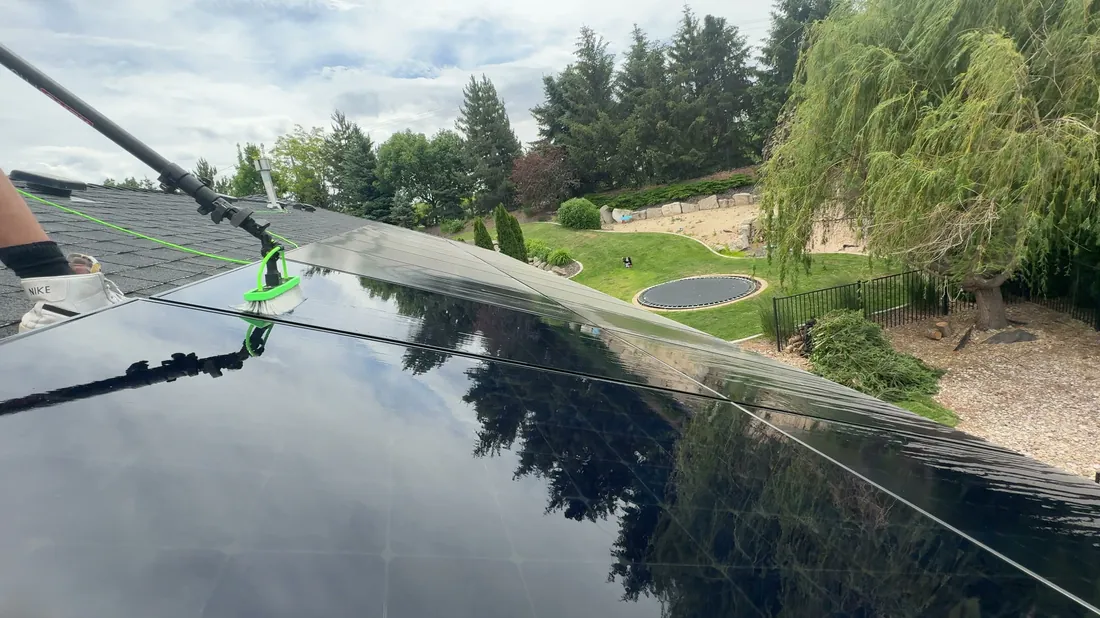
These are current-decade builder plans: architectural shingle on a moderate pitch, generally somewhere in the 4:12 to 6:12 range, with the main roof plane facing whichever direction the lot was platted rather than whichever direction the sun runs. Two things follow from that. First, a moderate pitch is walkable but it is still a roof with a fall off the edge of it, so we work from ladders and extension poles rather than tramping across your shingles and standing on panel frames. Second, a shallower pitch self-rinses less. Dust that would slide off a steep array in a hard rain instead sits on a 5:12 array, wicks down, and turns to mud along the bottom lip of each frame. That bottom-edge band is where we find the heaviest buildup on nearly every array in this neighborhood, and it is the part a garden hose never gets.
Sprinkler Overspray on Low-Mounted Arrays
New sod and starter beds mean sprinklers running hard through the first several summers, and Caldwell tap water comes out of the mineral-heavy Snake River Plain aquifer. If any part of your system is mounted low, a ground rack, a shop or shed roof, or a garage plane sitting close to the beds, that overspray is doing more to your production than the dust is. Hard water dries on hot glass and leaves calcium bonded to the surface. Unlike dust, it does not rinse off later. It has to be taken off. That is why we run 100% pure deionized water on panels with nothing added: no soap, no surfactant, nothing left behind for the next round of feedlot dust and sprinkler minerals to grab. Soap film on a panel just gives the next month of dust something to stick to.
What Cleaning Fixes and What It Does Not
Washing gets back the output you lost to soiling, and nothing else. Panels degrade on their own, a fraction of a percent a year is normal and spec'd by the manufacturer, and no washing reverses that. Cleaning does nothing for shade either. Landscaping in Caldwell Origins is still young, so shading is less of an issue here than in older parts of Caldwell, but the trees going in on these lots will reach the south roofline eventually, and one branch over one panel can drag a whole string down. Here is the diagnostic worth running before you call anybody: open your monitoring app and compare a clear day this month against a clear day from your first season. A slow slide across a dusty summer is soiling, and a wash fixes it. A step drop on one date, or one string low while the others read fine, is electrical or shading, and a wash will not touch it.
Timing, Pricing, and Getting on the Schedule
Most arrays out here do fine on twice a year: once after the spring pollen and field-work dust settles out, once at the end of the dry summer stretch before the winter fog cap moves in. Homes on the south edge of the neighborhood, closest to open feedlot ground, sometimes want a third. We quote per array rather than per panel, after we see the mount, the pitch, and how we are getting to it. Memberships are Monthly or Quarterly with no contract, and there is a 7-Day Rain Guarantee, though on a panel job that guarantee matters less than it does on windows, because rain landing on glass with no soap on it dries clean. Next-Day slots are usually open. Reflekt is locally owned and fully insured, founded in 2025 by Hunter Stevens and Ethan Seusy, 4.9 stars across 125+ Google reviews.
Ready for Solar Panel Cleaning in Caldwell Origins?
Free, no-obligation quote — we'll call or text you with your price.
Get My Free Quote