What actually cuts output on a Central Foothills array
Three things, in this order. First is decomposed granite dust off the Boise Front, carried down the gulches on nightly drainage wind. It's pale, sharp-edged and it bonds into a haze rather than sitting loose. Second is wildfire ash in August and September, which lands on anything facing open sky and turns greasy the first time it gets damp. Third is hard water spotting, covered below. Pollen is a smaller factor here than it is in the North End, because the street canopy up here is young or absent on most lots. The exception is the older, established properties toward Hill Road and Crane Creek, where grown-in trees drop a sticky spring layer that traps dust behind it. Soiling losses on a residential roof array are real but modest, usually single-digit percentages between rains, higher after a smoke week.
Roof pitch and orientation on this build era
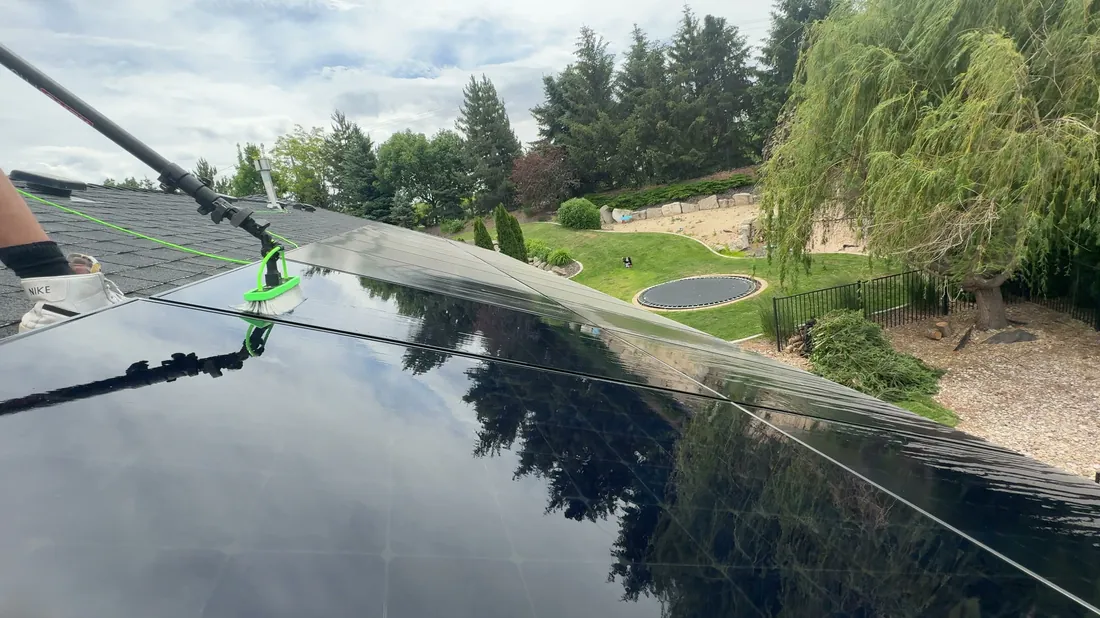
Most of what's gone up in Central Foothills in the last fifteen to twenty years follows the same pattern: fiber cement and stone, black-framed glass, and a roof plane deliberately angled south to carry panels. That's good for production and awkward for service. Pitches are steep, the lots are tiered, and the panel side frequently overlooks a drop rather than a flat yard. We work these from the ground with pole-fed pure water wherever the geometry allows, because walking an array is how modules get microcracked and how flashing gets stepped loose. If the array can't be reached safely from the ground or from a stable ladder set, we'll tell you that on the estimate instead of improvising on your roof. Steep-pitch north Boise lots are the main reason we quote per array rather than per panel.
Sprinkler overspray on low-mounted and ground arrays
Boise-area water runs hard, commonly 10 to 13 grains per gallon, and Central Foothills properties on pressurized landscape irrigation throw it all summer. If your array is low-mounted on a shed, a garage plane, or racked at ground level, one head aimed slightly high will bake a white mineral crust onto the bottom row by the next afternoon. That crust is not dust and it does not wash off with plain water. Plain water just moves minerals around and adds its own. We rinse with 100 percent deionized water, which carries no dissolved solids, so nothing is left behind to dry into a new spot. No soap either, because soap film is exactly what the next round of granite dust sticks to. Worth checking your sprinkler arc before we come out.
The honest limits of cleaning panels
Cleaning gets back output you lost to soiling. That's it. It does nothing for panel degradation, which runs roughly half a percent per year on its own and is permanent. It does nothing for shading, and shading is the one that catches Central Foothills owners off guard: trees planted when these houses were built are now tall enough to clip an array for part of the afternoon, and a shaded string loses far more than a dirty one. It won't fix a cracked module, a failed bypass diode, or an inverter fault. Here's the diagnostic. Open your monitoring app and compare strings. Soiling drops everything together and gradually. If one string fell off while the others held, or output dropped in one step on a clear day, that's a hardware or shading problem and washing the glass will not move it.
Pricing, scheduling and how we handle Central Foothills
Solar panel cleaning is quoted per array, since size, pitch, height and access vary more than panel count does. We'll want to know roughly how many modules, what plane they're on, and whether there's ground access on that side. Central Foothills sits inside our regular Boise route and we usually have next-day slots open. Monthly and Quarterly memberships are available with no contract, and most homes up here do better on Quarterly, timed so one visit lands after wildfire season clears. Every job carries our 7-Day Rain Guarantee. Reflekt is locally owned and fully insured, founded in 2025 by Hunter Stevens and Ethan Seusy, with 125+ Google reviews at 4.9 stars. Call (208) 453-6760 and we'll quote your array.
Ready for Solar Panel Cleaning in Central Foothills?
Free, no-obligation quote — we'll call or text you with your price.
Get My Free Quote