What actually costs you output out here
Century Farm still has open dirt in it. New phases keep breaking ground below Amity toward Lake Hazel, and there is working farm ground on the south and west edges that gets disked and harvested every year. Both throw a fine, pale silt. A window sheds that stuff; a panel does not. Modules sit tilted at 20 to 30 degrees, so they hold what runs off vertical glass, and the film builds up flat and even across the whole array. Add grass and cottonwood pollen through May and June and you get a dull sheen instead of a mirror. The loss it causes is gradual, it is even panel to panel, and in your monitoring app it looks like a slow sag in the daily peak through a dry July and August — not a sudden drop.
Sprinkler mineral on low-mounted arrays
Pressurized irrigation here is untreated canal water — silty and hard. On these compact lots the heads sit close to the house, and any array mounted low catches the overspray: panels on a single-story garage wing, patio-cover mounts, the occasional ground mount along a side yard. The bottom edge of those modules picks up a chalky tan-white crust that no rain shower will lift. It is worse than dust for a specific reason. Dust dims the whole cell evenly; a hard mineral band shades part of a cell with a hard edge, and partial shading on one cell drags down everything wired in series with it. If you can see a distinct line where the sprinkler reaches, that is mineral, not dirt, and it needs a scrub before the rinse rather than another pass with the hose.
The roofs these arrays sit on
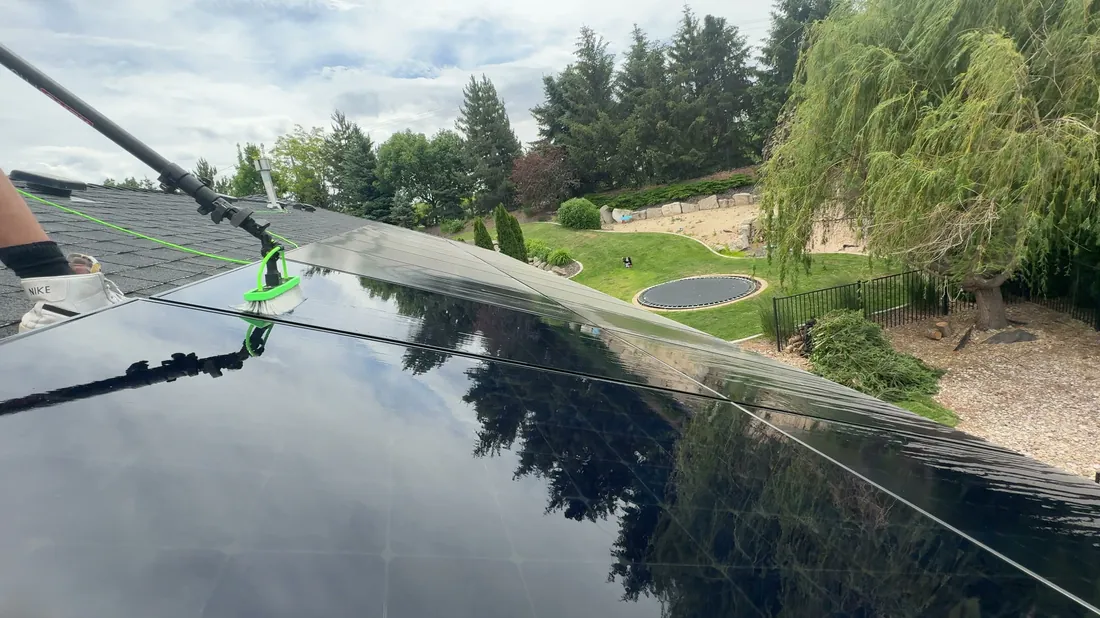
Everything in Century Farm is new enough that the roofs are architectural asphalt shingle on a moderate pitch, and nearly every array here landed on the south or west plane of the main house or the garage wing. That helps us. On most of these homes we can reach the modules with a water-fed pole from the ground or from a ladder set at the eave, without walking the array at all. We do not step on panels — a micro-crack you cannot see still costs you output for the life of the module. Some of the larger custom plans carry a tall two-story rear elevation, and reach gear handles those without a roof walk either. If your array sits on a steeper plane than the tract homes around you, mention it when you call so we bring the right setup.
What a cleaning will not fix
Before you book, open your monitoring app and look at the shape of the loss. Cleaning recovers output lost to soiling — a slow, even sag across the whole array through a dry stretch. It does nothing for three other things. Panel degradation is permanent; modules lose a fraction of a percent every year and no wash brings that back. Shading is geometry, not dirt. Century Farm's street trees are still young, but the maples going in along the parkstrips will eventually clip a low winter sun angle, and that is a trimming job. And a sudden overnight drop, or one string reading flat while the rest looks normal, is electrical — an inverter, an optimizer, or a tripped breaker. Call your installer for that one. If a soaking rain did not bring your numbers back up, dirt probably was not the problem.
How we clean them, and what it runs
We use 100% pure deionized water and no soap. Soap leaves a film, and a film on tilted glass in a subdivision with open dirt in it is a dust magnet — the array reloads faster than it did before you cleaned it. DI water dries with nothing left behind, so there is no residue and no spotting. No pressure washing, no abrasive pads, nothing harsh on the seals or the anti-reflective coating. Solar is quoted per array rather than per panel, because a straight 14-module run on a garage plane and a split array across two roof planes are not the same job. Reflekt is locally owned and fully insured, founded in 2025 by Hunter Stevens and Ethan Seusy, with 125+ Google reviews at 4.9 stars. Memberships are Monthly or Quarterly, no contract, 7-Day Rain Guarantee. Next-Day slots. Call (208) 453-6760.
Ready for Solar Panel Cleaning in Century Farm?
Free, no-obligation quote — we'll call or text you with your price.
Get My Free Quote