What actually loads screens out here
Screens in Century Farm don't load with what people expect. The Boise River cottonwood corridor is several miles north, so we pull far less cotton off these screens than we do off a Garden City or Barber Valley address. What we do pull is mineral: fine pale silt off graded lots and open phases, plus dust drifting up from the farm ground still being worked south toward Lake Hazel. It is heavier and sharper than pollen, and it packs down into the weave instead of sitting on top of it. Post-frontal northwest wind drives it onto the west and northwest elevations hardest, which is why those screens always look worse than the ones on the east side of the house. The tell is a screen that looks fine from six feet away and turns your finger gray at one touch. That is loaded mesh, and it is what dulls the view through glass you just had cleaned.
Young trees, field pollen, and elm seed bugs
Century Farm's trees are still young — subdivision plantings and street trees, not a mature canopy. That means less leaf litter and tree pollen on the screens than you would get on an older Boise bench street, but more grass and field pollen blowing in off open ground through May and June, and it sticks hard to mesh that already has silt in it. The bigger seasonal problem here is the elm seed bug. From roughly July into August they wedge into the screen frame channel and the window track by the hundreds, and a screen with bodies packed into the bottom corner is not something a garden hose fixes. We pull the screen, flush the frame channel out, and clean the track underneath before the screen goes back in. Skipping the track is why they seem to come right back the next week.
Screen age and frame type — what we check first
Most Century Farm homes were built inside the last decade, so the fragile mid-century screens — brittle old aluminum with dried spline that snaps the moment you flex it — mostly are not here. What we do find is builder-grade roll-formed aluminum frame, usually about 5/16 inch, with fiberglass mesh and rubber spline. Those bow if you lean on them and the corner keys pull apart if a screen gets carried by one side. So we pull each one straight out, carry it flat, and number it to its opening so it goes back into the same window. Half-screens on single-hung units are not interchangeable even when two of them measure the same. On houses where somebody added dark sun screens to the west elevation, we clean those gentler than standard mesh, because the coating scuffs and you cannot put it back.
How we clean them, and when we tell you not to
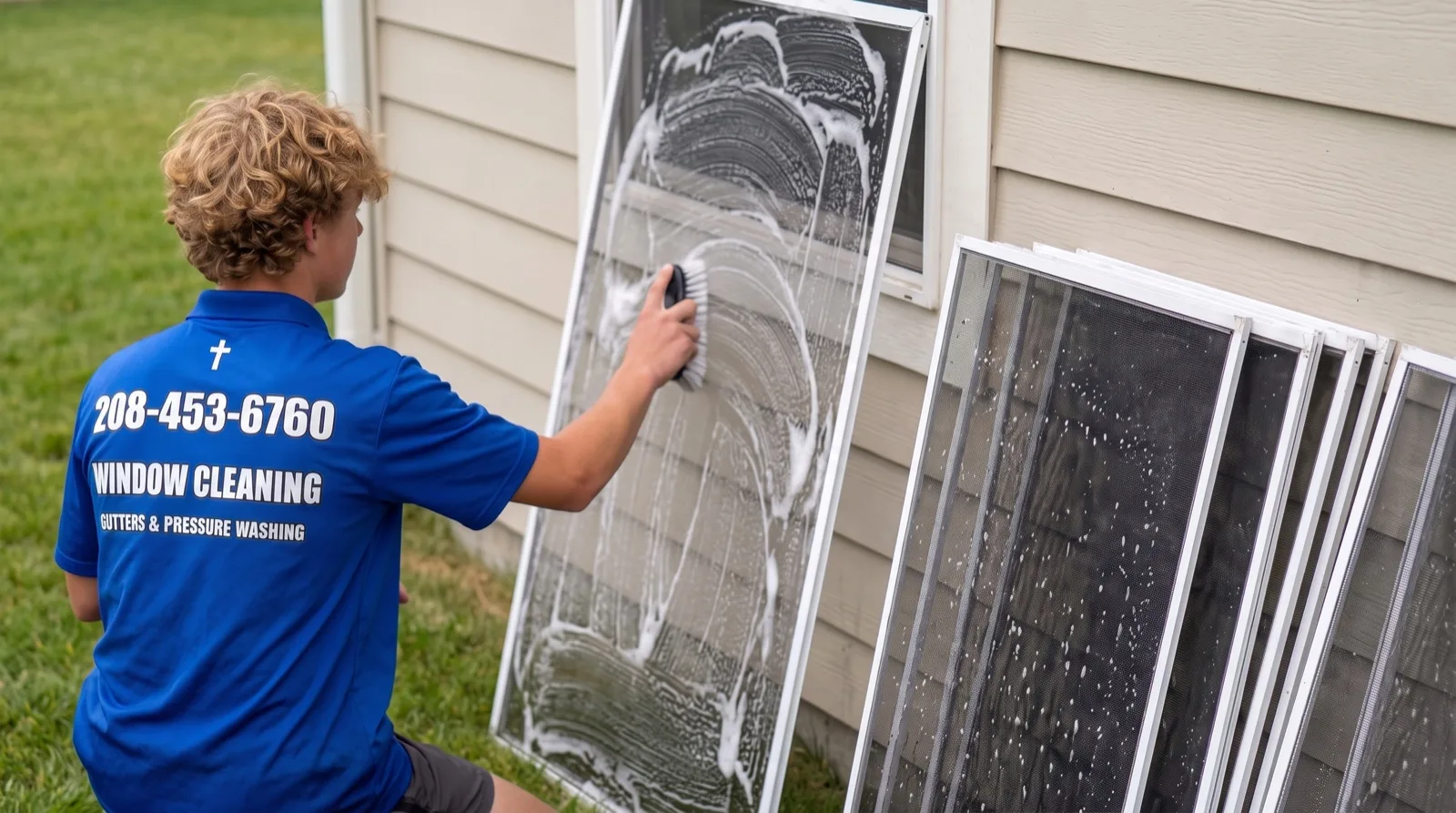
Screens come out of the house, get laid flat, and get washed with a soft brush and rinsed through — never pressure washed, and never scrubbed while still hanging in the window, which is how mesh gets stretched and frames get bowed. They dry before they go back in, because a wet screen set against clean glass leaves a grid of spots you will see the next sunny morning. Here is the honest part: some screens should not be cleaned at all. If the spline is dry and lifting out of the channel, if the mesh has a hole or a soft bulge in the middle, or if the corner keys are already loose, washing it is what finishes it off. We will show you and tell you it needs re-screening. We do not re-screen, so there is nothing in it for us either way.
What it costs and how to time it
Screen cleaning is $50 added to a window service. We do not run it as a standalone trip — a clean screen against dirty glass is not worth the drive for either of us. On any membership, Monthly or Quarterly, screens clean free once a year, and on a construction-frontier block like this the timing is worth thinking about. Late August into September usually wins: the elm seed bugs have thinned out, the summer grit off the open phases has already landed, and the screens go into fall clean. Running it in April, on a block with an active dirt phase behind it, means they reload before the sod is even down. Window work uses 100% pure deionized water and no soap. No contract, 7-Day Rain Guarantee on the glass, and we hold next-day slots most weeks. Call (208) 453-6760.
Ready for Screen Cleaning in Century Farm?
Free, no-obligation quote — we'll call or text you with your price.
Get My Free Quote