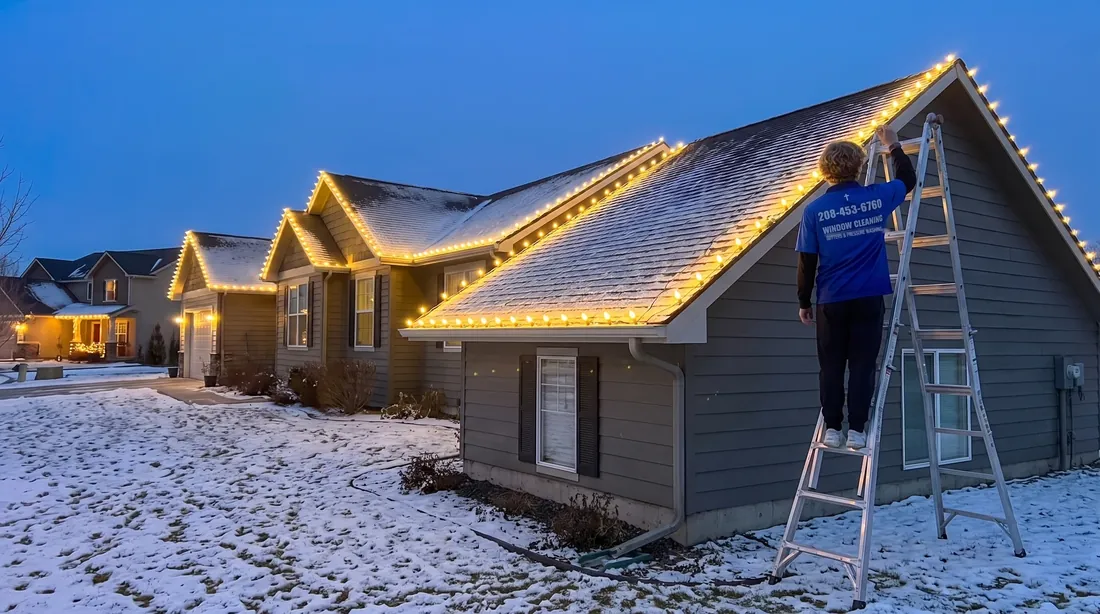
The rooflines out here, and what actually drives the price
Most of Century Farm went up in the last decade and the plans repeat: a two-story front with a steep architectural-shingle gable over the entry, a lower gable or hip over the garage bay, and a long straight eave running the width of the house. That eave is the cheap line to light. It's a continuous run of 5-inch K-style gutter, or 6-inch on the larger custom builds, and clips ride it fast. The cost sits in the gables. A front peak on a steep pitch puts the apex close to thirty feet up on the two-story plans, and that line gets worked off ladders and from the edge — not by walking the slope. So when we quote per roofline, we're pricing gable count and peak height, not square footage. Two houses on the same street with the same footprint can quote differently because one has a second front peak.
Century Farm ices over before the rest of the valley
Cold air drains downhill overnight and pools on low, open ground. Century Farm is exactly that — the bottom of the slope below Amity, with unbuilt field on the edges and not much built mass around it to hold heat. These blocks carry frost on the shingles in the morning when the neighborhoods up closer to the freeway are already dry. That shortens the install window here compared to north Meridian or the Boise bench. Once a steep front gable has frost or a skim of ice on it, nobody should be up there, and we won't send a crew. We start booking Century Farm in September and aim to have roof work done by the first week of November. Calls that come in late November usually end the same way: we light the gutter line and the ground-level trim, and the front peak stays dark until next season.
Nothing goes into your roof
No staples, no nails, no screws in the shingles. Steep gable runs get all-weather clips that hook over the shingle edge. Eaves get gutter clips that grip the outer lip of the K-style. Stapling through architectural shingle is the fastest way to make a roof warranty argument on a house this new — and on a lot of these builds there's still coverage worth protecting. Down at grade there's a second thing worth knowing here. Century Farm runs pressurized irrigation, and in newer phases the lateral lines can sit shallow, sometimes only six or eight inches under the sod. We keep stakes short for walkway and tree lighting and stay off the head lines. If you know roughly where your laterals run, tell us at the walkthrough and we'll work around them.
Your HOA rules, and what we ask before quoting
Like most of the newer south Meridian communities, Century Farm is HOA-governed, and we don't hold a copy of your current CC&Rs — boards update holiday rules, and we're not going to tell you yours allows something it doesn't. So we ask two things before we quote. First, is there a display window? Plenty of valley associations set an earliest-on date near Thanksgiving and a takedown deadline in January, which matters because our install date and your allowed-on date are two different things. Second, is there a color or bulb restriction? If your documents call for warm white only, we quote warm white. If color is allowed, we'll say so. If you're genuinely unsure and can't reach your board in time, we can install to the most conservative reading — warm white, roofline and trim only, nothing pushed out onto common-area frontage — and you're covered either way.
What the per-roofline quote covers
Install, takedown, and storage of the strands through the offseason. When they come down in January we label each run by elevation, so year two goes up faster than year one and the same peak lights the same way it did before. Two honest limits worth hearing before you book. If a peak is genuinely out of safe ladder reach — a few of the steeper two-story rear gables here are, especially where a tight side yard leaves no place to foot a ladder — we tell you that at the quote and price only the lines we can actually reach. We'd rather lose the peak than fake it. And we don't work a roof carrying frost or ice; if that moves your date a few days, we move it. Reflekt is locally owned and fully insured, 4.9 stars across 125+ Google reviews. Call (208) 453-6760.
Ready for Holiday Light Installation in Century Farm?
Free, no-obligation quote — we'll call or text you with your price.
Get My Free Quote