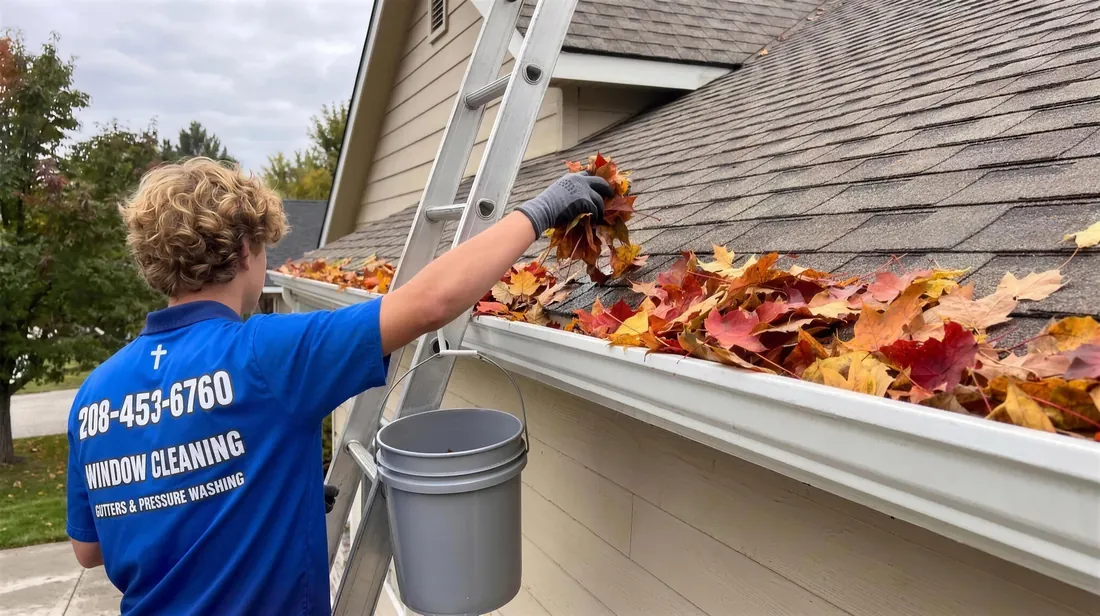
Low-pitch ranch roofs hold debris instead of shedding it
Most of the older stock here is 1950s and 60s ranch, and those roofs run shallow: a wide, low plane with a short eave and the gutter tucked tight to the fascia. Shallow pitch means debris that lands does not slide off. It sits, gets rained on, and composts into a mat that holds water against the back of the trough. Shingle grit washes down with it and settles into a sludge you scoop by hand, not blow out. The short eave matters too. With almost no overhang, an overflowing gutter dumps straight down the siding into the foundation and the low ranch window wells instead of out past the drip line. Newer two-story infill on the same block has steeper pitch, which moves water faster and overshoots at the valleys into a gutter the same size.
The canopy is the real problem, and it is not just fall leaves
Fall leaves are the least of it here. The ranch tracts were planted when they were built, so Sunrise Rim has sixty-year-old silver maples, elms and honey locusts standing well above the roofs they shade. Maples drop seed in May and June, and those wings are exactly the wrong shape: they slide down a shallow roof, ride into the trough, and pack a downspout elbow into a plug a garden hose will not push through. Honey locust leaflets are small enough to pass any strainer and then pile up at the bottom of the drop. Cottonwoods along the canal and river corridor add fluff in June that mats with the seed. Then the real leaf drop lands in late October and November. That is two separate clogging seasons on the same house, not one.
Downspout access on split infill lots
Infill has split a lot of lots around here, and the side yards left over are tight. A newer two-story can sit close enough to the fence that the downspout on that elevation has an AC unit, a gate and a utility meter stacked around it. On the older ranch homes, downspouts often turn into a buried line running out to the curb or an old irrigation stub. We clear the trough by hand, bag the debris rather than blowing it into your beds, then flush each downspout and watch the outlet at the bottom. If water backs up at the top of a buried line, the clog is underground, and we tell you that instead of running more water at it. We do not dig or open buried drain lines.
How to tell whether yours actually need cleaning yet
Not every house here needs this twice a year. Check it yourself before you pay for it. After a decent rain, stand at the downspout outlet and watch. A full, steady stream means the trough and the drop are both clear, whatever the roof looks like from the ground. A trickle, or water sheeting over the front lip while the outlet runs slow, means it is packed. Ranch homes on the interior streets with no big canopy over the roof can genuinely go once a year in late November and be fine. Worth knowing too: cleaning the inside does nothing for the dark vertical stripes on the outside face. That is oxidation and road film, it takes a separate gutter-face wash, and on sixty-year-old aluminum it usually improves rather than disappears.
What gutter cleaning costs in Sunrise Rim
Gutter cleaning starts at $199 for one- and two-story homes, and the price follows linear footage and how much roof feeds it, not a flat guess over the phone. We hand-clear, bag debris, flush the downspouts, and tell you what we found. Loose spike-and-ferrule hangers pulling out of sixty-year-old fascia are common on the ranch homes and worth knowing about before winter. Memberships come Monthly or Quarterly with no contract, plus a 7-Day Rain Guarantee, and next-day slots are usually open on this side of the river. Reflekt Window Cleaning is Hunter Stevens and Ethan Seusy, founded in 2025, fully insured and locally owned, 4.9 stars across 125+ Google reviews. Call (208) 453-6760 or book online.
Ready for Gutter Cleaning in Sunrise Rim?
Free, no-obligation quote — we'll call or text you with your price.
Get My Free Quote