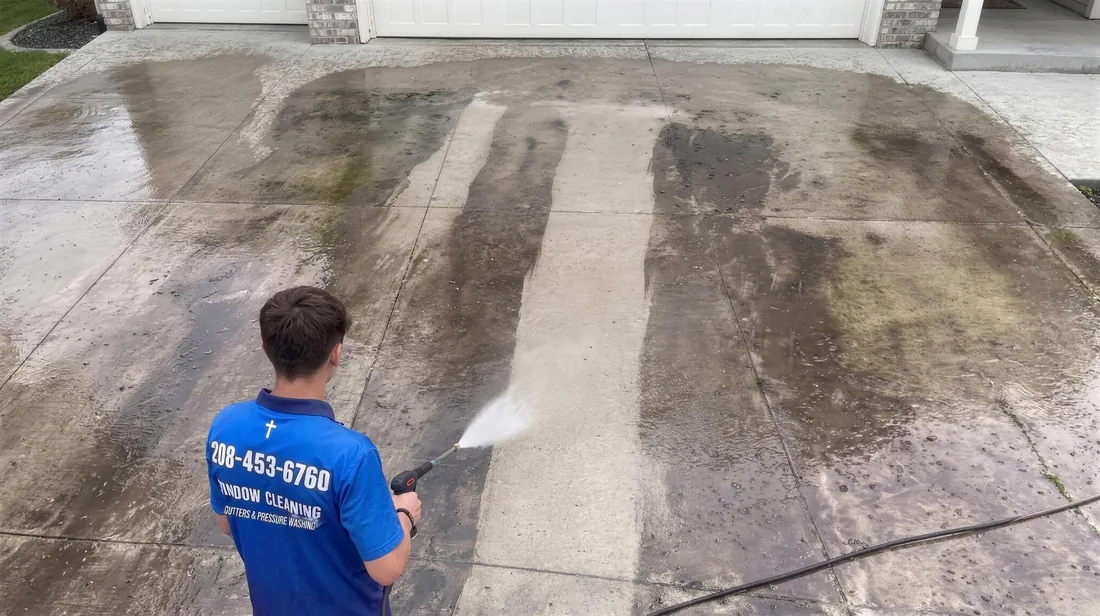
Two ages of concrete on the same block
Walk a street in Sunrise Rim and you cross sixty years of concrete in a hundred feet. The ranch-era driveways from the fifties and sixties have had the broom finish walked and plowed off them, so the surface paste is gone and the sand aggregate sits proud. That concrete is porous, it holds stain deep, and it does not take a hard tip. Next door on a split lot, an infill build has a slab poured within the last few years, still tight and sealed at the surface, still blooming efflorescence as it cures out. Those two need different work. On the old ranch aprons we run a surface cleaner at reduced pressure so we lift grime without blowing more paste off. On the newer slabs we can run normal pressure but have to watch for cut lines from dwelling in one spot. Same crew, same trailer, two settings.
New York Canal irrigation and the rust fans
The New York Canal runs untreated irrigation water straight through this part of the south rim, and a lot of Sunrise Rim yards water off it. That water carries iron and silt that city tap does not. What it leaves on concrete is an orange fan shape, wide at the outside edge, exactly matching where the sprinkler head throws across a driveway or walk. Homeowners usually think it is dirt. It is not. Iron oxide bonds into the pore structure, and pressure alone will not touch it. We treat it with an oxalic-based rust remover, dwell it, then rinse. That takes it out on most slabs and lightens it badly staining ones. Here is the part nobody tells you: if the head keeps hitting the same concrete, the stain comes back in one irrigation season. Turn or shorten that head first, or you are paying us again next year.
Broadway grit, apron oil, and sixty years of drips
Broadway and Boise Avenue box this neighborhood in, and both carry constant traffic with Boise State right across the river. Driveway aprons on the streets nearest those arterials collect road grit, brake dust and exhaust film that grinds into the concrete every time a car turns in. Under that, on the older homes, is decades of accumulated oil from cars that have not been parked there since the nineties. We degrease those spots first, dwell, then hit them with hot pressure. Fresh oil comes up clean. Old oil that has wicked down into porous fifties concrete comes up maybe seventy to ninety percent, and sometimes leaves a gray shadow that is permanently part of the slab. We will tell you which one you have when we look at it, not after we have cashed the check. If a stain is going to stay, you should hear that first.
Shaded walks, tree litter and the slick green film
The original ranch lots here have mature trees on them, which is exactly why people buy on this side of the Bench. The cost is on your north-side walkways and back patios. Leaf litter sits wet through the winter, tannin bleeds into the concrete brown, and any strip that stays damp from irrigation grows a green algae film you can feel underfoot before you can see it. That film is the actual slip hazard on this street, more than ice is. We soft wash algae with a low-pressure detergent pass rather than blasting it, because pressure alone kills the surface growth and leaves the roots in the pores to come back in six weeks. Tannin from leaves lifts well with the right cleaner. If the shaded side of your walk feels tacky underfoot in March, that is what you are standing on.
Pricing and scheduling around Boise State
Pressure washing runs $0.20 per square foot for driveways, patios and walkways. A typical Sunrise Rim ranch driveway is somewhere around 600 to 800 square feet, so measure yours and multiply. Rust treatment and heavy degreasing are the two things that add time, and we quote those up front rather than surprising you. Access matters here more than in most of Boise. Infill builds sit tight to the property line, some older homes now share a driveway or converted alley with a newer build next door, and street parking near Boise State fills up on class and game days. Tell us if there is a gate code or a shared apron when you book. Memberships come Monthly or Quarterly with no contract, and the 7-Day Rain Guarantee applies. Reflekt Window Cleaning is Hunter Stevens and Ethan Seusy, founded 2025, fully insured, locally owned, 4.9 stars across 125+ Google reviews. Call (208) 453-6760.
Ready for Pressure Washing in Sunrise Rim?
Free, no-obligation quote — we'll call or text you with your price.
Get My Free Quote