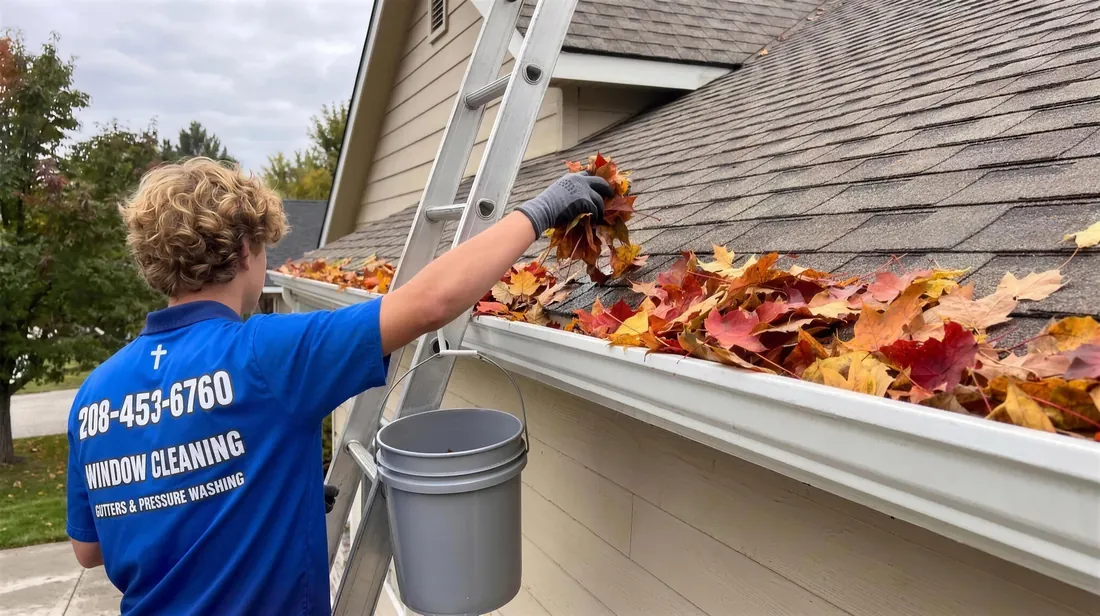
Cottonwood fluff fills West End gutters in June, before the leaves ever drop
The cottonwoods along the river corridor at Esther Simplot Park and Whitewater Park let go in mid-June, and blocks downwind get it in drifts. Fluff does not behave like leaves. It is fine, and once it takes on water it mats into a felt layer across the bottom of the trough that holds water instead of shedding it, then wraps the downspout outlet like a filter sock. Come October the older cottage streets drop maple and elm on top of that. Two loads a year, where most of the bench gets one. If you are within a few blocks of the river or sitting under a mature cottonwood, a single fall cleaning means the trough carried packed wet fluff all summer. That is where the standing water, the mosquitoes and the rust-through at the seams start.
Cottage rooflines and infill rooflines clog for different reasons
The older West End cottages generally have a simple steep gable with a short eave overhang, carrying either original half-round gutter or a 5-inch K-style retrofit hung on spikes. Short eaves mean debris lands in the trough instead of blowing past it, and spike-hung gutter works loose at the fascia once it carries a wet load through a freeze. The infill build next door is a different animal: two stories, larger roof planes, often a low-slope shed section over the entry, 6-inch gutter with oversized outlets. Bigger plane means more water through fewer downspouts. On the low-slope sections debris never washes to the edge at all, it sits mid-roof and feeds the gutter a little at a time all season. We look at the roof and the trough both, then tell you which one is actually causing the trouble.
Downspouts in four-foot side yards and buried alley drain lines
Access is the part most gutter quotes here get wrong. Cottage blocks with alley garages often have downspouts feeding buried drain lines that run out to the alley or the curb, and those lines are usually older than anyone currently living in the house. You can have a spotless trough and still get overflow at the elbow because the underground run is packed. We flush every downspout after we clean and tell you plainly whether it is draining or backing up. On the infill builds the downspouts frequently sit in a three- or four-foot side yard between two houses with a gas meter or an AC condenser in the way, which is no place to foot a ladder. We plan those off the front elevation or the alley instead of forcing it, and we ask about gate and parking access when you book.
When your gutters do not need cleaning yet
Gutters do not run on a calendar. If nothing overhangs your roof, which is true of a fair number of the newer infill builds where the street trees are still young, one cleaning in November after the leaves finish is plenty and a June visit is money wasted. Two other things worth knowing before you book. If your gutter overflows at the same spot every rain but the trough looks clean when you check it, that is not debris, that is pitch or a sagging hanger, and cleaning will not fix it. And if what comes out of your gutters is mostly black sand-like granules rather than organic matter, that is your shingles shedding, not the trees, and it is worth having a roofer put an age on the roof. We will tell you which of those you have rather than selling you a cleaning that does nothing.
Pricing, scheduling and how we work a tight lot
Gutter cleaning starts at $199 for 1- and 2-story West End homes. We hand-scoop and bag the debris rather than blowing it across the roof and into the neighbor's yard, because lots here sit too close together for that to be neighborly. Every downspout gets flushed and checked before we leave. Memberships run Monthly or Quarterly with no contract, but for most houses in this neighborhood gutters make better sense twice a year, late June after the cottonwood drop and again in November ahead of the first hard freeze, so tell us your trees and we will set it up that way. Every visit carries the 7-Day Rain Guarantee, and next-day slots are often open. Reflekt is locally owned and fully insured, founded in 2025 by Hunter Stevens and Ethan Seusy, 4.9 stars across 125+ Google reviews. Call (208) 453-6760.
Ready for Gutter Cleaning in West End?
Free, no-obligation quote — we'll call or text you with your price.
Get My Free Quote