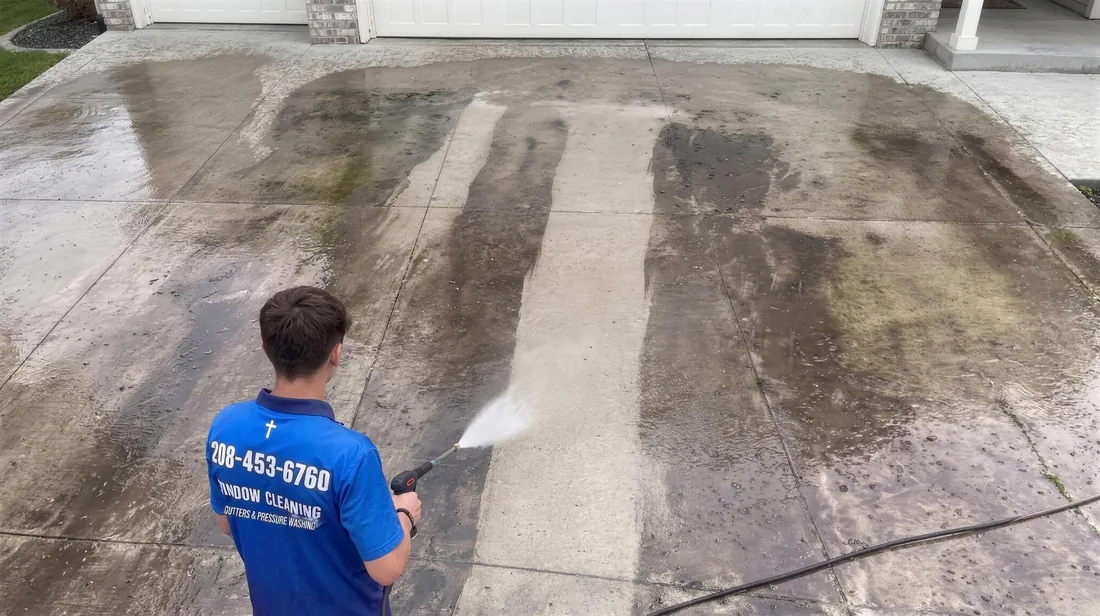
Cottage-era concrete and new infill slabs take different pressure
Most West End blocks have both, sometimes side by side. The original cottage drives are narrow, occasionally still a two-strip ribbon with grass down the middle, and after eighty-odd Idaho freeze-thaw winters the top paste is gone in patches with aggregate showing through. Concrete like that is already shedding its surface. Run a narrow tip at full pressure across it and you cut lines into it that stay visible far longer than the dirt you took off. We drop pressure on those and run a flat surface cleaner so the water lands evenly instead of in a concentrated stripe. A spalled section will come out clean and still look mottled afterward, because that is the concrete you are seeing, not dirt we left behind. The newer infill drives next door handle a normal wash without any of that fuss.
Alley garages, gravel, and the apron that catches everything
A lot of the older West End houses park off the rear alley instead of a street driveway, and plenty of those alleys are gravel or chip seal at best. Every time you pull in you drag alley grit onto the apron, and by August that fine dust has worked into the surface and holds a gray cast a garden hose will not touch. The strip right in front of a detached garage door is usually the dirtiest square footage on the property: alley dust, oil drips, and roof runoff if the garage has no gutter. We blow and sweep the loose material off before any water goes down, because pressure washing gravel dust mostly relocates it into the yard and then back onto the wet slab. Then we clean toward the alley, not toward the house.
New infill pours: white bloom, mortar smear, rust freckles
West End caught Boise's infill wave harder than most established neighborhoods, so there is a lot of concrete here under five years old, and new concrete brings its own mess. The chalky white film is efflorescence, salt migrating out of the slab as it cures and dries. Pressure knocks the surface bloom off and the slab looks great, but it does not stop the process, and it can return two or three more times across the first couple of years. Small orange freckles usually trace back to rebar tie wire sitting close to the surface, and those bleed again too. Mortar and stucco splatter left over from the build is a permanent win and worth removing before it hardens further. If your slab was poured inside the last twelve months, say so when you book. It gets a lighter wash than cured concrete.
What pressure will not take out, honestly
Three stains show up on West End hardscape that no amount of pressure fixes. Irrigation rust, the orange fan where a sprinkler head throws iron-heavy water across concrete, is a chemical stain down in the pores and needs an oxalic treatment rather than more psi. Motor oil that sat on old porous concrete through a summer has soaked past where water reaches; degreaser and a second pass lighten it, and the honest expectation is lighter, not gone. Tannin bleed under the mature trees on the older blocks, that reddish ring where a leaf pile sat, usually lifts but can ghost on rough concrete. The one that does come off completely is the black-green organic growth on shaded north-side walks, common this close to the river and the Greenbelt. That is biological, and a soft wash takes it back to bare concrete.
Pricing, scheduling and what we need on site
Driveways, patios and walkways run $0.20 per square foot, so you can measure length times width and do the math before you ever call. We need a working outside spigot and access to the surface, which on the alley-garage blocks means gate or alley access rather than the front curb. Move the cars and the pots and we handle the rest. Monthly and Quarterly memberships are available with no contract if you would rather keep the hardscape up than rescue it once a year, and every visit carries our 7-Day Rain Guarantee. Next-Day slots are often open. Reflekt is locally owned and fully insured, founded in 2025 by Hunter Stevens and Ethan Seusy, with 125+ Google reviews at 4.9 stars. Call (208) 453-6760.
Ready for Pressure Washing in West End?
Free, no-obligation quote — we'll call or text you with your price.
Get My Free Quote