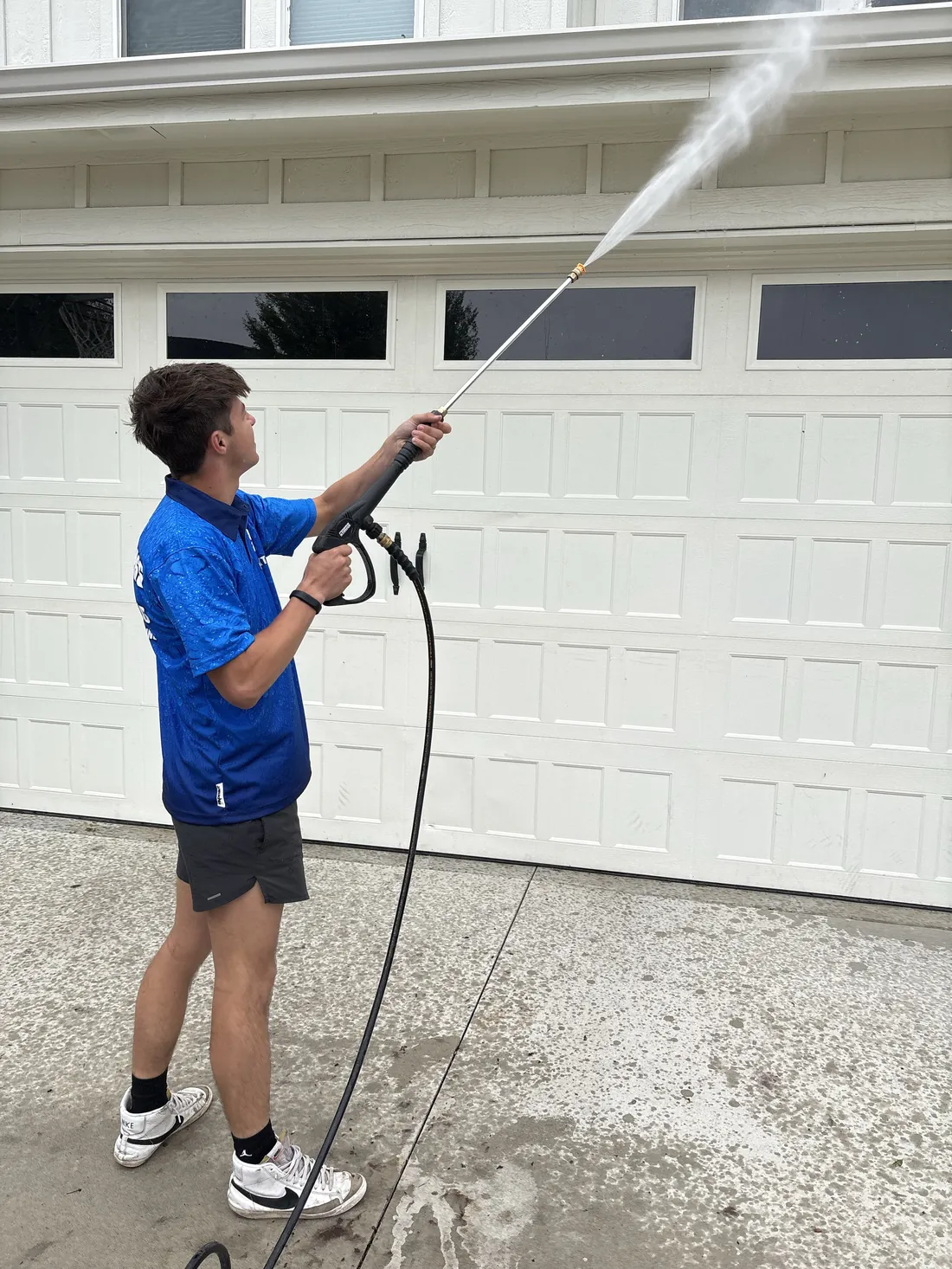
On this siding, the paint sets the pressure — not the dirt
A 1912 Craftsman with painted cedar lap siding and a 2015 vinyl two-story in a Caldwell subdivision are not the same wall, even if they look equally dirty from the sidewalk. Vinyl is a sealed plastic skin. Painted wood on a hundred-year-old house is a stack of paint layers over softwood, and the bottom layers are older than anyone living in the house. Put a pressure washer tip on that and you don't clean it — you drive water behind the lap joints and take paint off in sheets. Every house here gets soft washed instead: a cleaning solution does the work at garden-hose pressure, dwells long enough to kill what's growing, then gets rinsed. Same result, minus the repaint bill.
North and east walls under the canopy grow algae, not dirt
The mature elms, maples and sycamores over Cleveland Boulevard and the side streets are the reason the north face of your house looks nothing like the south face. Shade plus the humidity these old lots hold after irrigation means the north and shaded east walls grow a thin green-to-black algae film, heaviest under the eave line and behind foundation shrubs that were planted close to the wall decades ago. That's biological, not dirt, which is why homeowners tell us scrubbing it makes it look better for six weeks and then it's back. Pressure alone knocks the surface layer off and leaves the roots. The soft wash mix kills it, so it comes back on a season timeline instead of a month one.
The stripe along the bottom is the sprinkler line
Look at the lowest 18 to 36 inches of your siding. In this district that band is usually a different color than the rest of the wall — a gray-brown or chalky white stripe right at sprinkler-head height. A lot of this part of Caldwell irrigates off pressurized canal water, and that water carries fine agricultural silt plus real mineral hardness. Every cycle throws it at the same strip of siding, and it dries there. On vinyl it rinses off. On painted wood and especially on stucco it soaks into the surface and builds a crust that a soft wash lightens a lot but does not always take to zero. Honest version: expect a big improvement on that band, not always a perfect match to the wall above it. If yours is heavy, adjusting the head arc or swapping to a lower trajectory nozzle does more for it long term than washing does.
Sun-side chalking is a paint problem a wash won't fix
Here's the test we'd run before you spend a dime: drag a dark rag or your palm down the south or west wall in a spot that gets full afternoon sun. If it comes back coated in white or pastel powder, that's chalking — the binder in the paint has broken down from UV and the pigment is letting go. Washing removes the loose chalk, and the wall will look noticeably better and stop streaking your windows and porch, but it will not restore the finish. Chalked paint is spent paint, and it will be chalking again by next summer. That's a painter's job, not ours. We'll tell you that on the estimate rather than sell you a wash that disappoints you in six months. Plenty of walls here only chalk on one elevation — that side is a repaint candidate, the other three are just dirty.
Stucco, brick, cedar shingle, and what it costs
This district isn't all one material. The Tudor and Colonial Revival houses run stucco, which holds algae in its texture and needs a longer dwell and a very gentle rinse — stucco is the material most often wrecked by a pressure washer in Idaho. Brick and painted brick take the same low-pressure approach; on painted brick we watch for spots where the paint has already lost bond, because we're not going to be the reason it flakes. Cedar shingle and clapboard get the softest handling of all. All of it prices the same way: $0.18 per square foot, soft wash, safe for any siding on the block. Reflekt is locally owned, founded in 2025 by Hunter Stevens and Ethan Seusy, fully insured, 4.9 stars across 125+ Google reviews. Monthly and Quarterly memberships, no contract, 7-Day Rain Guarantee. Next-Day slots most weeks — (208) 453-6760.
Ready for House Washing in Steunenberg Residential Historic District?
Free, no-obligation quote — we'll call or text you with your price.
Get My Free Quote