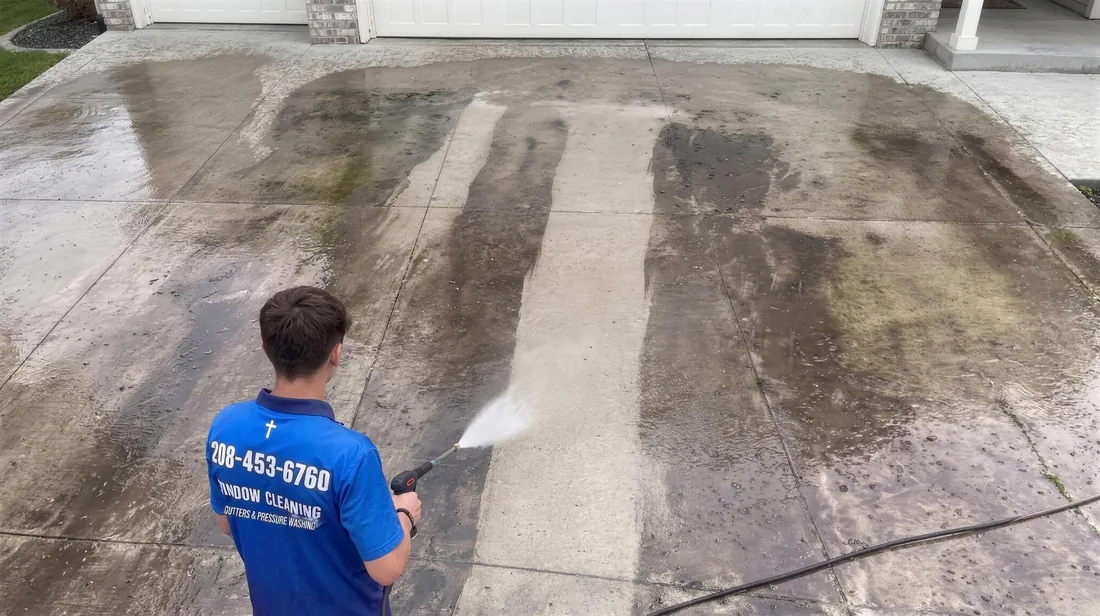
Old concrete does not take pressure the way a new slab does
A driveway poured in 1955 in a newer part of Caldwell is a thick, air-entrained slab that shrugs off a turbo nozzle. A lot of what we run into in this district is older, thinner, and already showing its age — hairline map cracking, popped aggregate at the surface, spalled edges where the ribbon meets the alley apron. Hit that with the pressure a contractor uses on a 2015 subdivision driveway and you do not clean it, you strip more paste off the surface and leave a permanent stripe pattern that gets worse every year. We run a surface cleaner at a pressure matched to what the concrete can actually hold, and on badly spalled sections we back the pressure down further and accept a slower, gentler pass. Clean and intact beats bright and etched.
Tannin, moss and shade are the real staining sources here
This is one of the most heavily canopied parts of Caldwell, and that canopy is what dirties the hardscape. Leaves that sit on a walkway through a wet October leach tannin down into the concrete and leave dark blotches shaped like the leaves themselves. Anything on the north or east side of a house — the side walk running past the porch, the steps down to the alley, the shaded section of the drive under a big maple — holds moisture long enough to grow the green-black film of algae and moss that makes those surfaces slick by February. Those two problems want opposite handling. Tannin comes up with dwell time and the right cleaner, not raw pressure. Moss and algae need to be killed at the root, or they are back within a season looking exactly the same.
What we do not put a pressure washer on
Plenty of these homes still have original brick walkways, brick porch piers, sandstone or rough-poured foundations, and painted wood porch decks. Old brick set in soft lime mortar will not survive a pressure wand — you will blow the joints out and turn a cleaning job into a repointing job. Painted porch floors and old wood steps peel under pressure that would not touch a concrete patio. On those surfaces we soft-wash: low pressure, appropriate cleaner, hand work where it needs it. If you have a brick walk we will tell you straight whether it should be soft-washed or left alone. Not every stain on an eighty-year-old surface is worth chasing, and some of them are the reason the surface still looks like it belongs to the house.
Rust, oil and the stains pressure will not fix
Two things show up constantly on hardscape in this district and neither is a pressure problem. First is orange-brown sprinkler rust — irrigation water in Caldwell carries iron and silt, and a head that hits the same section of drive or walk every cycle bakes a fan-shaped stain into the concrete. That is a chemical stain sitting inside the pore structure, and a pressure washer will clean the dirt off it and leave the rust exactly where it was. It takes a rust-specific treatment. Second is decades of drip from a car parked on the same spot in front of an alley garage. Fresh oil lifts with a degreaser and hot dwell. Oil that has been soaking into unsealed old concrete since the Reagan administration usually lightens considerably and does not disappear. We will tell you which one you have before we quote it, not after.
What it costs and how we schedule it
Driveways, patios and walkways run $0.20 per square foot, measured off the actual surface. A single-track alley drive plus the front walk and porch steps is a small job and prices like one; a full drive, side walk and rear patio prices higher. Rust treatment and heavy oil work are quoted separately because they are a different process, not a longer wash. Memberships are available Monthly or Quarterly with no contract, and there is a 7-Day Rain Guarantee on the work. Next-Day slots open up most weeks. Reflekt was founded in 2025 by Hunter Stevens and Ethan Seusy, is locally owned and fully insured, and holds 4.9 stars across 125+ Google reviews. Call (208) 453-6760 for a number on your specific address.
Ready for Pressure Washing in Steunenberg Residential Historic District?
Free, no-obligation quote — we'll call or text you with your price.
Get My Free Quote