What is actually on the wall here, and why it matters
Drive the avenue and you are mostly looking at painted wood: narrow lap siding, shiplap, cedar shingle in the gables, wood brackets and dentil trim under deep eaves. Mixed into that are solid brick elevations from the same era and a run of 1920s stucco. Almost none of it is vinyl or fiber cement, and that changes the whole job. Vinyl shrugs off a bad operator. Hundred-year-old paint over old-growth wood does not, and neither does soft lime mortar between century brick. So everything we do on this street is soft wash: a cleaning solution that does the work chemically, applied and rinsed at pressures closer to a garden hose than a pressure washer. The chemistry kills and lifts the growth. Pressure is only there to carry water.
North wall green, south wall chalk. They are not the same problem
The mature canopy over Warm Springs, the silver maples, lindens and old elms, means the north and east elevations on most of these houses never fully dry out through spring. That is why the north wall goes gray-green and blotchy while the south wall of the same house looks fine. That growth is algae and mildew sitting on top of the paint film, and soft washing takes it off completely. The south and west walls have the opposite problem. Twenty-plus years of Treasure Valley sun oxidizes the paint film into a loose chalky powder that comes off on your hand. Washing removes the dirt sitting in that chalk and evens the wall out, but it does not restore the paint. If the chalk is heavy, what you are actually seeing is a paint job at the end of its life.
The sprinkler line along the bottom of the siding
Plenty of yards along this stretch still run off the Boise City Canal, and that water is untreated: silty, algae-carrying and mineral-heavy. Boise tap is not much better at roughly 10 to 13 grains of hardness. Either way, a head that throws at the house instead of past it lays a band a couple feet up the wall: tan silt haze, hard white spotting, and on brick a chalky crust. The organic film and the silt wash off. Bonded mineral scale is a separate fight and sometimes it does not fully come out of porous brick or weathered paint at all. We will tell you which one you have before we quote it, and we will point out the specific head causing it, because if that head stays aimed at the house the band is back by August.
How we run a soft wash on a house this old
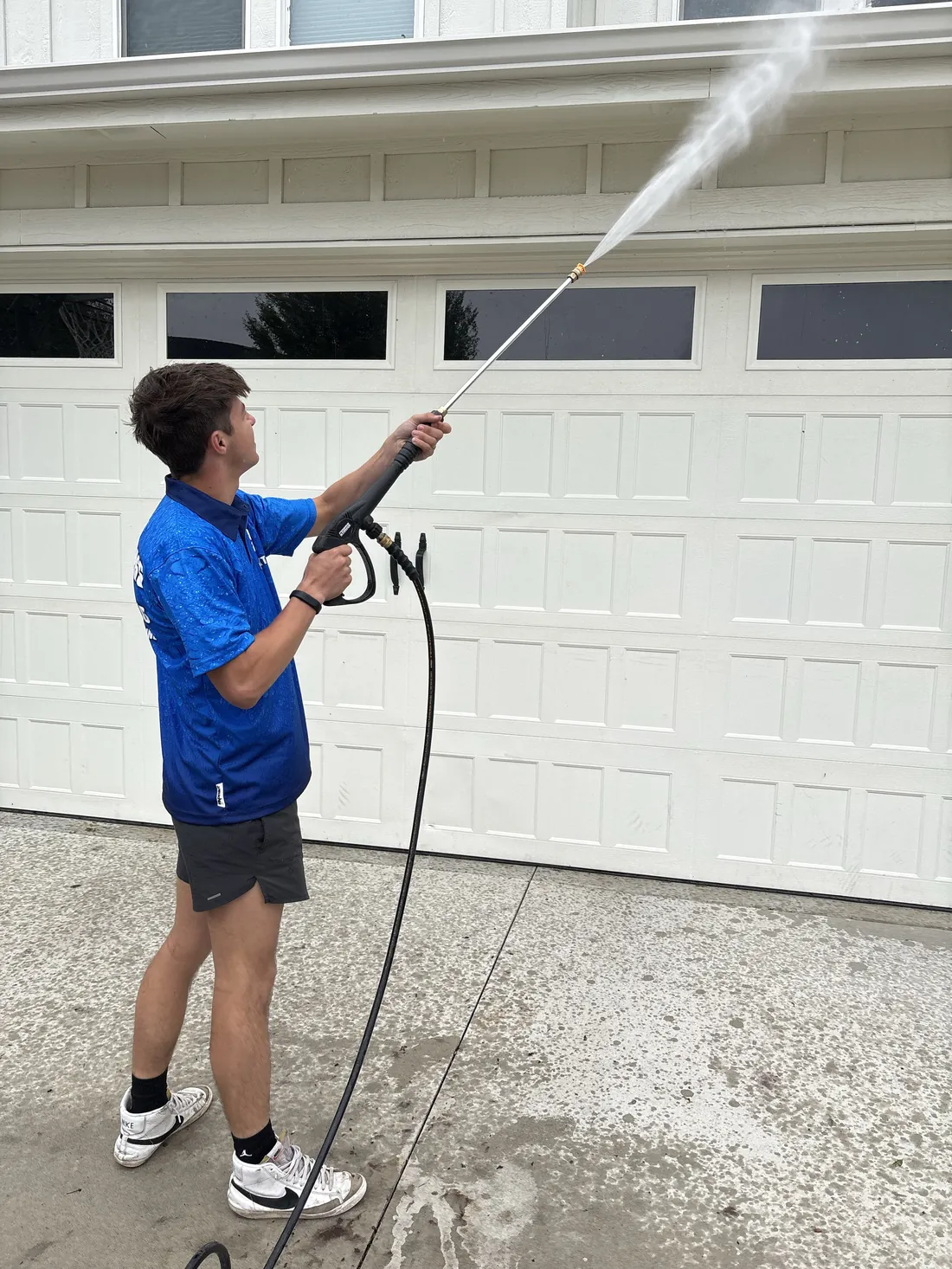
First pass is a walk-around. Loose or curling paint, open siding joints, failed caulk at the trim, missing glazing, crumbling mortar. Anything already coming off the house will come off faster with water on it, and we would rather flag it than find it. Beds get pre-wet and rinsed after; the foundation planting on these lots is old and worth protecting. Solution goes on low and dwells, then rinses from the top down at low pressure. No wand held against painted wood, no lance work on brick joints, nothing driven up under lap siding where it will sit in the wall cavity. On homes this old the paint is very likely lead-based, which is another reason nothing here gets blasted. We are cleaning the surface, not stripping it.
Pricing, memberships and getting on the schedule
House washing is $0.18 per square foot, soft wash, safe for painted wood, brick and stucco. We quote the whole elevation before anyone unrolls a hose. Most Warm Springs houses do not need all four sides every year. The shaded north and east walls are usually on a yearly cycle and the sun sides go two or three years, so ask us to price it that way if it fits your house. Pressure washing for walks and drives is $0.20 per square foot, gutter cleaning starts at $199, and window cleaning starts at $199. Memberships are monthly or quarterly with no contract, quarterly saves $100 per cleaning, and every visit carries our 7-Day Rain Guarantee. Next-Day slots are often open. Call or text (208) 453-6760.
Ready for House Washing in Warm Springs Avenue?
Free, no-obligation quote — we'll call or text you with your price.
Get My Free Quote