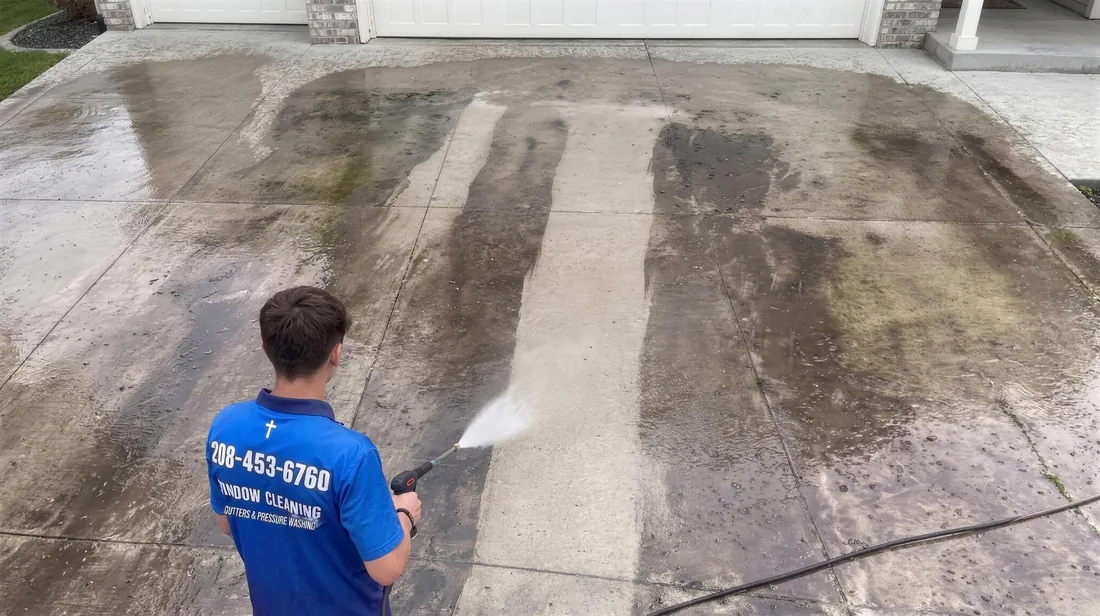
Old concrete takes a different pressure than new concrete
A 2015 subdivision driveway is machine-finished, air-entrained and hard on the surface. Most of the flatwork here is not. Along Warm Springs you get hand-troweled slabs poured in the twenties through the fifties, patched more than once, with the sand already showing at the aggregate and hairline map cracking through the middle of the panels. Hit that with a zero-degree tip at full pressure and you take the cream off, leave wand stripes you can read from the sidewalk, and expose sand that then holds dirt worse than before. We run a rotary surface cleaner at moderate pressure so the pass is even, and we drop pressure further on anything spalling, popped or lifted at a joint. If a slab is already failing, washing it makes that obvious rather than fixing it, and we will say so before we start.
That black on your walk is sooty mold, not dirt
The mature maples, lindens and old elms over this street carry heavy aphid loads from June on. The aphids rain honeydew down onto everything under them, including the front walk, the porch steps and the driveway apron. Sooty mold feeds on that sugar and turns the concrete gray-black in the shaded strips, usually worst on the north side of the house and under the canopy line where the slab never fully dries. Pressure alone knocks the top off it and it is back within a season, because you removed the growth and left the food. We soft-wash first, let the solution dwell, then rinse at controlled pressure. That kills what is in the pores. It also explains why the shaded half of your walk looks worse every year while the sunny half stays fine.
Boise sandstone does not get pressure washed
Steps, retaining walls, foundation courses and the low front walls on this street are frequently Table Rock sandstone, and that stone is soft and porous. A pressure washer at driveway settings blows the grain right out of it, leaves the face sugary, and rounds off tool marks that have been sharp for a hundred years. There is no undoing that. We hand-wash sandstone with a low-pressure rinse and a soft brush, no zero-degree tip anywhere near it, and no bleach left sitting on the stone or running down onto it from the steps above. Same for old brick walkways with soft lime mortar joints. If you want the drive done at full surface-cleaner pressure and the sandstone left alone, that is a normal request here and it costs nothing extra to work that way.
Ditch water, rust fans, and stains pressure will not remove
Plenty of yards along here still irrigate off the Boise City Canal, and that water is untreated, silty and iron-bearing. A head throwing across the driveway lays down an orange fan that reads as rust because it is rust. Pressure will not take it out. It is a mineral deposit inside the pore structure, and it needs a rust-specific treatment applied and rinsed, which we do as a separate step. Same story with a few others we run into on this street: decades of oil under a detached garage apron usually lightens rather than disappears, tannin shadows from leaf litter left over winter come out most of the way, and paint or sealer failure is not a cleaning problem at all. We will tell you which of those you have before we quote, not after.
Access, water, and what it costs
Pressure washing runs $0.20 per square foot on driveways, patios and walkways. We measure what is actually getting cleaned, so a narrow side drive plus a front walk and porch steps quotes very differently from a full parking pad, and you get the number before anyone pulls a hose. We work off your outside spigot and need decent flow, which the older lines along here sometimes do not have, so tell us if your hose bib runs weak. Parking is on-street, and where an alley reaches the garage we will stage back there instead of blocking the avenue. Next-Day slots are usually open. Memberships are monthly or quarterly with no contract, every visit carries our 7-Day Rain Guarantee, and Reflekt is locally owned, fully insured, and rated 4.9 stars across 125+ Google reviews.
Ready for Pressure Washing in Warm Springs Avenue?
Free, no-obligation quote — we'll call or text you with your price.
Get My Free Quote