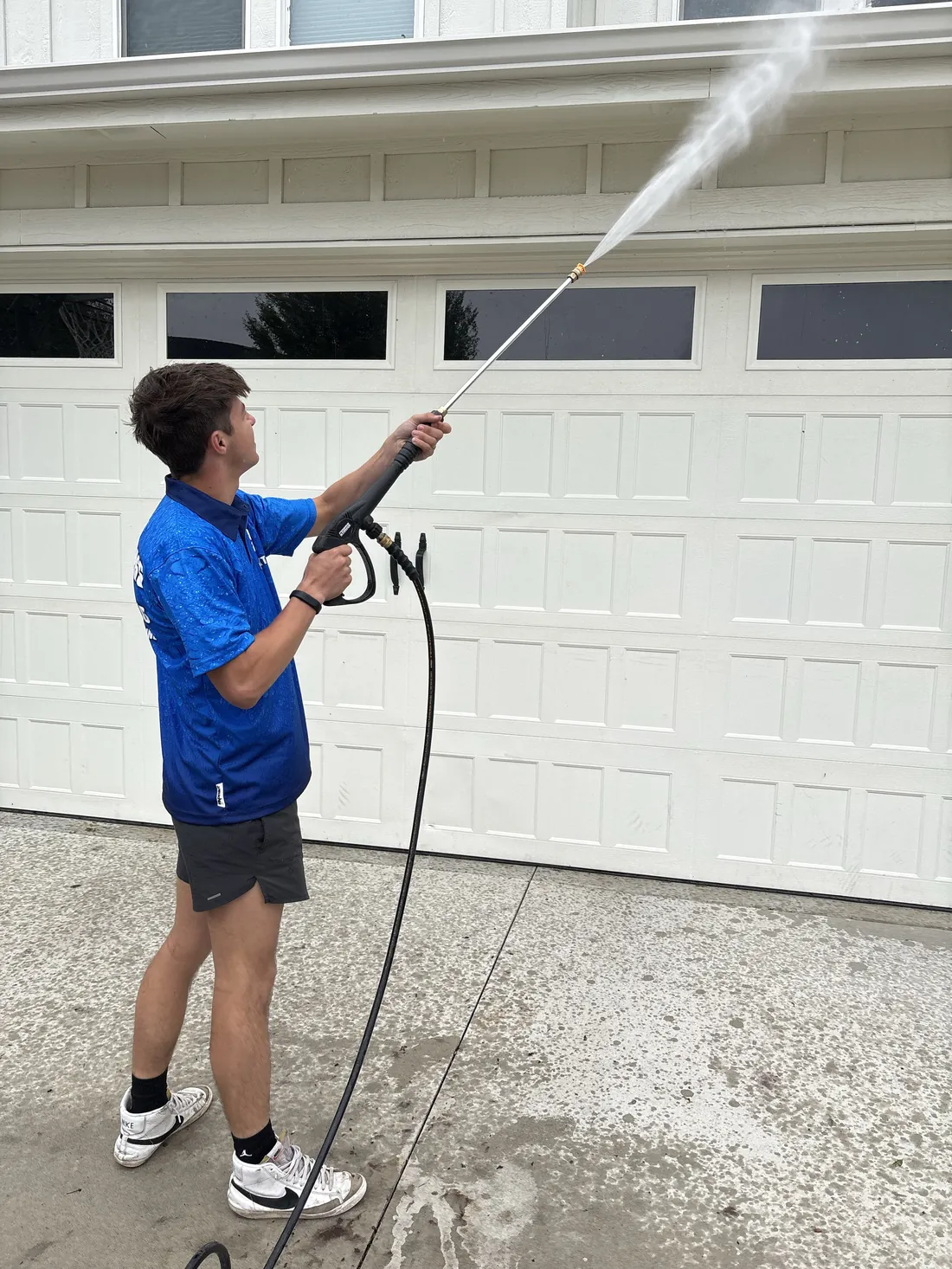
Fiber cement and metal panel, not vinyl
Almost nothing out here is vinyl. The Waterfront District builds run factory-finished Hardie panel and lap, corrugated or standing-seam metal panel as an accent or a full elevation, and stretches of painted stucco on the older infill. All three want the same thing: low pressure and the right soap, not a turbo nozzle. Fiber cement has a baked-on color coat maybe a few thousandths of an inch thick, and once you blast through it you are looking at raw gray board that only paint fixes. Metal panel dents from the ladder before it dents from the water, but high pressure will drive water up behind the panel seams and into the rainscreen gap. We soft-wash all of it at $0.18 a square foot, which means chemistry does the work and the water just rinses.
The sprinkler line is the dirtiest three feet of the house
Most Waterfront District lots irrigate off the Thurman Mill and Farmers Union ditches, and that water comes straight out of the Boise River with silt and dissolved iron still in it. On lots this narrow the heads are close to the wall, so every cycle throws overspray onto the same band of siding, roughly eighteen to thirty-six inches up. You end up with a horizontal stripe: gray silt film on top, and underneath it an orange or rust-tan mineral stain that has actually bonded into the paint. Homeowners usually call it dirt. It isn't. The silt washes off with soap. The iron does not, and it will not come off with pressure either, no matter how close you hold the wand. That takes a separate oxalic treatment, and we price it as its own item.
North walls, greenbelt shade, and the green-black film
The greenbelt cottonwoods and the river keep the north and northeast elevations damp and shaded most of the year. Those walls grow a green-to-black algae film, worst under eaves and behind downspouts, and worst of all on the lower half where the sprinkler keeps it wet. South and west walls on the same building are usually fine. That's not you neglecting one side, it's just where the sun never reaches. Algae is a living thing, so it has to be killed, not scrubbed. We apply a sodium hypochlorite and surfactant mix, let it dwell so it kills the root layer, then rinse at low pressure. Pressure alone knocks the surface green off and it grows back in about six weeks, which is why cheap pressure-only washes never seem to hold on north walls.
Sun-side chalking, and what a wash will not fix
Here's the one we'd rather tell you before we quote than after. West and south elevations catch full afternoon sun with no mature tree cover on most of these lots, and after ten or fifteen years the paint binder on fiber cement and stucco breaks down at the surface. Rub a dark rag on it. If the rag comes back loaded with pigment, that wall is chalking. Washing a chalked wall removes the chalk, which is the right thing to do, but it also removes the faded pigment layer sitting on top, and the wall can come out looking lighter or slightly blotchy compared to the shaded sides. That's degraded paint showing through, not damage from us. If a wall is chalking badly, the honest answer is that it needs paint, and washing is the prep step, not the fix. We'll flag it and show you the rag.
What it costs and how we schedule it
House washing runs $0.18 a square foot soft-wash, safe on Hardie, metal panel, stucco, and brick. Hardscape and decks price separately at $0.20 a square foot. Rust and mineral treatment on the sprinkler band is quoted on its own because it's chemistry, not washing. We bag or pre-rinse plantings along the foundation, and on the narrow Waterfront District lots we'll ask you to shut the irrigation off the night before so the walls are dry going in. Memberships are Monthly or Quarterly, no contract, and every wash carries our 7-Day Rain Guarantee. Next-Day slots open most weeks. Reflekt is Hunter Stevens and Ethan Seusy, founded 2025, locally owned and fully insured, 4.9 stars across 125+ Google reviews. Call (208) 453-6760.
Ready for House Washing in Waterfront District?
Free, no-obligation quote — we'll call or text you with your price.
Get My Free Quote