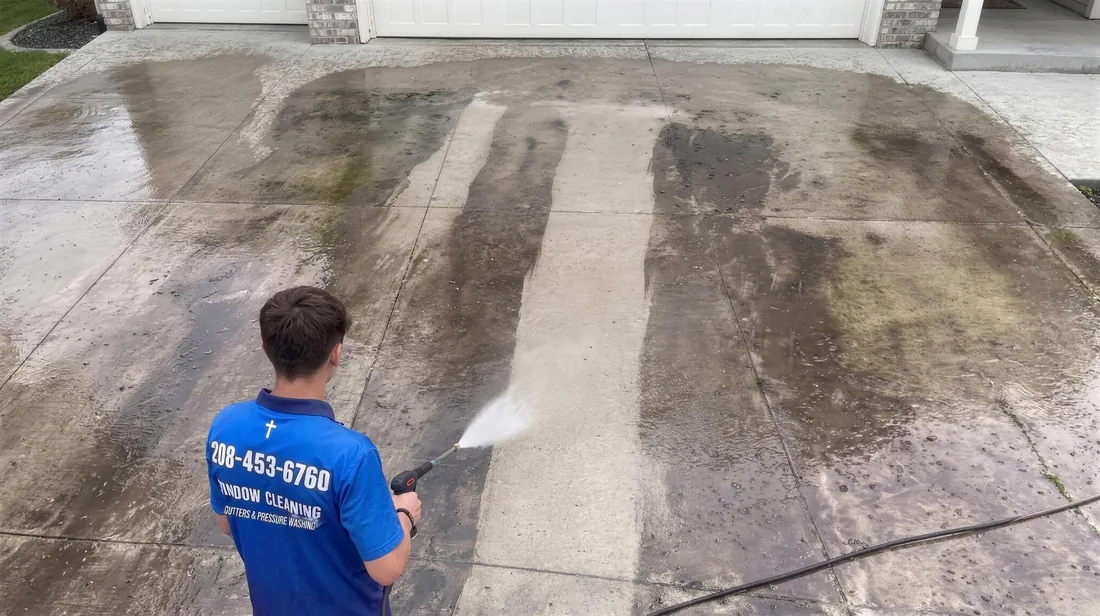
Newer slabs hold dirt on the surface, not down in it
Older Garden City concrete from the 1950s and 60s has decades of wear opening up the surface, so grime works down into it and comes out slowly. The Waterfront District slabs are newer, tighter broom finish, and a lot of them were sealed once when the unit was built. That is good news for washing. On a tight slab the dirt sits on top and a surface cleaner pulls it in one pass at moderate pressure, which is why a driveway here usually cleans up faster than the same square footage across the Glenwood Bridge. The exception is any slab poured in the last year or two. New concrete is still curing and still pushing lime to the surface, and that shows as a white chalky haze that people mistake for dried cement splatter. Pressure does not take that off. More on that below.
Ditch-water sprinklers and the orange fan on the driveway edge
Most irrigation on these lots comes off the Thurman Mill and Farmers Union laterals rather than city water, and that water carries iron and river silt. On a narrow lot the heads sit close to hardscape, so every cycle throws water directly onto the driveway apron and the walkway. Over a season that leaves an orange fan-shaped stain radiating out from the head, darkest at the edge closest to the grass. Here is the honest part: rust is a chemical stain, not a dirt film. It is inside the top of the concrete, not on it. No amount of pressure removes it, and a contractor who tells you 4,000 psi will take it out is going to etch a permanent clean stripe into your slab instead. Rust comes out with an oxalic-based treatment and dwell time, then a rinse. We will tell you before we start whether the stain is dirt or iron.
Greenbelt shade, river humidity, and the green film on north slabs
Waterfront District lots back onto the river corridor, and the buildings sit close enough together that a lot of hardscape gets very little direct sun. Add river humidity and shade from the greenbelt cottonwoods and you get a thin green algae film on north-facing walkways, side-yard slabs, and the concrete under stair runs. It is not just cosmetic. Algae on a shaded walkway is genuinely slick from the first fall rain through spring, and it is the single most common reason we get called out here. Algae wants a soft wash with a surfactant and dwell time, not raw pressure. A high-pressure pass knocks the green off the surface, looks great for a month, then it comes right back because the root film is still in the pores. Treating it kills the growth and the slab stays clean roughly twice as long.
Pavers, gravel tracking, and where pressure does damage
Plenty of patios and entry landings here are paver sets rather than poured slabs, and pavers have a rule: the joint sand goes first. Run a zero-degree tip down a paver seam and you will blow the sand out, the pavers will start rocking under foot within a season, and weeds move into the empty joint. We wash pavers at reduced pressure with a surface cleaner that spreads the load, and we tell you up front if joints need re-sanding afterward. Tracking is the other local wrinkle. The greenbelt path, the gravel parking strips, and the alley approaches shed fine grit that gets walked and driven onto the hardscape constantly, so a Waterfront District driveway grays back over faster than one in a fully paved subdivision. That is a maintenance-interval question, not a washing-quality one.
Pricing, wash water, and the ditch
Pressure washing is $0.20 per square foot on driveways, patios and walkways, measured off the actual slab, so a typical two-car driveway plus the front walk lands in a predictable range before we show up. One thing we handle differently on these lots: the irrigation ditch. Wash water carrying loosened algae, silt and surfactant should not go into a live lateral that feeds somebody's yard downstream, so we direct runoff toward landscape and street drainage away from the ditch bank and we do not wash a slab that drains straight into an open channel without a plan for it. Access is tight here, so we run hose lines from wherever the truck can legally sit. Memberships are Monthly or Quarterly with no contract, we back work with a 7-Day Rain Guarantee, and next-day slots are usually open. Reflekt is Hunter Stevens and Ethan Seusy, founded 2025, fully insured, locally owned, 4.9 stars across 125+ Google reviews. Call (208) 453-6760.
Ready for Pressure Washing in Waterfront District?
Free, no-obligation quote — we'll call or text you with your price.
Get My Free Quote