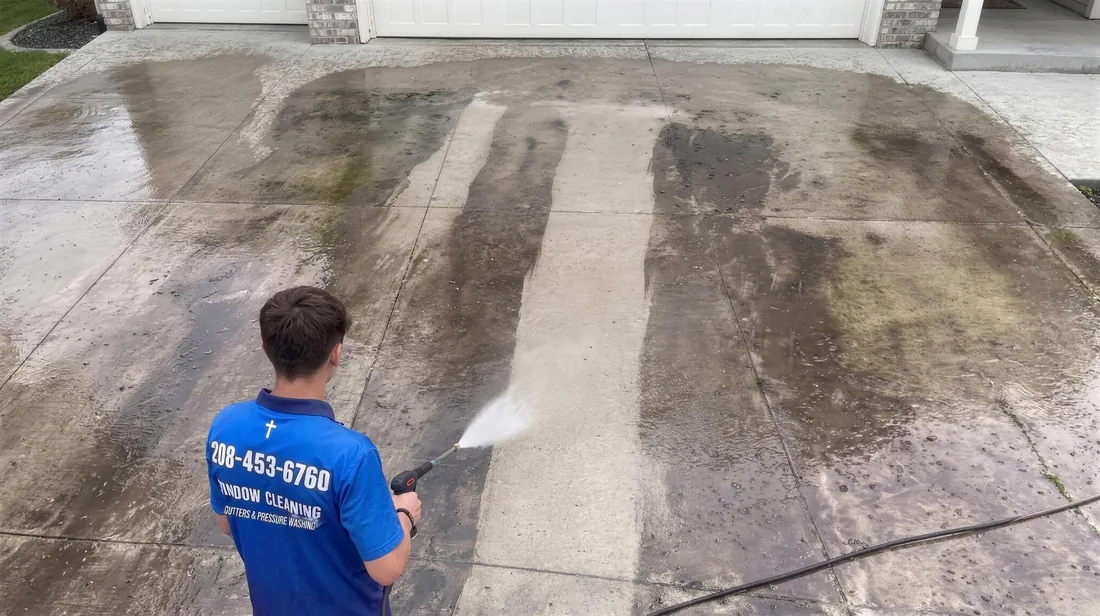
Thirty-year-old concrete doesn't clean like new concrete
Riverwoods flatwork mostly dates to the 1992-to-1999 build-out, and concrete that age has lost some of its cream — the smooth top paste that came off the float. Once that surface opens up, dirt sits down in the pores instead of on top, and the fix is dwell time and a surface cleaner, not more pressure. Put a turbo nozzle on a thirty-year-old broom finish and you'll leave wand stripes and start popping aggregate loose, which no amount of later washing hides. We pre-treat first so the chemistry does the lifting, run a flat-surface cleaner at pressure the slab can actually take, and back off over anything already spalling or pitted — usually the garage apron and the driveway edges where freeze-thaw and the plow got at it.
Cottonwood, canopy, and the tannin stains underneath
Riverwoods has had thirty years to grow a canopy, and the trees along the ponds and river frontage drop more on the concrete than most Garden City lots ever see. Cottonwood fluff mats down in late May and June, then leaves pile through fall on the north side of the house and against garage aprons where nobody sweeps. Wet leaf litter sitting on concrete leaves tannin — a brown-to-black stain that soaks into the pores and reads as a leaf-shaped shadow long after the leaves are raked. Tannin lifts with a percarbonate-style pre-treat and real dwell time. It does not lift by hitting it harder. If a pile sat there since October, expect a dramatic improvement that still faintly shows you where the pile was.
Pond-side and shaded flatwork grows algae, not dirt
North-facing walkways, walkout lower-level patios, and any flatwork within throwing distance of a pond stay damp here long after the rest of the property dries out. That's algae territory: a thin green-black film that feels slick underfoot and comes back fast if you only knock the top off it. Algae is a biological growth, so it gets a soft-wash approach — right mix, enough dwell to kill it at the root, then rinse — instead of a pressure-only pass that scours the visible layer and leaves everything behind it. Pressure alone on algae typically buys you about six weeks. Treated properly it holds through the season. Pond-side steps and dock approaches are also where people actually slip, so if you only get one area done before company comes, do that one.
Ditch water leaves mineral haze and rust the wand can't touch
Riverwoods irrigation still traces back to the same gravity ditch system as the rest of Garden City — silty, mineral-heavy water — and a lot of these lots run heads close to the house to keep pond-side landscaping green. On concrete that shows up two ways: a chalky white mineral haze along the spray arc, and orange-brown iron staining where a head has been throwing at the same slab for years. Here's the honest part. Pressure does not remove sprinkler rust. The iron has bonded into the pores, and you can wash that spot until the concrete is thinner and the orange is still sitting there. It takes a separate acid rust treatment, it usually lightens rather than disappears, and on the worst slabs the real fix is redirecting the head. We'll tell you which one you've got before we quote it.
What it costs and how we work next to the water
Driveways, patios, and walkways run $0.20 a square foot, and we measure before anything gets wet so you have a firm number, not a range. Because so much Riverwoods flatwork drains toward a pond, the river, or the greenbelt, we keep runoff controlled and skip harsh degreasers on any surface sloping to water — that's a real constraint on these lots, not a talking point. Memberships come Monthly or Quarterly with no contract, and the 7-Day Rain Guarantee covers window work done on the same visit. Reflekt is locally owned and fully insured, founded in 2025 by Hunter Stevens and Ethan Seusy, with 4.9 stars across 125+ Google reviews. We usually have next-day slots open. Call (208) 453-6760.
Ready for Pressure Washing in Riverwoods?
Free, no-obligation quote — we'll call or text you with your price.
Get My Free Quote