A low-pitch ranch roof does not spill, it backs up
The tract roofs through here run shallow, somewhere around a 3/12 or 4/12, and that changes how a plugged gutter fails. On a steep roof water hits fast enough to push debris along and a full gutter overflows off the front lip where you can see it. On these you get almost no velocity. Leaves stop where they land, the gutter fills level, and when it finally overflows it goes over the back edge first, behind the gutter and onto the fascia. On a house from this era that fascia is usually painted hardboard or old fir, and it takes on water at the bottom edge without ever showing a drip out front. By the time a homeowner notices, it is a soft, swollen board under the shingle line, not a wet flowerbed. That is why we check the back side of the run, not just the trough.
The trees are sixty years past what the gutter was sized for
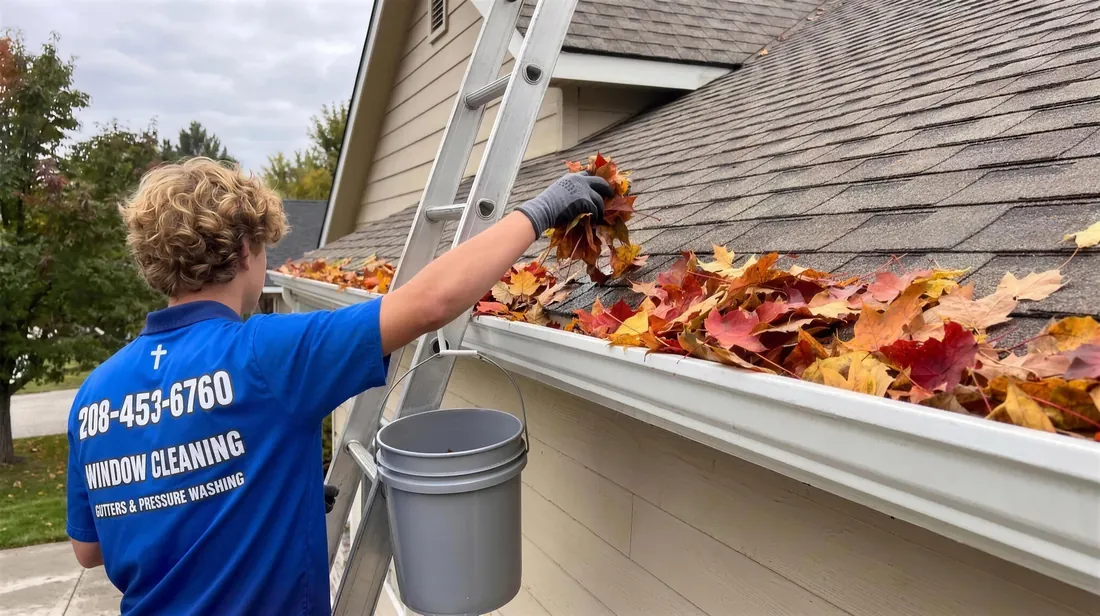
Whoever built these blocks planted saplings. Those silver maples, Lombardy poplars and honey locusts now stand well over the roofline, and on the south side near the Greenbelt you get cottonwood on top of that. It makes for three separate loads a year instead of one. Maple seeds come off in May and they are the worst of the bunch, because a helicopter seed is exactly the shape that wedges sideways in a two-by-three downspout outlet and dams everything behind it. June brings the cottonwood fluff off the river, which mats into a wet felt plug right over the drop. Then October and early November drops the real leaf load, and the first serious rain compacts it into something you have to break up with a hand. The blue spruce a lot of these front yards have shed needles year-round, and needles pack tighter than leaves do.
Downspouts on a flat lot are half the job
These are flat river-bottom lots, so nothing drains by gravity the way it does up on the bench. Two things show up over and over. First, splash blocks that have settled level or tipped back toward the foundation, so the downspout is technically clear and the water still sits against the stem wall. Second, buried three- or four-inch drain lines run out to the curb or an old irrigation ditch, and after sixty years of the same maples the line is full of root. We flush every downspout from the top and watch the bottom end. If we pour and nothing comes out at the discharge, the gutter is clean and the problem is underground, and we will tell you that instead of charging you a second cleaning for it. Access matters too: a lot of these back yards have one gate, and it is often behind an RV pad or a boat trailer.
When your gutters do not need cleaning yet
If you had them cleaned after the November leaf drop and you have no maple, spruce or cottonwood directly over the roof, a spring visit is usually a waste of your money. Check the outlets and leave the rest alone. You can read most of it from the driveway during a real rain: a clean run drips off the downspout and nowhere else, while a curtain of water anywhere along the front lip means it is full. Two things a cleaning will not fix. A gutter that leaks steadily at a corner miter has a failed seal, not a clog. And a section that has pulled loose from the fascia and back-pitched will pond and drip no matter how empty it is, because water is running the wrong direction inside it. Both need re-hanging or resealing. We would rather say so than sell you a cleaning that changes nothing.
What a gutter visit costs and how it runs
Gutter cleaning starts at $199 for one- and two-story homes. We hand-scoop the debris into buckets rather than blowing it out over your beds or the Greenbelt easement, bag it, flush every downspout, and confirm water actually exits at the discharge end. You get photos of the runs before and after, including the back edge and the fascia, so you are not taking our word for what was up there. Most single-story ranches on these blocks are a one-visit job in a morning. Memberships run Monthly or Quarterly with no contract, and every job carries our 7-Day Rain Guarantee. We hold next-day slots on the west side, which matters most in the first week of November when everyone realizes at once. Locally owned, fully insured, 4.9 stars across 125+ Google reviews. Call (208) 453-6760.
Ready for Gutter Cleaning in Veterans Park?
Free, no-obligation quote — we'll call or text you with your price.
Get My Free Quote