Sixty-year-old broom finish is not new concrete
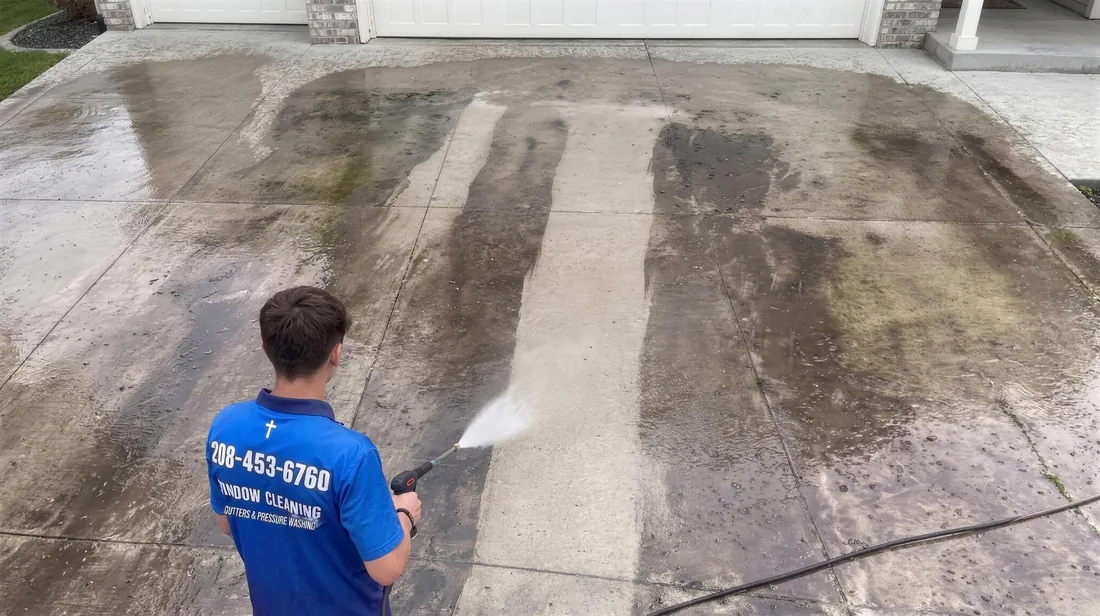
Most drives between State Street and the Greenbelt were poured with the house, roughly 1962 through 1985. They are broom-finish slabs that have gone smooth in the wheel tracks and along the front walk, the cream layer worn off, hairline map cracking through the middle, and spalling at the apron where road salt and the plow reach. That surface will not take the pressure a five-year-old pour will. We run a flat surface cleaner at a moderate tip and keep the wand off the open field except at edges and joints, because a narrow tip on a soft old slab leaves permanent stripes you will see every time the sun is low. On worn concrete the honest goal is even and clean. It will not come back white, and anybody promising white on a 1970s driveway is about to eat the surface off it.
Two organic loads a year, and neither one is dirt
Concrete here takes a beating twice. In June the cottonwood standing through Veterans Memorial State Park and along the river drops seed fluff that mats into wet felt on shaded walks and in control joints. In October the silver maples and poplars planted with the subdivision, plus the Greenbelt canopy, dump a leaf load that sits through the first real rains. Wet leaves bleed tannin straight into the pores and leave brown prints, sometimes the exact outline of the leaf. Tannin comes out with the right cleaner and dwell time, not with more pressure. Blast at it and you polish the concrete around the stain and leave it sitting in a bright halo that looks worse than before. If you can get leaves swept off the patio within a couple weeks of the drop, you save yourself most of the marking.
North sides, shade, and the green that gets slick
This is river bottom with mature canopy and sprinklers running every morning from May to September, so the north and east sides of these houses never fully dry out. Side-yard walks, the strip between the fence and the foundation, and covered back patios grow algae film and moss in the joints. It reads as a dull green-black cast, and in March it is genuinely slick under a work boot. That is a soft-wash job. We apply a cleaner, let it dwell, and rinse at moderate pressure so the biological growth is killed rather than skimmed off the top. Skim it with pressure alone and it is back green within two months because the roots in the joints and pores never died. Same treatment works on the shaded pavers and stepping stones a lot of these back yards have.
RV pads, oil, rust, and what pressure will not fix
Half the back gates on these blocks are blocked by an RV pad or a boat trailer, and that concrete has decades of drips in it. Here is the honest version. Fresh oil and transmission fluid lift well with a degreaser and heat. Old drips that have soaked deep into porous 1970s concrete usually lighten by most of the way and then stop, and no amount of pressure pulls out the rest. Rust is the other one: if your sprinklers or a pump pull iron-bearing water, that orange staining is a chemical problem, not a pressure problem, and it needs an oxalic treatment. Deep rust on old concrete sometimes only fades. We check the worst spots and tell you which category yours falls in before you pay, not after. If a slab is already spalling and popping aggregate, we wash it gentle or tell you to leave it alone.
Pricing, timing, and getting on the schedule
Pressure washing runs $0.20 per square foot on driveways, patios and walkways, measured off the actual slab. Best timing on these blocks is either late June once the cottonwood finally quits, or early November after the leaf drop finishes but before hard freeze, since we would rather clean tannin off once than twice. If your gate is blocked by the trailer or the woodpile, tell us on the phone so we bring the extra hose length instead of finding out in the driveway. We are locally owned and fully insured, founded in 2025 by Hunter Stevens and Ethan Seusy, and sitting at 4.9 stars across 125+ Google reviews. Memberships come Monthly or Quarterly with no contract, every job carries our 7-Day Rain Guarantee, and we hold next-day slots on the west side. Call (208) 453-6760.
Ready for Pressure Washing in Veterans Park?
Free, no-obligation quote — we'll call or text you with your price.
Get My Free Quote