The Siding Mix Off 36th Street
Most buildings in this pocket went up or got converted as studio and live-work shells, and the exterior shows it: corrugated or standing-seam metal panel over a good share of the wall area, painted CMU at the base on some of the older shop conversions, and stucco or fiber-cement lap on the newer infill built toward the Greenbelt. That mix matters because each surface holds dirt differently. Metal panel is smooth, but the ribs trap grit in the valleys and hold water at the bottom hem. Stucco is porous and grabs algae in its texture. Fiber-cement sits between the two and starts chalking sooner than most owners expect. We walk the building before mixing anything, because one detergent strength does not fit all three.
The Sprinkler Line Is Mineral, Not Dirt
On nearly every building down here there's a stained band running roughly 18 to 30 inches up from grade on whatever wall a sprinkler head faces. Garden City irrigates off gravity ditch water — silty river water carrying dissolved mineral — so what dries on that wall is a tan-to-orange crust, not soil. Owners call it rust and go at it with a pressure washer, which accomplishes nothing except etching the paint around it. It comes off with an acidic cleaner sized to the surface, worked cold and rinsed fast, and on painted metal panel we test a low, hidden spot first. Honest version: on stucco that has been soaking up sprinkler deposit for several seasons, we can usually take that band from obvious to faint, not always to gone.
North Walls, River Shade, and the Green Film
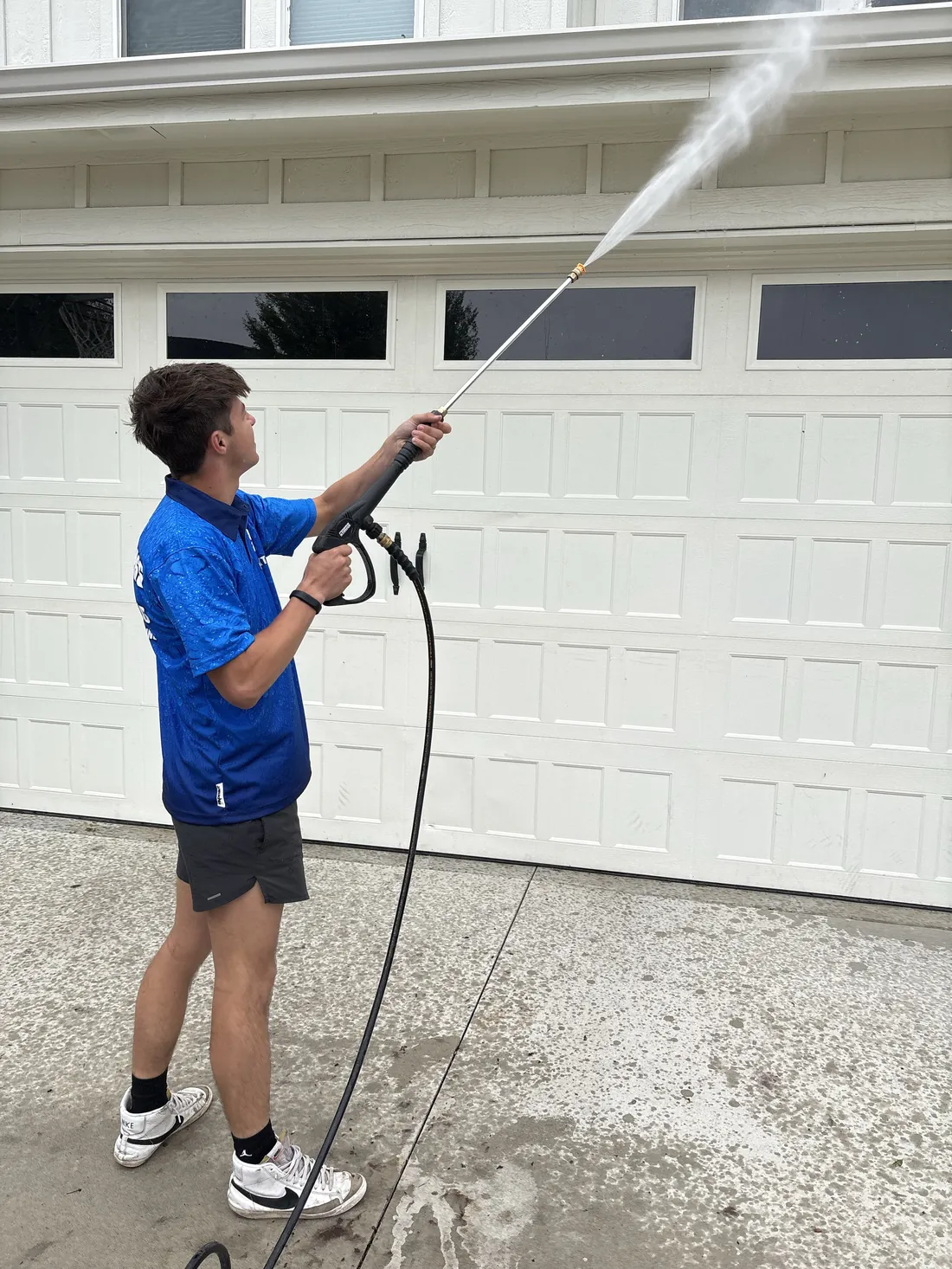
The Boise River and the Greenbelt run along the south edge of this district, and the cottonwood canopy that comes with them keeps north- and river-facing walls damp well past mid-morning. That's the algae wall. It reads as a dull green or gray-black film that looks like ordinary dirt until you put a light on it at an angle. Pressure alone knocks the surface layer off and it's back in a couple of months, because the root film is still down in the paint's texture or the stucco pores. We soft-wash it instead — low pressure, a hypochlorite mix at house-wash strength with surfactant, real dwell time, then a full rinse — so the growth is killed rather than relocated. On the shaded walls here that usually buys a year instead of a season.
Chalking on the Sun Side: What Washing Will and Won't Fix
South and west walls take a beating in this district because there isn't much mature shade on the street side of these lots. On older painted metal panel and aged fiber-cement, that UV exposure breaks the paint binder down and leaves chalk — rub the wall and you get a white smear on your hand. Washing removes that loose chalk, which is the right thing to do, but it also means the wall comes out flatter and sometimes slightly uneven where the fading was never even to begin with. That's the paint's condition showing through, not damage from the wash. We hand-test for chalk before we start and tell you what to expect. If it's heavy, what that wall actually needs is paint, and we'll say so.
Pricing and Working Around a Live-Work Building
House washing runs $0.18 per square foot of wall area, soft-wash, safe for all siding — metal panel, stucco, fiber-cement, brick, or cedar. We measure wall, not floor area, so a tall single-story shell often prices higher than its footprint suggests. If the ground floor is a working shop, studio, or storefront, tell us at booking and we'll schedule around your open hours and cover or move whatever is staged along the walls. Memberships are Monthly or Quarterly with no contract, and every job carries our 7-Day Rain Guarantee. Next-Day slots open most weeks. Reflekt is locally owned, fully insured, and rated 4.9 stars across 125+ Google reviews. Call (208) 453-6760 for a quote on a live-work building.
Ready for House Washing in Surel Mitchell Live-Work-Create District?
Free, no-obligation quote — we'll call or text you with your price.
Get My Free Quote