The Rust Drip Line Under Metal Siding
Almost every building in this district carries corrugated or standing-seam panels, and the fasteners and cut edges on those panels bleed a fine iron film when they get wet. That runoff lands in a straight line on the concrete a foot or two out from the wall, and over a couple of seasons it stains orange-brown. Here is the honest part: pressure will not take that out. Rust is a chemical stain sitting inside the pores of the slab, not dirt sitting on top of it, and blasting it only chews up the cream finish while the color stays. It comes off with an oxalic-acid rust treatment and a rinse, applied as a separate step. If the fasteners are still weeping, it will come back — we will tell you that before we quote it, not after.
Roll-Up Door Aprons and Studio Bays
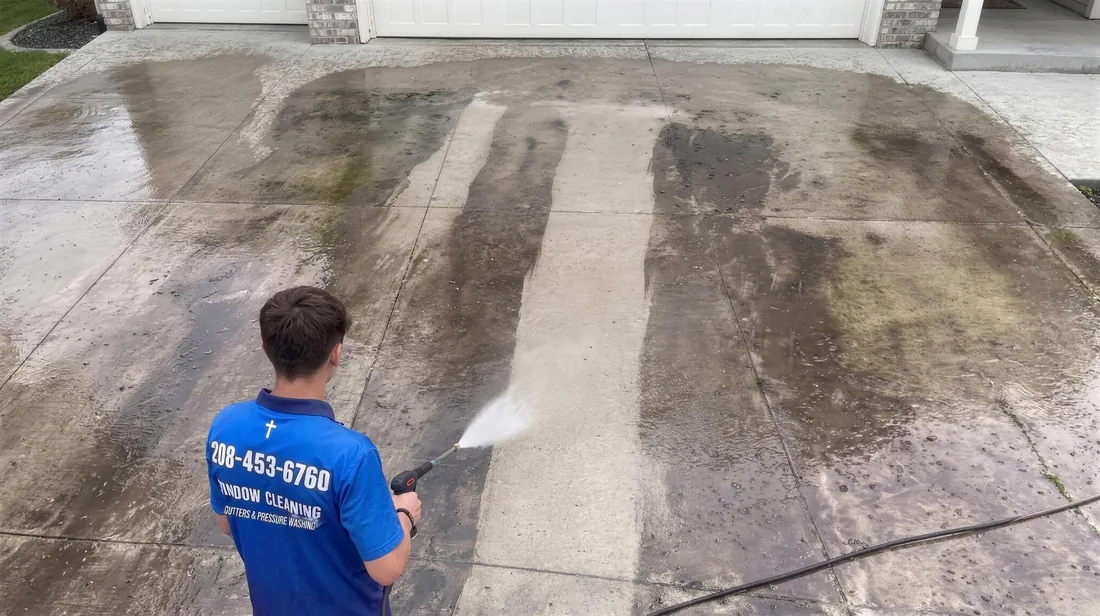
These are commercial-footprint lots, so most units have a roll-up or garage bay opening onto a short concrete apron instead of a normal driveway. Those aprons take a specific beating: black hot-tire marks where a warm tire sat parked on the slab, drive oil in the wheel tracks, and whatever gets dragged in and out of a working shop or studio. Hot-tire marks are polymer transferred out of the rubber and usually lift with a degreaser dwell before the wand ever touches them. Fresh oil comes up. Oil that soaked in years ago will lighten, not vanish, and anyone who tells you different has not washed enough concrete. We work aprons at surface-cleaner pressure so the pass comes out even instead of striped, then edge the seams by hand.
Ditch Water, River Shade, and Gravel Grit
Garden City irrigates off gravity ditch water carrying river silt and dissolved iron, and where a sprinkler head throws the same arc onto a walkway all summer, that iron dries into an orange band that follows the spray pattern exactly. Same treatment as the siding rust, not a pressure problem. On the river side of the district, walkways within reach of the Greenbelt canopy stay damp and shaded long enough to grow a green-black algae film that gets slick by fall — that one is a soft-wash job, low pressure with the right mix, because algae has roots in the surface and blasting it just moves it. Add the fine gravel dust off nearby contractor yards, storage lots, and the Expo Idaho acreage, and slabs here load up faster than concrete deeper in a residential block.
New Pours and When to Leave Concrete Alone
A good share of this district is recent infill, which means a lot of the slabs are young. Concrete under roughly six months should not see a pressure washer at all — the surface paste has not fully cured and a 3,000 PSI pass will etch it permanently. Under a year, we drop pressure and use a surface cleaner rather than a direct wand. The white chalky bloom on new concrete is efflorescence, mineral salts pushing out from inside as the slab dries, and it will keep returning for a year or two no matter how many times it gets washed. Washing it makes the driveway look better today. It does not stop the cycle. If your slab was poured last season, the useful move is often to wait one more season and spend the money on the apron instead.
Pricing and Scheduling Around a Working Storefront
Hardscape runs $0.20 per square foot for driveways, patios, walkways, and aprons — we measure the actual slab rather than guessing off the lot size. Rust treatment and heavy degreasing are quoted as separate line items so you can see what you are paying for instead of getting one flat number. If your ground floor operates as a shop, studio, or tasting room, tell us at booking and we will run the front walk before you open or after close; upstairs-only work is easier to slot midday. Monthly and Quarterly memberships are available with no contract, every job carries our 7-Day Rain Guarantee, and we usually have next-day openings in Garden City. Reflekt is locally owned, fully insured, and holds a 4.9-star rating across 125+ Google reviews. Call (208) 453-6760.
Ready for Pressure Washing in Surel Mitchell Live-Work-Create District?
Free, no-obligation quote — we'll call or text you with your price.
Get My Free Quote