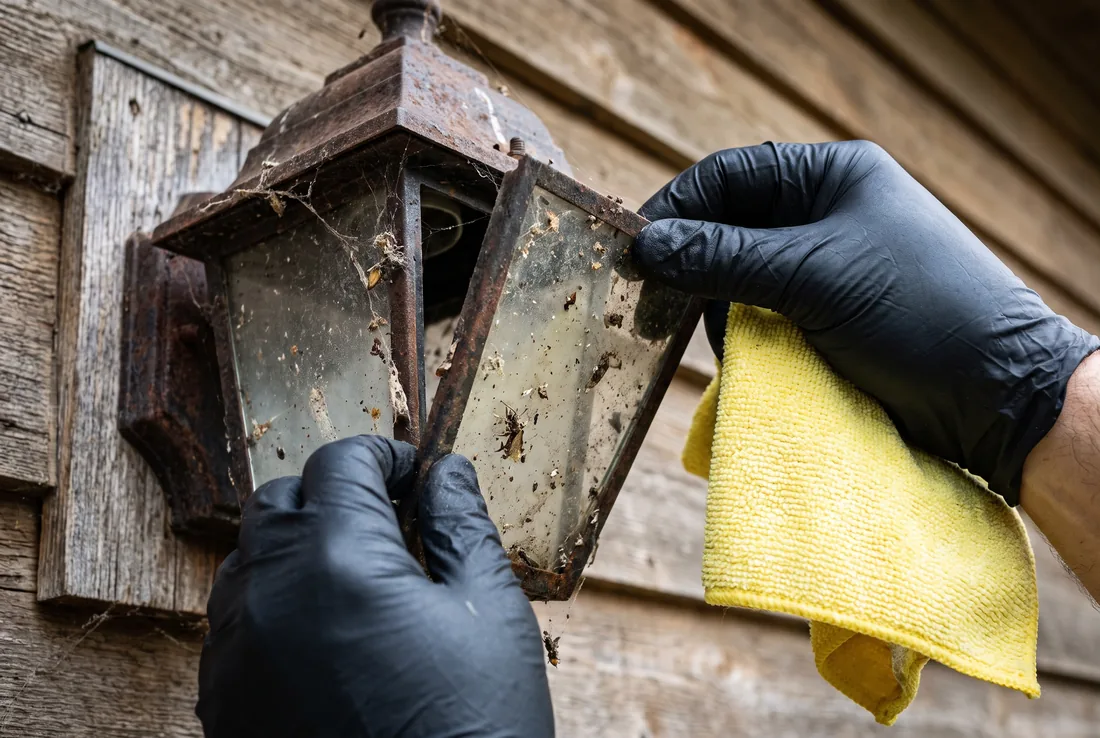
Why they fill up
A warm lit fixture attracts flying insects all night, and a share of them die inside it rather than around it. Spiders follow the insects in and web the housing from the inside out. Dust and pollen settle on top of that over a season, and any fixture that is not genuinely sealed for its rated location also takes in moisture through the same gaps the insects use. The accumulation is gradual enough that nobody notices until the light is visibly dim.
The bulb usually is not the problem
A fixture half full of debris can lose a large fraction of its output before anyone thinks to look inside it. People replace the bulb, see a small improvement because the new bulb happens to be marginally brighter than the old one, and conclude bulbs just do not last long outdoors. Clearing the housing typically restores far more light than a new bulb does, and it costs nothing but ten minutes.
Where cleaning's job ends and an electrician's begins
Debris holds moisture against the socket and wiring, and that moisture corrodes metal contacts over time. Corrosion causes flickering, intermittent failure, and eventually a dead fixture, and clearing the debris out slows that process going forward. What cleaning cannot do is undo corrosion that has already set into a socket or a connection. If a fixture still flickers, trips a breaker, or will not hold a bulb securely after it has been cleaned out, that is a wiring and hardware issue, not a debris issue, and it needs an electrician rather than another cleaning.
What is genuinely a DIY job and what is not
A porch or entry fixture at arm's reach is a reasonable job for a homeowner: shut off the breaker first, remove the globe, and clear it out with a dry brush and a damp cloth rather than spraying water directly into an open housing. Eave-mounted floodlights and gable lights on a second story are a different matter, not because the cleaning itself is harder, but because doing it safely means a ladder against an upper wall, and that is the same fall risk that applies to any second-story work around the house.
Where it fits in a service
Fixture cleaning goes naturally with exterior house washing or a window visit, since the crew is already working the elevations and already has the right access equipment up. It is worth asking for specifically because it is rarely included by default in a standard quote, and it is quick work when someone with proper access is already there.
Want This Done For You?
Free, no-obligation quote — we'll call or text you with your price.
Get My Free Quote